Scale E-Commerce With Snapchat DPA: Complete Guide
Scale E-Commerce With Snapchat DPA
If your ecommerce store has already found success on Meta or Google ads and you are looking for the next channel to unlock genuine growth, Snapchat Dynamic Product Ads deserve a serious look. Most ecommerce brands treat Snapchat as an afterthought, something to test with a small budget after everything else is already optimized, but that mindset leaves real revenue on the table, especially now that Snapchat’s advertising tools have matured into something genuinely capable of scaling.
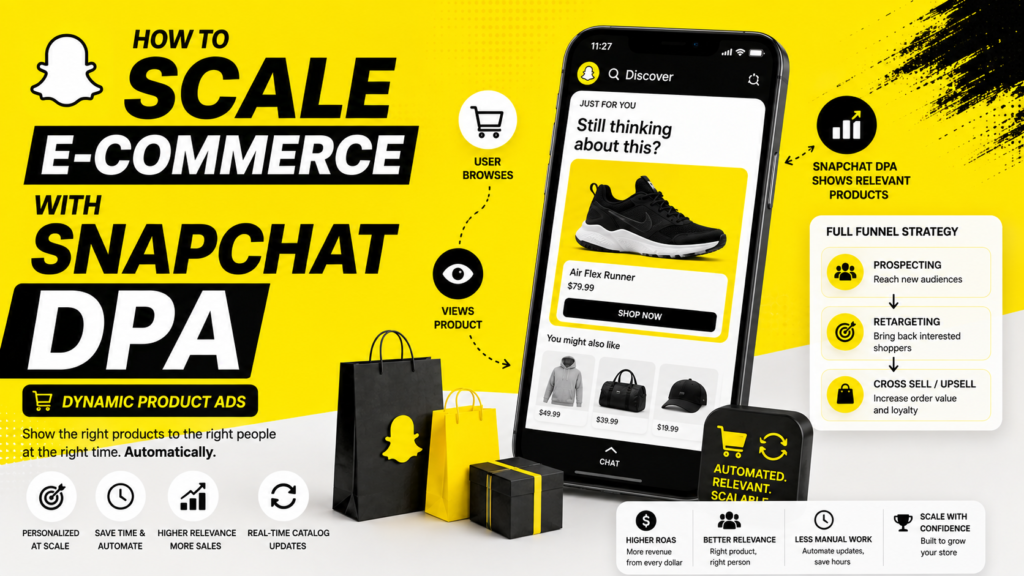
Dynamic Product Ads, often shortened to DPA, are one of the most powerful tools available for ecommerce advertisers because they automate what used to require enormous manual effort, showing the right product to the right person at exactly the right moment, without you having to build a separate ad for every single item in your catalog.
This guide walks you through exactly how Snapchat DPA works, how to set it up correctly, and the specific strategies that turn this feature into a genuine revenue driver rather than just another line item in your ad account.
What Are Snapchat Dynamic Product Ads?
Snapchat Dynamic Product Ads automatically pull product information, images, pricing, and availability from your product catalog and generate personalized ads based on each individual user’s behavior. Instead of manually creating and managing hundreds or thousands of individual product ads, you upload your catalog once, and Snapchat’s system handles showing the most relevant products to each person automatically.
This means a user who viewed a specific pair of shoes on your website might later see an ad on Snapchat featuring that exact product, along with similar items Snapchat’s algorithm predicts they might also be interested in, all generated automatically from your existing catalog data.
Why Dynamic Product Ads Matter for Scaling Ecommerce Revenue
- Personalization at scale means every user sees ads relevant to their own browsing behavior, rather than a generic product selection that may not match their actual interest.
- Massive time savings come from not having to manually build and update individual ads every time your inventory or pricing changes.
- Stronger relevance typically drives better performance, since showing someone a product they already viewed or something closely related tends to convert better than a cold, generic ad.
- Automatic catalog updates ensure your ads always reflect current pricing and availability, preventing the embarrassing and costly mistake of advertising an out of stock or discontinued item.
- Broad reach potential across the funnel, since DPA can be used for both retargeting warm audiences and, increasingly, for prospecting new customers based on catalog performance signals.
Setting Up Snapchat Dynamic Product Ads: The Foundation
1. Set Up the Snapchat Pixel Correctly
Before DPA can function properly, Snapchat needs accurate behavioral data from your website, which comes from the Snapchat Pixel.
- Install the Snapchat Pixel across your entire website, not just key pages, to ensure comprehensive tracking.
- Confirm that key ecommerce events are firing correctly, including page view, view content, add to cart, and purchase.
- Use Snapchat’s Pixel Helper tool or similar diagnostic tools to verify data is flowing accurately before launching campaigns.
2. Build and Upload a Clean Product Catalog
Your catalog is the backbone of every dynamic ad Snapchat generates, so its quality directly determines how effective your campaigns will be.
- Ensure every product has a clear, high quality image, since low quality visuals will directly undermine ad performance regardless of targeting.
- Write concise, benefit focused product titles and descriptions rather than vague or overly technical language.
- Keep pricing, availability, and inventory data accurate and updated automatically through a feed connection rather than manual updates, which are prone to errors and delays.
- Organize products into logical categories or groups, since this becomes useful later for building more targeted campaigns around specific product lines.
Most ecommerce brands connect their catalog to Snapchat through their existing ecommerce platform or a dedicated feed management tool.
- If you are using a major ecommerce platform, check whether it offers a direct Snapchat integration or feed export option.
- For more complex catalogs, consider using a dedicated feed management tool that can format and sync your product data correctly.
- Set your catalog to update automatically on a regular schedule, ensuring Snapchat always has current, accurate product information.
Building Effective Snapchat DPA Campaigns
4. Structure Your Campaigns Around Funnel Stages
Just like other advertising platforms, Dynamic Product Ads perform best when structured around where a customer is in their buying journey, rather than treating every user identically.
- Prospecting campaigns use DPA to introduce your catalog to entirely new audiences, often using Snapchat’s algorithm to identify users likely to be interested in your product category based on catalog performance signals.
- Retargeting campaigns focus on users who have already interacted with your website or app, showing them the specific products they viewed or added to cart.
- Cross sell and upsell campaigns target recent purchasers with complementary products, encouraging repeat purchases and increasing overall customer value.
5. Segment Retargeting Audiences by Funnel Depth
Not all website visitors are equally close to converting, and treating them identically wastes an opportunity to tailor your messaging appropriately.
- Build a segment for users who viewed a product but did not add it to cart, generally your coolest retargeting audience.
- Build a separate segment for users who added to cart but did not complete checkout, a warmer and often highly valuable group.
- Consider a segment for users who started checkout but abandoned before completing payment, representing your hottest, closest to converting audience.
Each of these segments can use different messaging, urgency levels, or even different discount incentives depending on how close they already are to making a purchase.
6. Use Broad Prospecting Alongside Retargeting
While retargeting is often where DPA shines most obviously, do not overlook prospecting, since Snapchat’s algorithm has become increasingly capable of identifying new customers likely to convert based on catalog and pixel signals.
- Test a broad prospecting DPA campaign alongside your core retargeting campaigns rather than relying solely on warm audiences.
- Give prospecting campaigns enough budget and time to gather meaningful data before judging performance too early.
- Compare cost per acquisition between prospecting and retargeting to understand the realistic blended cost across your full funnel.
It is easy to assume that because DPA is automated, creative quality matters less. In reality, the surrounding ad elements, such as your overlay text, branding frame, or accompanying video content, still significantly influence performance.
- Use Snapchat’s creative tools to add branded overlays or engaging visual elements around your dynamic product images.
- Test different call to action phrases to see which drives stronger swipe up rates for your specific audience.
- Keep branding consistent with the rest of your Snapchat presence so dynamic ads do not feel disconnected from your other content.
Dynamic Product Ads work exceptionally well for communicating time sensitive offers directly tied to specific products a user has already shown interest in.
- Highlight limited time discounts directly within your ad copy or overlay for retargeting audiences close to converting.
- Use urgency focused messaging, such as low stock alerts, for products with genuinely limited inventory.
- Avoid overusing discount messaging across every single campaign, since constant discounting can train customers to wait for a deal rather than purchasing at full price.
9. Test Different Product Set Groupings
Rather than showing your entire catalog indiscriminately, testing specific product groupings can reveal which categories perform best with different audience segments.
- Create separate campaigns for your best selling products versus newer or lower performing items.
- Test seasonal or promotional product sets during relevant periods, such as holiday collections or clearance items.
- Compare performance across groupings to understand which categories resonate most strongly with your Snapchat audience specifically, since this can differ from what performs best on other platforms.
10. Monitor Feed Health and Catalog Quality Regularly
A common but often overlooked reason DPA campaigns underperform is simple catalog hygiene issues that quietly undermine otherwise solid targeting and creative strategy.
- Regularly check for disapproved products, broken image links, or missing pricing data within your catalog.
- Remove out of stock or discontinued items promptly to avoid wasting ad spend on unavailable products.
- Periodically review how your product titles and descriptions appear within live ads, since formatting issues sometimes only become visible once ads are actually running.
Measuring Success: Key Metrics for Snapchat DPA Campaigns
- Return on ad spend, the ultimate measure of whether your DPA investment is generating profitable revenue.
- Cost per purchase, tracked separately for prospecting versus retargeting campaigns to understand true blended acquisition cost.
- Catalog sales attributed directly to Snapchat, helping you understand this channel’s specific contribution alongside your other advertising efforts.
- Add to cart and checkout initiation rates, which reveal how effectively your ads are moving people further down the funnel even before a final purchase.
- Frequency and audience saturation within retargeting segments, ensuring you are not overexposing the same warm audience without introducing fresh creative or messaging.
A Practical Example of a Scaling DPA Structure
Sometimes the strategy makes more sense with a concrete example. Imagine an ecommerce brand selling athletic wear, running Snapchat DPA as part of a broader growth push.
- A broad prospecting campaign runs DPA to Snapchat’s algorithmically identified audience, showcasing best selling products across the catalog to attract new customers who have never visited the site before.
- A retargeting campaign specifically targets people who viewed a product page in the last seven days but did not add anything to cart, showing them the exact items they browsed alongside similar recommended products.
- A second, more urgent retargeting campaign targets users who added items to cart in the last three days but did not complete checkout, featuring a small time sensitive discount to encourage completion.
- A cross sell campaign targets recent purchasers from the past thirty days, showing complementary products like accessories or related apparel categories they have not yet purchased.
- Every campaign excludes very recent purchasers from the last seven days to avoid wasting spend showing new offers to people who just completed a transaction.
As this structure runs, the brand reviews performance weekly, shifting budget toward whichever segment shows the strongest return, while periodically refreshing overlay creative and testing new product groupings to keep the campaigns from feeling stale to repeat viewers.
How Snapchat DPA Fits Into a Broader Multi Channel Strategy
Snapchat DPA rarely works best as a completely isolated channel, disconnected from the rest of your advertising efforts. Understanding how it fits alongside other platforms helps you allocate budget more effectively.
- Use Snapchat DPA to reach a younger demographic segment that may be underrepresented in your Meta or Google campaigns, rather than treating it as a direct replacement for those channels.
- Cross reference your customer data across platforms to understand whether Snapchat is bringing in genuinely new customers or simply reaching the same audience already captured elsewhere.
- Consider sequencing, where a customer first discovers your brand through Snapchat prospecting, then gets retargeted through Meta or email as they move further along in their consideration process.
- Track blended return on ad spend across your full advertising mix periodically, rather than judging Snapchat DPA purely in isolation, since its true value sometimes shows up more clearly in assisted conversions than last click attribution alone.
Common Mistakes to Avoid With Snapchat Dynamic Product Ads
- Launching DPA with an incomplete or poorly maintained catalog, undermining performance before the campaign even has a fair chance.
- Relying exclusively on retargeting, missing the growth potential available through broader prospecting campaigns.
- Ignoring creative quality around the dynamic product images, treating the format as fully automated when strategic input still meaningfully affects results.
- Failing to segment retargeting audiences by funnel depth, sending the same generic message to both a casual browser and someone who abandoned checkout.
- Neglecting regular catalog audits, allowing broken listings or out of stock items to quietly waste budget over time.
Budget Planning for a Growing Snapchat DPA Program
Deciding how much budget to allocate and how to grow it over time is a common question once a brand sees early success with DPA. Here is a practical framework to guide that decision.
- Start with a modest, dedicated test budget split roughly evenly between prospecting and retargeting, giving each side enough spend to gather meaningful early data.
- Once retargeting segments show consistently strong return on ad spend, gradually shift a larger share of budget toward prospecting, since retargeting pools are naturally limited by the size of your existing website traffic.
- As prospecting scales, apply the same gradual increase principles used across other advertising platforms, growing budget in modest increments rather than large sudden jumps that can disrupt algorithmic learning.
- Revisit your budget split monthly, adjusting based on which funnel stage is delivering the strongest incremental revenue rather than sticking rigidly to an initial allocation.
Frequently Asked Questions
1. Do I need a large product catalog for Snapchat DPA to be worth using?
Not necessarily. Even a modest catalog can benefit from dynamic ads, since the core value comes from personalization and automation rather than sheer catalog size, though larger catalogs typically unlock more sophisticated segmentation opportunities.
2. How is Snapchat DPA different from dynamic ads on Meta platforms?
The underlying concept is similar, both use your product catalog combined with pixel data to generate personalized ads, but Snapchat’s audience skews younger and the platform’s creative environment favors a more casual, native feeling presentation compared to Meta’s more varied ad formats.
3. Can Snapchat DPA be used for prospecting new customers, or only retargeting?
Yes, while retargeting is a common and effective use case, Snapchat’s algorithm can also use catalog and pixel signals to identify new, relevant prospects, making DPA useful across both cold and warm audience stages.
4. How often should I update my product catalog for Snapchat DPA?
Ideally, your catalog should sync automatically on a regular schedule, often daily or even more frequently, ensuring pricing, availability, and inventory data stay accurate without requiring manual updates.
5. What is a realistic return on ad spend to expect from Snapchat DPA campaigns?
This varies significantly by industry, product price point, and overall funnel maturity, making it more useful to benchmark against your own historical performance and business margins rather than relying on a universal target figure.
6. Should small ecommerce brands invest in Snapchat DPA, or is it only worthwhile at scale?
Smaller brands can absolutely benefit, particularly for retargeting website visitors who did not convert, though scaling into broader prospecting campaigns often becomes more cost effective as your catalog, pixel data, and overall budget grow.
Final Thoughts
Snapchat Dynamic Product Ads give ecommerce brands a genuinely powerful way to scale revenue without the manual burden of building individual ads for every product in their catalog. Success ultimately comes down to the fundamentals, a clean and accurate catalog, properly segmented audiences based on funnel depth, and consistent attention to both creative quality and catalog health over time. Brands willing to invest that structure and ongoing attention into their Snapchat DPA strategy often find it becomes one of the more efficient, scalable channels in their overall ecommerce advertising mix, rather than the afterthought it is too often treated as.
