How to Use TikTok Spark Ads to Amplify Organic Content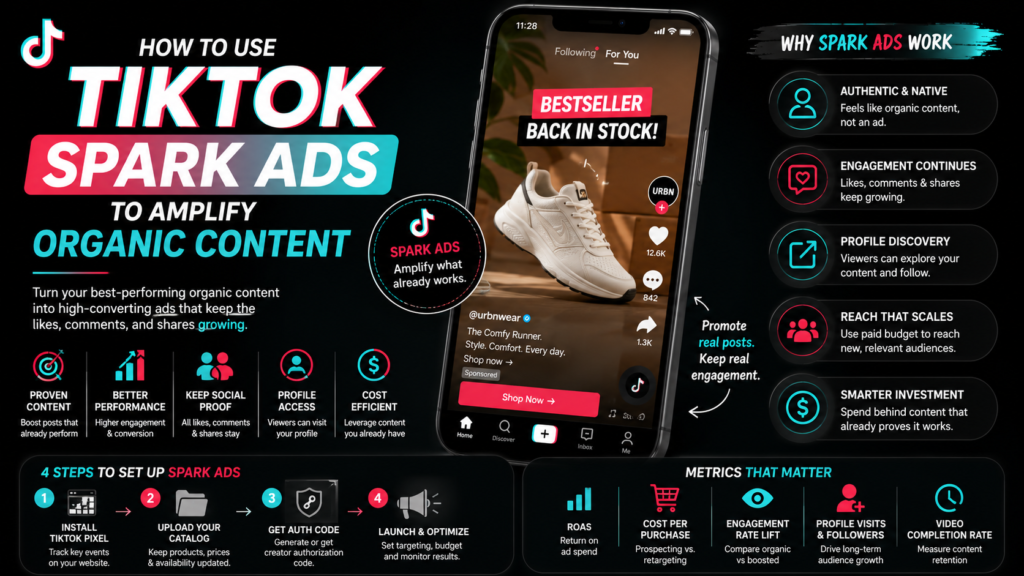
TikTok Spark Ads
If you have ever posted a TikTok video that took off organically, racking up genuine engagement, comments, and shares, only to watch that momentum fade after a few days, you have felt the frustration Spark Ads were built to solve. Most brands treat paid and organic TikTok content as two completely separate worlds, running polished ad campaigns in one lane while their organic posts live and die on their own in another. Spark Ads exist to bridge that gap, letting you pour real advertising budget behind content that has already proven it resonates, rather than starting from scratch with something the algorithm has never tested.
This guide breaks down exactly what TikTok Spark Ads are, how they differ from standard in feed ads, and how to use them strategically to amplify organic content in a way that feels native, authentic, and genuinely effective rather than like a heavy handed advertising push.
What Are TikTok Spark Ads?
Spark Ads are a TikTok advertising format that lets you boost existing organic posts, either from your own brand account or from a creator’s account with their permission, using the native engagement, likes, comments, and shares already attached to that content. Unlike traditional ads that are built specifically for advertising purposes and appear as a separate entity from any organic post, Spark Ads promote the actual original post, meaning viewers can tap through to your profile, see your existing content, and interact with the ad exactly as they would with any organic video.
This distinction matters enormously. A standard in feed ad exists in isolation, disconnected from your brand’s broader presence on the platform. A Spark Ad carries all the credibility, social proof, and native feel of a post that real people have already engaged with organically.
- Authenticity is preserved, since the ad is literally the same content that already resonated organically, rather than a separately produced advertisement that can feel disconnected from platform culture.
- Existing engagement carries forward, meaning the likes, comments, and shares already on the post continue building, which strengthens social proof for anyone who sees the ad afterward.
- Viewers can access your full profile, unlike standard ads that typically limit interaction to the ad unit itself, giving Spark Ads a chance to convert casual viewers into actual followers.
- Lower production costs, since you are amplifying content that already exists rather than commissioning entirely new, ad specific production.
- Often stronger performance metrics, since native, proven content tends to feel less like an interruption and more like an extension of what someone was already scrolling through.
Spark Ads vs Standard In Feed Ads: Key Differences
Understanding exactly how these two formats differ helps clarify when each one makes sense for your strategy.
- Content origin: Spark Ads promote existing organic posts, while standard in feed ads are built specifically as advertising content, often without ever being posted organically first.
- Profile visibility: Spark Ads let viewers tap through to the original creator or brand’s profile, while standard ads typically direct only to your specified call to action link.
- Engagement accumulation: Spark Ads add to the existing post’s engagement numbers, while standard ads generate entirely separate engagement metrics tied only to the ad itself.
- Perceived authenticity: Spark Ads tend to feel more native and trustworthy since they are visibly tied to a real account with an existing content history, while standard ads can sometimes feel more obviously promotional.
- Creator collaboration potential: Spark Ads make it straightforward to boost creator generated content with their permission, which is significantly more complicated to replicate using standard ad formats.
How to Set Up TikTok Spark Ads
1. Identify High Performing Organic Content
Before boosting anything, you need content that has already shown genuine signs of resonating with your audience.
- Look for posts with above average engagement rates compared to your typical content, not just raw view counts alone.
- Pay attention to strong completion rates and comment sentiment, since these often indicate content that genuinely connects rather than content that simply reached a lot of people passively.
- Consider both your own brand account content and creator partnership content, since either can qualify for Spark Ads with proper authorization.
2. Obtain the Spark Ads Authorization Code
If you are boosting your own brand’s content, this step is straightforward since you already own the account. If you are boosting a creator’s content, you need their explicit permission.
- For your own account, generate the authorization code directly within TikTok’s settings under the video you want to promote.
- For creator content, request the creator generate and share their authorization code with you, which grants permission to run ads using their post without requiring you to have access to their account directly.
- Confirm the authorization code’s validity period, since these codes typically expire after a set number of days and will need to be regenerated if your campaign timeline shifts.
3. Launch Your Campaign Through TikTok Ads Manager
Once you have your authorization code, setting up the actual campaign follows a similar process to other TikTok ad formats.
- Create a new campaign and select your objective, whether that is traffic, conversions, engagement, or app installs, depending on your specific goal.
- Choose Spark Ads as your ad format and input the authorization code for the post you want to promote.
- Set your targeting, budget, and bidding strategy just as you would for any other TikTok campaign.
Once live, treat your Spark Ads campaign with the same attention to optimization you would apply to any other paid effort.
- Track engagement metrics separately from your organic performance to understand the specific lift the paid boost is providing.
- Test multiple pieces of organic content as separate Spark Ads campaigns to identify which themes or formats respond best to paid amplification.
- Adjust budget allocation toward whichever posts are showing the strongest cost efficiency once you have enough data to compare.
Strategic Ways to Use Spark Ads to Amplify Organic Content
5. Extend the Life of Viral Moments
Organic virality is often short lived, fading within days as the algorithm moves on to newer content. Spark Ads let you extend that momentum well beyond its natural organic lifespan.
- Identify posts showing strong early signs of organic traction and move quickly to boost them with Spark Ads before momentum fades.
- Use the extended reach to drive traffic toward a specific goal, such as website visits, app downloads, or follower growth, while attention is still high.
- Continue monitoring organic performance even after boosting, since a successful Spark Ads campaign can sometimes reignite further organic reach as a secondary effect.
6. Support Creator Partnerships With Paid Amplification
Rather than relying purely on a creator’s organic reach, combining creator content with Spark Ads budget significantly extends the value of any partnership.
- Negotiate Spark Ads usage rights as part of your creator partnership agreements from the outset.
- Boost the creator’s best performing content specifically, rather than spreading budget evenly across every piece of partnership content regardless of initial performance.
- Track performance separately for each creator to understand which partnerships are delivering the strongest return when amplified with paid support.
7. Build Retargeting Audiences From Spark Ads Engagement
Spark Ads are not just a top of funnel tool, the engagement they generate can feed directly into your broader retargeting strategy.
- Build a custom audience of users who engaged with or watched a significant portion of your Spark Ads content.
- Retarget this warm audience with a more direct offer or conversion focused campaign, similar to how retargeting works on other advertising platforms.
- Layer this into your existing funnel structure rather than treating Spark Ads engagement as a disconnected, one time interaction.
8. Test Multiple Organic Posts Before Committing Larger Budget
Rather than betting your entire budget on a single piece of content, spreading smaller test budgets across multiple organic posts helps you identify true winners before scaling spend.
- Launch small test budgets behind several different pieces of organic content simultaneously.
- Compare cost per engagement, click through rate, and ultimately conversion metrics across each test.
- Scale budget specifically toward whichever content proves most efficient, rather than assuming your highest organic view count automatically translates to the strongest paid performance.
Creative Best Practices for Content Likely to Succeed as Spark Ads
- Native, authentic style content tends to translate best, since Spark Ads inherently rely on the organic, unpolished feel that made the original post resonate in the first place.
- Strong hooks within the first few seconds matter even more under paid amplification, since you are now paying for every impression rather than relying on free organic distribution.
- Content with genuine social proof, such as strong comment engagement, tends to perform well, since new viewers can see that real people already responded positively.
- Avoid over polishing content specifically for Spark Ads, since the format’s strength comes precisely from feeling like real, native platform content rather than traditional advertising.
Metrics to Track When Running Spark Ads Campaigns
Measuring Spark Ads properly means looking at both the paid performance and how it interacts with the underlying organic post, since these two layers work together rather than existing in isolation.
- Cost per click and cost per result, tracked against your specific campaign objective, whether that is traffic, conversions, or engagement.
- Engagement rate lift, comparing how the post performed organically before boosting versus the combined engagement rate once paid amplification began.
- Profile visit rate, since one of the unique advantages of Spark Ads is driving viewers to your full profile, and tracking how many actually do so helps measure this specific benefit.
- Follower growth attributed to the campaign period, giving insight into whether the boosted content is converting viewers into long term audience members, not just one time viewers.
- Comment sentiment during the boosted period, watching for any shift in tone once paid distribution significantly widens the audience seeing the content.
- Video completion rate under paid distribution, since a wider, colder audience reached through paid boosting may behave differently than the original organic audience who saw the post first.
Tracking these together gives you a much clearer picture of whether a Spark Ads campaign is genuinely extending your organic success or simply spending budget without meaningfully compounding the results.
A Practical Example of a Spark Ads Amplification Strategy
Consider a small apparel brand that posts a behind the scenes video showing their production process, which unexpectedly gains strong organic traction within the first twenty four hours.
- The brand notices unusually high completion rates and a wave of genuinely curious, positive comments within the first few hours of posting.
- Rather than waiting to see how far it goes organically, they quickly generate a Spark Ads authorization code and launch a modest test budget behind the post, targeting a broader but still relevant audience.
- Within a few days, the boosted post continues accumulating comments and shares at a noticeably higher combined rate than the brand’s typical organic content, and profile visits spike significantly.
- Seeing strong cost efficiency, the brand gradually increases budget behind the same post over the following week, while simultaneously testing two other pieces of organic content with smaller budgets to identify the next potential winner.
- A custom audience built from people who watched a significant portion of the Spark Ads video becomes the seed for a retargeting campaign a few weeks later, promoting a limited product drop tied to the original video’s behind the scenes theme.
This kind of layered, responsive approach, watching for early organic signals and moving quickly to amplify genuine winners, is what separates brands getting real compounding value from Spark Ads versus those simply boosting content at random without a clear strategic thread connecting each step.
Common Mistakes to Avoid With TikTok Spark Ads
- Boosting content too late, missing the window while organic momentum is still building and losing some of the compounding benefit of extending an already rising trend.
- Failing to secure proper creator authorization, which can create legal and platform compliance issues when boosting content you do not fully own.
- Treating Spark Ads as a set and forget tactic, without monitoring performance or testing multiple pieces of content to find genuine winners.
- Ignoring the retargeting opportunity, missing the chance to build on Spark Ads engagement with a more direct, bottom funnel follow up campaign.
- Choosing content based on view count alone, rather than deeper engagement signals like completion rate and comment sentiment that better predict paid performance.
How Spark Ads Fit Into a Broader TikTok Advertising Strategy
Spark Ads work best as one component of a fuller TikTok advertising approach, rather than the only tool in your arsenal. Understanding where they fit helps you allocate budget and effort more effectively.
- Use standard in feed ads for campaigns requiring very specific, controlled messaging or creative that has not yet been tested organically, such as a brand new product launch with no existing content history.
- Reserve Spark Ads specifically for content that has already demonstrated genuine organic resonance, letting proven winners carry more of your paid budget over time.
- Combine both formats within the same overall campaign structure, using standard ads for initial creative testing and shifting budget toward Spark Ads once a clear organic winner emerges.
- Maintain a consistent posting cadence of organic content specifically to keep generating new Spark Ads candidates, rather than relying on a single viral moment to sustain your entire paid strategy.
Frequently Asked Questions
TikTok Spark Ads
1. Can I use Spark Ads on any organic TikTok post?
Generally yes, as long as you have proper authorization, either because it is your own account’s content or because a creator has granted permission through an authorization code. Some content restrictions may still apply based on TikTok’s advertising policies.
2. Do Spark Ads cost more than standard TikTok in feed ads?
Cost varies based on targeting, competition, and bidding strategy rather than the format itself. Spark Ads are not inherently more expensive, and many advertisers find them more cost efficient due to stronger engagement driven by the content’s proven organic appeal.
3. How long does a Spark Ads authorization code remain valid?
Authorization codes typically have an expiration period, often around thirty days, though this can vary. It is worth confirming the exact validity window when generating or receiving a code to ensure it covers your intended campaign timeline.
4. Can boosting a post with Spark Ads hurt its organic performance?
No, boosting a post with Spark Ads does not negatively affect its organic reach. In fact, the additional engagement generated through paid amplification can sometimes contribute positively to how the algorithm continues distributing the content organically.
5. Is it better to boost my own brand content or partner with creators for Spark Ads?
Both approaches have value, and many successful strategies use a combination. Creator content often benefits from an existing built in audience trust, while brand content offers more direct control over messaging and profile growth.
6. How do I know which of my organic posts are good candidates for Spark Ads?
Look for posts with above average engagement rates, strong completion rates, and positive comment sentiment relative to your typical content, rather than focusing solely on raw view counts, which do not always correlate with strong paid performance.
Final Thoughts
TikTok Spark Ads offer a genuinely valuable bridge between organic content strategy and paid advertising, letting brands amplify what has already proven to resonate rather than starting every campaign from a blank slate. The brands seeing the strongest results are the ones treating Spark Ads as an extension of their content strategy rather than a separate advertising silo, consistently testing organic content, identifying true winners based on meaningful engagement signals, and then backing those winners with paid budget to extend their reach and impact well beyond what organic distribution alone could achieve.
