
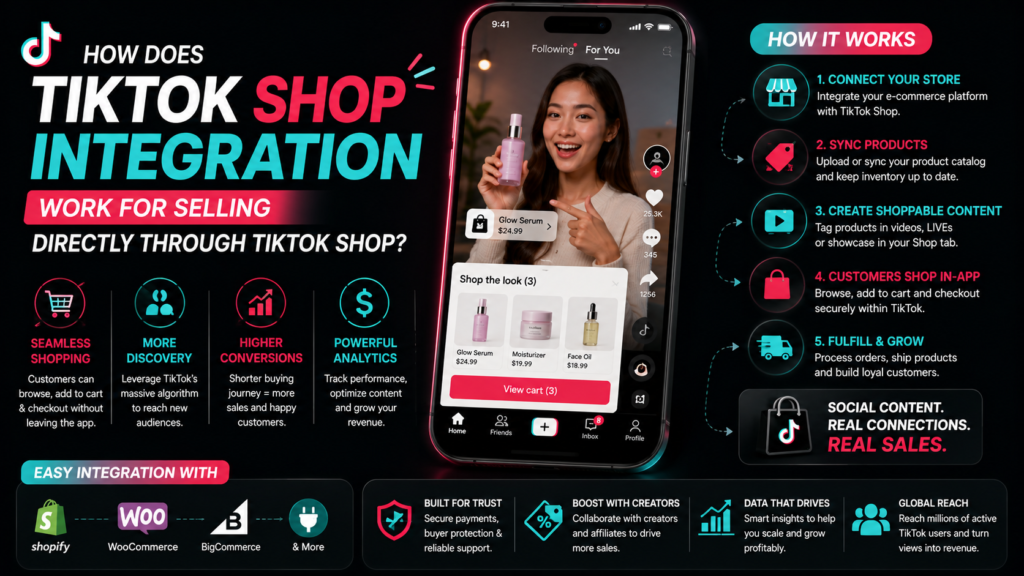
 TikTok Shop E-Commerce Integration
If you’ve spent any time scrolling TikTok lately, you’ve probably noticed something different. Videos aren’t just entertaining anymore, they’re shoppable. A creator holds up a skincare product, taps a little bag icon, and suddenly you’re checking out without ever leaving the app. That’s TikTok Shop e-commerce integration in action, and it’s quietly becoming one of the biggest shifts in how people buy things online.
For brands and small business owners, this raises a real question: how does it actually work behind the scenes, and is it worth setting up? This guide breaks down everything you need to know about selling on TikTok, connecting your store, and making the most of social shopping without the confusing jargon.
TikTok Shop e-commerce integration is the process of connecting your online store or product catalog directly to TikTok’s built-in shopping feature. Instead of sending viewers to an external website through a link in bio, your products live natively inside the app. People can browse, add to cart, and pay without ever switching platforms.
Think of it as turning your TikTok profile into a mini storefront that sits right alongside your content. Videos, livestreams, and even your profile page can all include shoppable tags that lead straight to checkout.
Traditional social media marketing used to work like this: post content, hope people click a link, hope they don’t abandon the checkout page halfway through. Every extra step lost customers along the way.
TikTok Shop removes most of those steps. It shortens the distance between “I saw this and I want it” and “I bought it” down to just a few taps. That’s why so many sellers are rushing to figure out how it works.
Before diving into setup steps, it helps to understand the moving parts that make the whole system function.
Each of these pieces connects to form one smooth shopping experience, and understanding them makes the setup process much less intimidating.
Setting up TikTok Shop isn’t difficult, but it does involve a handful of stages. Here’s how the process generally works.
Not every country or business type has access to TikTok Shop yet, so the first move is confirming availability in your region. You’ll also need basic business documentation ready, things like a business license, tax information, and identity verification.
You’ll register through TikTok’s Seller Center, separate from your regular creator or business profile. This account is where all the backend management happens.
This is where the real integration begins. You have a few options here:
Syncing automatically is usually the smarter route because it keeps your stock levels, pricing, and product details consistent across every channel you sell on.
You’ll need to link a payment method for receiving funds and configure shipping options, whether that’s TikTok’s fulfillment partners or your own logistics setup.
Once your catalog is live, you can tag products in videos, livestreams, and your Shop tab. This turns ordinary content into a direct sales channel.
After everything’s approved, your shop goes live. From here, it’s about tracking performance, adjusting your product mix, and refining what content actually drives conversions.
Most sellers aren’t building this connection from scratch using raw code. Instead, they rely on existing e-commerce platforms that offer built-in TikTok Shop integrations.
Shopify has one of the smoothest connections available. Merchants can install the TikTok channel app, sync their catalog automatically, and manage TikTok orders right inside their existing Shopify dashboard. Inventory updates happen in real time, which cuts down on overselling.
For WordPress-based stores, plugins exist that link WooCommerce inventory to TikTok Shop. It requires a bit more manual configuration compared to Shopify, but it still automates most of the heavy lifting.
Larger platforms like BigCommerce also offer native or third-party connectors. The general workflow stays the same across platforms: connect your account, map your product categories, and sync inventory data.
For bigger brands with development resources, TikTok offers API access that allows for deeper, more customized integrations. This route gives more control but requires technical know-how, which is where working with a digital marketing or development partner, like the team at Pulse Digitall, can genuinely save time.
Social shopping isn’t just a buzzword, it describes an entire shift in consumer behavior where discovery, entertainment, and purchasing happen in the same breath. TikTok Shop leans heavily into a few standout features to make that possible.
Regular content creators can tag products directly in their videos. Viewers see a small shopping cart icon and can browse the tagged items without pausing the video.
Livestream selling has exploded in popularity, especially in markets where it’s already mainstream. Sellers showcase products in real time, answer questions, and viewers purchase instantly during the stream.
This acts like a dedicated storefront inside TikTok’s navigation, letting users browse an entire catalog the same way they would on a traditional e-commerce site.
Brands can partner with creators through TikTok’s affiliate program, offering commission on sales generated through creator content. This taps into influencer marketing without needing a formal outside partnership.
Perhaps the biggest driver of conversions is the fact that payment happens without leaving the app. Fewer steps mean fewer chances for someone to abandon their cart.
So why go through the setup process at all? Here’s what makes it worth the effort for most businesses.
For small businesses especially, this combination of discovery and low-friction checkout can level the playing field against bigger competitors with larger ad budgets.
It isn’t all smooth sailing though. Here are a few obstacles that come up often, along with practical ways to handle them.
When your catalog isn’t properly connected, you risk selling products that are actually out of stock. The fix is choosing a reliable integration method, whether that’s an official app or a well-reviewed third-party plugin, and checking sync frequency settings regularly.
Plenty of sellers post product videos that get views but no sales. This usually comes down to weak calls-to-action or content that feels too much like a traditional ad. Native, authentic content tends to outperform polished commercials on this platform.
Shipping delays hurt trust fast. Setting realistic delivery timelines and choosing dependable fulfillment partners helps avoid negative reviews that can tank your shop’s visibility.
TikTok’s algorithm rewards engagement, not just follower count. A shop with fewer followers but highly engaging content can outperform a larger, less active account.
Certain product categories face restrictions or extra verification requirements. It pays to check TikTok Shop’s policies before investing heavily in a product line that might get flagged.
Getting the technical integration right is only half the equation. Here’s how top-performing sellers actually approach the platform.
Selling well on this platform rewards experimentation. What works for one niche might flop in another, so treating your first few months as a testing phase pays off long term.
It helps to understand what’s happening technically once you hit “connect” on an integration app, because it demystifies a lot of the confusion sellers run into later.
When you link a platform like Shopify, the integration app doesn’t just dump your products into TikTok. It maps each field, title, description, price, images, variants, into TikTok’s required format. Category mismatches are one of the most common rejection reasons, so double-checking that your product categories align with TikTok’s taxonomy saves a lot of back-and-forth.
Most integrations sync inventory on a schedule, sometimes real-time, sometimes every few minutes. If you’re selling on multiple channels simultaneously, understanding this sync delay matters. A sale on your website that isn’t reflected on TikTok fast enough can lead to overselling and cancelled orders, which hurts your seller rating.
Once a customer buys through TikTok Shop, the order typically flows back into your existing order management system if you’re using a connected platform. This means you can fulfill TikTok orders the same way you fulfill website orders, through the same warehouse, the same shipping labels, and the same tracking systems.
More advanced integrations use webhooks, small automated messages that fire whenever something changes, a price update, a stock change, a new order. This is what keeps everything feeling instantaneous rather than requiring manual refreshes.
Integration handles the technical side, but content is what actually drives sales. A shop with a perfectly synced catalog and zero engaging videos won’t generate much revenue. Here’s how sellers typically structure their content around TikTok Shop.
Pure product pitches tend to underperform. Instead, successful sellers blend in tutorials, comparisons, and behind-the-scenes content that happens to feature their products naturally.
Encouraging customers to post their own videos featuring your product, then resharing or tagging that content, builds trust faster than branded ads ever could. People trust other buyers more than they trust sellers.
Livestream performance depends heavily on when your audience is actually active. Testing different time slots and tracking viewer counts over a few weeks usually reveals a pattern worth sticking to.
Comments under shoppable videos often function like a live FAQ. Responding quickly, and sometimes even turning a good question into a follow-up video, keeps engagement high and builds credibility with potential buyers who are still on the fence.
Once your shop is live, it’s easy to get distracted by vanity metrics like views. Here’s what genuinely reflects whether your TikTok Shop strategy is working.
Checking these numbers weekly, rather than daily, usually gives a clearer picture since daily fluctuations can be misleading.
Social shopping isn’t a passing trend, it reflects a genuine shift in how people discover and purchase products. Instead of searching for what they need, consumers are increasingly stumbling onto products through content they enjoy watching anyway.
This blurring of entertainment and commerce means brands can’t treat social media as just an awareness channel anymore. It’s becoming a full sales channel in its own right, with TikTok Shop leading much of that charge alongside similar features on other platforms.
Businesses that adapt early, learning the content style, understanding the algorithm, and integrating their catalog properly, tend to build an advantage that’s hard for latecomers to catch up to.
It’s worth pausing to compare this model against the traditional online store setup most businesses are used to, since the differences explain why so many brands are shifting budget toward social shopping.
This doesn’t mean one approach replaces the other. Most successful sellers run both in parallel, using TikTok Shop for discovery and impulse purchases while still maintaining a website for retention, email marketing, and higher-consideration purchases.
Not necessarily. TikTok Shop tends to work best for:
It might not be the right fit for highly technical B2B products, extremely high-ticket items, or brands without the bandwidth to create consistent content. Knowing your audience and product type helps determine whether the investment in setup and content creation will actually pay off.
Is TikTok Shop free to set up?
Creating a seller account is generally free, though TikTok does take a commission on each sale and there may be additional fees depending on fulfillment choices and promotional tools you use.
Do I need a large following to sell on TikTok Shop?
Not at all. Plenty of small accounts with strong engagement outperform larger accounts with passive audiences. Content quality and relevance matter more than raw follower count.
Can I connect my existing Shopify or WooCommerce store?
Yes, both platforms offer integration options that sync your product catalog, pricing, and inventory automatically, saving you from manual double entry.
How long does approval take for a new TikTok Shop account?
It varies by region and business type, but sellers typically see approval within a few business days once documentation is submitted correctly.
What products aren’t allowed on TikTok Shop?
Restricted categories usually include things like weapons, certain supplements, counterfeit goods, and other regulated items. It’s worth reviewing TikTok’s official seller policies before listing anything questionable.
Does livestream selling actually work?
Yes, in many markets livestream shopping drives a significant share of sales. It works especially well for demonstrating products in real time and answering buyer questions instantly.
Can creators sell products without owning inventory?
Yes, through the affiliate and creator marketplace, creators can promote and sell brand products in exchange for a commission, without ever holding stock themselves.
Is TikTok Shop available worldwide?
No, availability depends on region. It’s expanded significantly over the past couple of years, but it’s worth checking current availability for your specific country before investing time into setup.
TikTok Shop e-commerce integration represents a real shift in how selling online works. It combines discovery, entertainment, and checkout into a single seamless experience, something traditional e-commerce simply can’t replicate. For businesses willing to learn the platform, connect their catalog properly, and commit to authentic content, the payoff can be substantial.
Setting everything up correctly, from catalog syncing to fulfillment logistics, takes some upfront effort, but the long-term reward is access to one of the fastest-growing sales channels available today. If you’re weighing whether to make the jump, starting small, testing content styles, and refining your approach based on real data is usually the smartest path forward.
If you’d rather have experts handle the technical setup and strategy while you focus on running your business, the team at Pulse Digitall works with brands on exactly this kind of integration, from connecting your store to building a content approach that actually converts.