
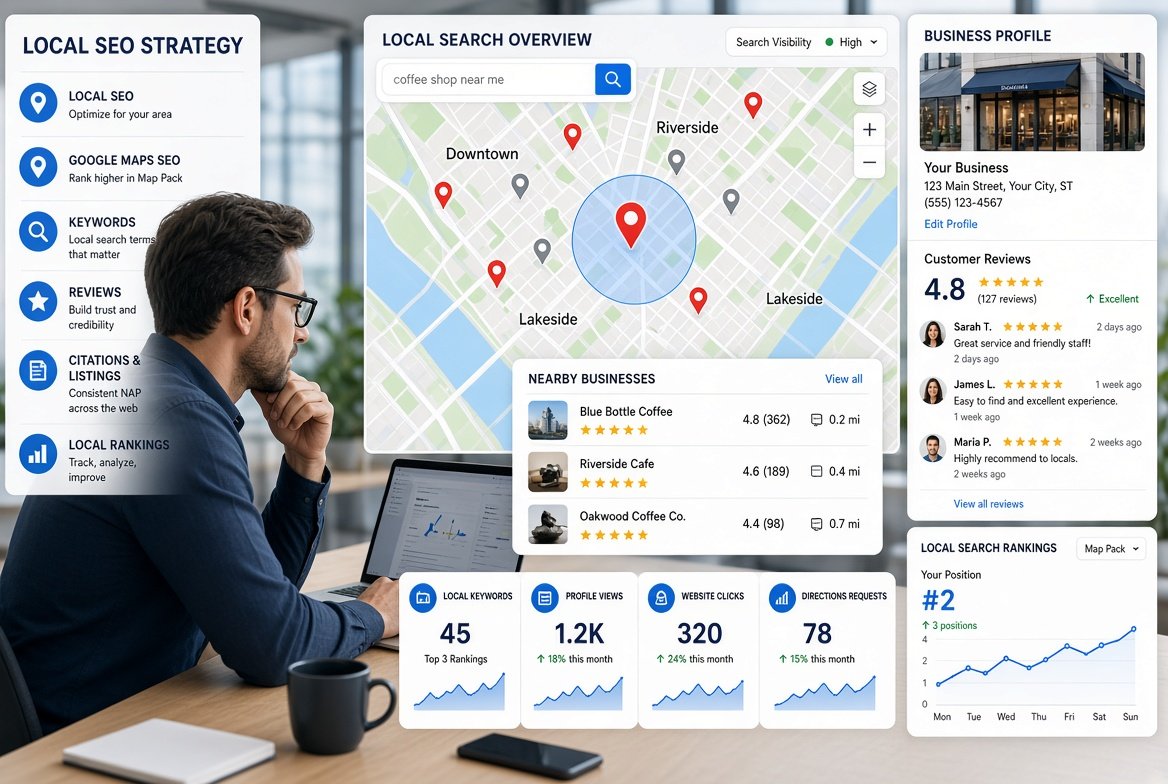
A local SEO strategy is a structured plan for improving a business’s visibility in local search results, Google Maps, and location based searches. It combines Google Business Profile optimization, local keyword research, website optimization, local content, customer reviews, citations, local links, and ongoing performance tracking. A well planned strategy helps businesses reach people who are actively searching for their products or services in a specific city, neighborhood, or service area. For businesses that depend on local customers, effective local search optimization can turn online visibility into phone calls, enquiries, bookings, visits, and sales.
A local SEO strategy is a step by step approach to making a business more visible to customers searching within a particular geographic area.
Instead of trying to rank for broad keywords across an entire country or the world, local SEO focuses on searches connected to specific locations.
For example:
These searches tell search engines that location is an important part of the user’s intent.
A strong local SEO strategy helps search engines understand:
The strategy should focus on both search engine visibility and the customer experience.
People often use search engines to find businesses close to them.
A customer may search for a service when they are ready to take action. For example, someone searching for “emergency electrician near me” may need help immediately.
Similarly, searches such as “best dentist in Chicago” or “coffee shop near me” can indicate strong local intent.
A strong local SEO strategy can help businesses:
Local SEO can be particularly valuable for businesses that rely on customers from a specific geographic area.
Local SEO works by building consistent signals around relevance, location, authority, and customer experience.
Search engines evaluate multiple factors when determining which businesses should appear for local searches.
These can include:
No individual factor guarantees a particular ranking.
Instead, successful local search optimization involves improving several areas together.
For example, a business may have an excellent website but a poorly optimized Google Business Profile. Another business may have strong reviews but weak location pages.
The strategy should identify these gaps and prioritize improvements based on their potential business value.
Traditional SEO and local SEO use many of the same principles, but their objectives can be different.
Traditional SEO may focus on ranking for broad informational or commercial searches.
Local SEO focuses on searches where geographic relevance matters.
For example:
Traditional SEO keyword:
“how to choose flooring”
Local SEO keyword:
“flooring company Dubai”
The first search can attract a broad audience.
The second search is much more location specific and may indicate that the user is looking for a local provider.
| Traditional SEO | Local SEO |
|---|---|
| Broad organic visibility | Location based visibility |
| National or global targeting | City or service area targeting |
| Website rankings | Website and Maps visibility |
| Topic relevance | Topic plus location relevance |
| General content | Localized content |
| Broad competitors | Local competitors |
A business can use both approaches as part of a broader digital marketing plan.
A successful local SEO strategy usually includes several interconnected areas.
These include:
Each element supports the overall objective of improving local visibility.
Keyword research should be one of the first steps in a local SEO strategy.
You need to understand what potential customers actually search for before optimizing pages.
Start by identifying your main services.
For example, a roofing company might offer:
Then combine those services with relevant locations.
Examples include:
You should also identify variations such as:
A detailed keyword research strategy can help identify service terms, location modifiers, search intent, and opportunities that competitors may be targeting.
Search intent is critical.
Consider these searches:
“roofing materials”
This may be informational.
“roofing contractor near me”
This has local commercial intent.
“emergency roof repair Houston”
This can have strong transactional intent.
Your strategy should prioritize keywords that have a realistic connection to your business goals.
Google Business Profile optimization is one of the most important parts of local SEO.
Your profile gives Google and customers information about your business.
Important information includes:
Accurate information helps customers understand your business and can strengthen the consistency of your online presence.
You can build this process into your wider strategy through Google Business Profile optimization.
Your primary business category should accurately represent what your business does.
For example:
Do not select an unrelated category simply because you believe it may generate more visibility.
Relevance is more important than trying to manipulate the category.
Your profile should accurately describe the services you provide.
For example, a plumbing company could list:
This gives customers a clearer understanding of what the business offers.
Your website is a major part of local search optimization.
Even when customers discover a business through Google Maps, they may visit the website before contacting the company.
The website should clearly communicate:
Important website elements include:
A broader SEO strategy can help establish the technical and content foundation required for local visibility.
Businesses serving multiple locations can create dedicated pages for important areas.
For example, an SEO agency serving:
could create relevant service location pages.
A page could target:
SEO Services Chicago
Another could target:
SEO Services Dallas
However, simply changing the city name on identical pages is not a strong strategy.
Each page should contain genuinely useful local information.
A useful location page can include:
The page should help both search engines and customers understand the relationship between the business and the location.
On page optimization helps search engines understand the purpose of each page.
Important elements include:
Include the service and location naturally where appropriate.
Example:
Local SEO Services in Chicago
The H1 should clearly communicate the page topic.
Example:
Local SEO Services Chicago
The content should answer customer questions and explain the service clearly.
Link relevant pages together using descriptive anchor text.
For example, a local SEO page could naturally link to:
A strong on page SEO strategy can improve the structure and relevance of local pages.
Local content can strengthen your connection with a target market.
Instead of publishing generic articles, create content that addresses questions and problems relevant to your customers.
Examples include:
For example, a landscaping company could publish:
How to Maintain a Lawn in Houston’s Climate
A flooring company could publish:
Best Flooring Options for Dubai Homes
The location should be meaningful to the topic rather than inserted simply for SEO.
Businesses can support this approach through professional content writing services.
Reviews are an important part of local business visibility and customer trust.
Customers often compare businesses based on:
A sustainable review strategy should focus on genuine customers.
Businesses can:
Businesses should not buy fake reviews or create misleading customer feedback.
A negative review does not necessarily mean a business has failed.
What matters is how the business responds.
A professional response can:
The response should be written for future customers as well as the original reviewer.
Consistency across online platforms is important for local businesses.
Pay particular attention to:
Name
Address
Phone number
This information should be accurate across important websites and directories.
Inconsistent information can create confusion for customers and search engines.
For example, if the business has moved, update the address across relevant platforms instead of leaving outdated information online.
A citation is an online mention of a business’s information.
Citations may appear on:
The objective is not to submit a business to every directory available.
Instead, prioritize relevant and trustworthy platforms.
A local restaurant may benefit from restaurant and local directories.
A legal company may focus on professional and industry relevant platforms.
A home service business may prioritize local and trade directories.
Quality and relevance matter more than quantity.
Local links can help establish geographic and topical relevance.
Potential sources include:
For example, a company sponsoring a local community event may receive a legitimate mention from the event organization.
The goal should be to earn relevant links rather than creating large quantities of artificial links.
An effective off page SEO strategy can support this process.
Google Maps SEO focuses on improving the visibility of eligible businesses within Google Maps and local search results.
Businesses should pay attention to:
Maps visibility is particularly important for customers who want to:
However, no legitimate SEO strategy can guarantee a specific Maps position for every search.
Search results can change based on location, query, competition, and other factors.
“Near me” searches are common examples of local intent.
Examples include:
Businesses should not repeatedly add “near me” to every page.
Instead, create a strong local presence that clearly communicates the business’s actual location and service areas.
Search engines can understand geographic relationships through multiple signals.
Local searches are frequently performed on mobile devices.
A customer may search for a service while traveling or when they need immediate assistance.
Your website should therefore make important actions easy.
Include:
A responsive website helps provide a consistent experience across smartphones, tablets, and desktop devices.
Technical problems can affect the user experience and make it harder for search engines to crawl and understand your website.
Review:
Technical SEO is not separate from local SEO.
A local landing page still needs to be accessible, useful, and technically sound.
Structured data can help search engines understand specific information about a webpage or organization.
Depending on the business and page, relevant structured data may describe information such as:
Structured data should accurately reflect information visible on the page.
It should not be used to provide misleading information.
Internal linking is often overlooked in local SEO.
A strong internal linking structure helps users and search engines discover related pages.
For example:
Homepage → Service Page → Location Page → Supporting Content
A local SEO page could link to a keyword research service, while a location page could link back to the main service page.
Use descriptive anchor text rather than generic phrases such as “click here.”
For example:
local SEO services
is more descriptive than:
learn more
This structure can help distribute internal relevance throughout the website.
Tracking local search rankings allows businesses to understand whether visibility is improving.
However, rankings should not be the only performance metric.
Track:
Search rankings can vary depending on the searcher’s location and search context.
Therefore, ranking data should be interpreted carefully.
The ultimate purpose of local SEO is to support business growth.
A ranking improvement matters more when it leads to useful customer actions.
For example:
More visibility → More website visits → More enquiries → More customers
Track conversions such as:
This allows the business to understand the commercial value of its local SEO investment.
Small businesses often have limited marketing budgets.
A focused strategy can help them prioritize the locations and services most relevant to their customers.
Start with:
Once the foundation is established, expand into additional services and locations.
A small business does not necessarily need hundreds of location pages.
It needs useful pages that target genuine demand.
Service area businesses operate differently from businesses with physical storefronts.
Examples include:
These businesses may travel to customers rather than receive customers at a physical location.
Their strategy should clearly communicate:
Businesses should not create fake offices simply to appear in additional locations.
Multi location businesses need a more structured approach.
For example, a company with branches in:
may need individual location pages and business profiles.
Each location should have accurate:
Avoid creating thousands of pages with almost identical content.
Each location page should provide genuinely useful information.
Ecommerce businesses can also benefit from local search when they operate physical stores, warehouses, pickup locations, or regional delivery services.
Local opportunities can include:
An effective ecommerce development setup can make it easier to support local shopping experiences.
B2B companies sometimes overlook local search because they serve professional customers rather than consumers.
However, local searches can still be valuable.
Examples include:
B2B local SEO should focus on:
The strategy should focus on qualified business searches rather than traffic volume alone.
Professional local SEO services can cover several areas.
A comprehensive service may include:
The exact scope depends on the business, market, number of locations, and competition.
Businesses should understand what is included before selecting a provider.
Do not create business locations where the company does not genuinely operate.
Repeating the city name excessively can make content unnatural and reduce its usefulness.
Changing only the city name while keeping the rest of the page identical provides limited value.
A strong website alone does not replace proper local business profile management.
Fake reviews can damage trust and create serious reputation problems.
Large numbers of unrelated backlinks do not create meaningful local authority.
A difficult mobile experience can reduce enquiries from local searchers.
Rankings matter, but calls, leads, bookings, and revenue are more meaningful business indicators.
There is no universal timeline for local SEO results.
The time required can depend on:
Some less competitive searches may show changes relatively quickly.
Competitive markets can require a longer period of consistent optimization.
The strategy should therefore be treated as an ongoing process rather than a one time task.
Local SEO should be monitored continuously.
Businesses should regularly review:
Seasonal businesses may need more frequent updates.
For example, a heating company may adjust its content and campaigns before winter demand increases.
Local SEO and paid search can complement each other.
Google Ads can provide paid visibility for selected searches while local SEO builds organic and Maps visibility.
For example, a local business could use paid search for:
Emergency plumber near me
while building organic visibility for:
Plumber in Houston
This gives the business different opportunities to reach customers.
A business interested in paid search can also explore Google Ads services alongside its local SEO strategy.
Social media can support local brand awareness.
Businesses can share:
A consistent social media marketing strategy can complement local search visibility by helping customers recognize and remember the brand.
Social media should support the wider marketing strategy rather than replace local search optimization.
Use this checklist when developing or auditing a local SEO campaign:
A local SEO strategy is a structured plan for improving a business’s visibility in local search results and Google Maps. It includes Google Business Profile optimization, keyword research, website optimization, reviews, citations, local content, links, and performance tracking.
Important areas include Google Business Profile optimization, relevant local keywords, useful service and location pages, genuine reviews, consistent business information, local authority, technical SEO, and ongoing measurement.
Google Maps SEO involves optimizing a business’s online presence to improve its relevance and visibility for local searches. Factors can include business information, categories, reviews, website relevance, location, and business prominence.
Start by improving your Google Business Profile, researching local keywords, optimizing service and location pages, collecting genuine reviews, maintaining consistent business information, developing useful local content, and earning relevant local links.
For eligible businesses that want visibility in Google Maps and local results, a Google Business Profile is an important part of the local SEO process.
Reviews are an important part of local business visibility and customer trust. Businesses should focus on obtaining genuine reviews and responding professionally to customer feedback.
Create location pages for genuine service areas or business locations where there is a meaningful reason for customers to visit that page. Quality and usefulness are more important than creating a large number of nearly identical pages.
Yes. Service area businesses can use local SEO when they genuinely provide services within specific geographic areas. Their website and business information should accurately communicate their service areas.
The timeline varies depending on competition, location, website authority, business profile strength, reviews, content, and other factors. Local SEO generally requires consistent optimization and monitoring rather than a one time change.
Yes. Improved local visibility can create opportunities for website visits, calls, enquiries, bookings, and other customer actions. The actual results depend on the market, business, offer, competition, and quality of the implementation.
They serve different purposes. Local SEO focuses on organic and Maps visibility, while Google Ads provides paid advertising placements. A business may use both depending on its goals and resources.
A successful local SEO strategy is not about adding a city name to every page or creating hundreds of business listings. It is about building a trustworthy and consistent online presence that clearly communicates what a business offers, where it operates, and why it is relevant to local customers.
Start with the fundamentals. Research local search intent, optimize the Google Business Profile, create useful service and location pages, maintain accurate business information, earn genuine reviews, build relevant local authority, and make the website easy to use on mobile devices.
Then measure the results.
Track local search rankings, Google Maps visibility, organic traffic, calls, enquiries, bookings, and other business outcomes. Use the data to identify opportunities and continuously improve the strategy.
When website optimization, Google Maps SEO, local content, reviews, citations, and local authority work together, businesses can build a stronger presence in local search and create more opportunities to connect with customers in their target areas.
If you want to improve your local visibility and build a structured local SEO strategy for your business, Get Free Strategy Session or Request Proposal to discuss your target locations, services, and growth objectives.