
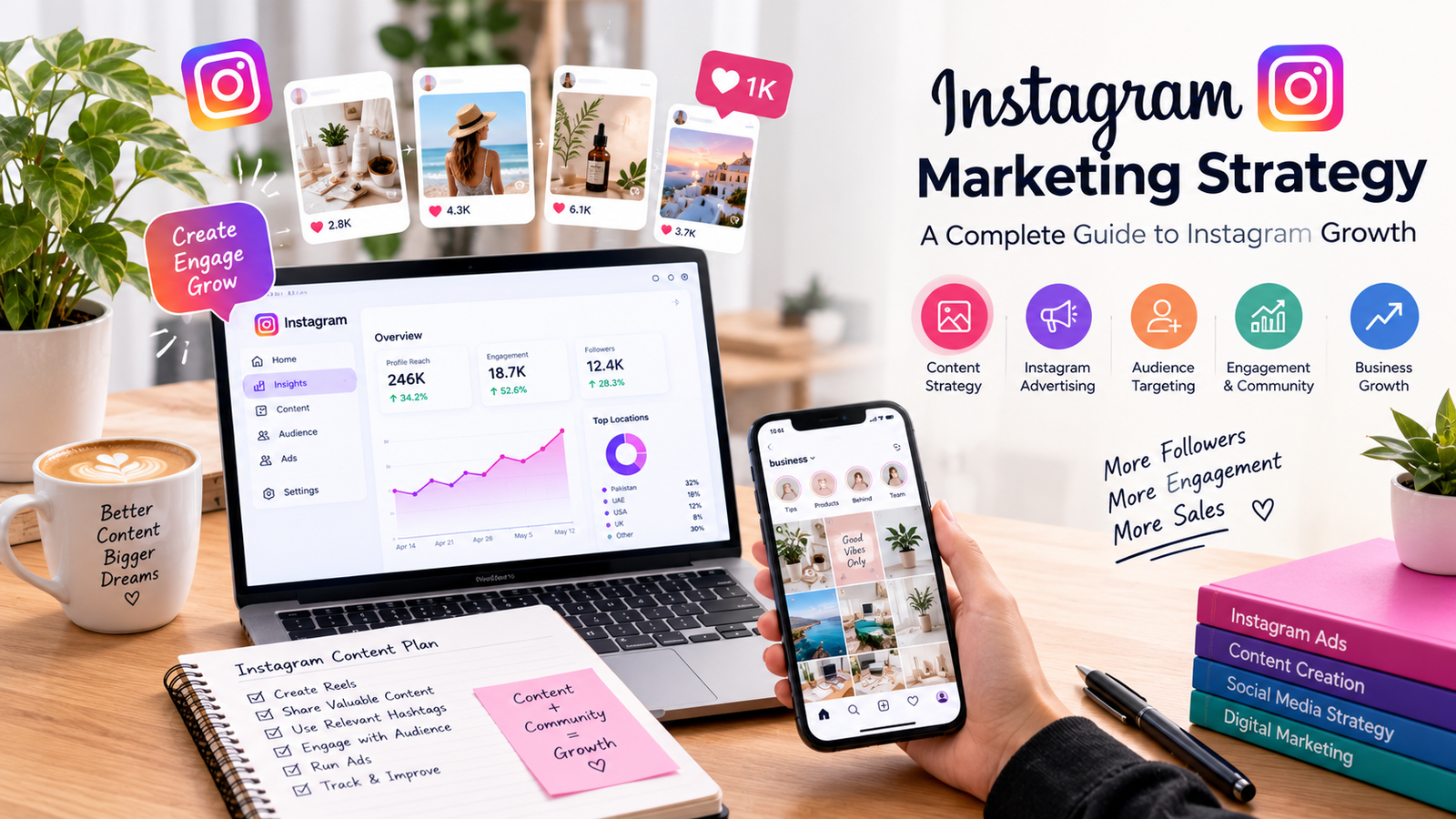
 Instagram Marketing Strategy: A Complete Guide to Instagram Growth
An effective Instagram marketing strategy combines a clear business goal, a defined audience, consistent content, strong visual communication, community engagement, and measurable promotion. For businesses using Instagram for business, the goal should not be to collect followers alone. A stronger strategy connects Instagram content with brand awareness, website traffic, leads, sales, customer relationships, and long term Instagram growth. Instagram advertising can then extend that strategy by putting relevant offers and content in front of selected audiences.
Instagram has become much more than a place to publish attractive photos. Businesses can use the platform to explain products, demonstrate services, answer customer questions, build credibility, showcase people behind the brand, distribute educational content, and create multiple touchpoints throughout the customer journey.
The challenge is consistency. Many businesses post whenever they have time, copy trends without understanding their audience, or focus heavily on follower numbers without knowing whether the audience is actually relevant. A practical strategy solves this by giving every content format and campaign a clear purpose.
An Instagram marketing strategy is a structured plan for using Instagram to achieve business objectives. It defines who the business wants to reach, what it wants to communicate, which content formats it will use, how often it will publish, how it will engage with users, and how performance will be measured.
A complete strategy usually includes:
The strongest plans connect these elements instead of treating them as separate tasks.
Instagram for business can give companies a visual environment for communicating what they sell and why customers should care. The platform can be particularly useful for products, lifestyle brands, restaurants, fashion, beauty, hospitality, real estate, professional services, local businesses, creators, and companies that can demonstrate their expertise visually.
Businesses can use Instagram to:
Instagram should not be expected to perform the same function for every business. The right role depends on the audience, product, sales cycle, industry, and overall marketing system.
Before planning content, define what the business wants Instagram to accomplish.
Possible objectives include:
Each objective changes the content strategy. A business focused on lead generation may need educational posts and strong calls to action. A fashion brand may emphasize product visuals, styling content, creator collaborations, and launches. A professional service company may need more educational content, case studies, FAQs, and expert commentary.
Instagram growth becomes more useful when the audience is relevant to the business. Before creating a content calendar, identify the people the business actually wants to reach.
Research:
A useful approach is to describe the ideal customer in terms of problems rather than demographics alone. For example, a local home service company may want to reach homeowners who need a specific repair. A software company may need to reach business decision makers who are struggling with a particular workflow.
Your profile is often the first place a potential customer goes after seeing a post or advertisement. It should explain the business quickly.
A useful profile should communicate:
Use a recognizable profile image, a concise bio, relevant contact information, and a clear destination link. Keep branding consistent across the website and other marketing channels.
A strong Instagram content strategy prevents the account from becoming a random collection of posts. Instead of asking “What should we post today?” the business can work from defined content pillars.
Common content pillars include:
Teach customers something useful. Explain common problems, mistakes, processes, comparisons, terminology, or practical tips related to your industry.
Show what the business actually sells. Demonstrate features, benefits, applications, use cases, results, and frequently asked questions.
Show how products are made, how services are delivered, or how the team works. Human context can make a business feel more approachable.
Share reviews, testimonials, customer stories, case studies, or other appropriate evidence of customer experience.
Communicate the values, personality, expertise, and positioning of the company.
Promote offers, launches, events, seasonal products, consultations, and other commercial opportunities without turning every post into a sales pitch.
Short form video can be useful for demonstrating products, explaining concepts, answering questions, showing processes, and presenting personality.
A simple Reel structure is:
Hook → Value → Demonstration or Explanation → Call to Action
The opening should establish relevance quickly. Avoid spending most of the video introducing the company before explaining why the viewer should continue watching.
Possible Reel ideas include:
Stories can support frequent communication without requiring every update to become a permanent feed post.
Businesses can use Stories for:
Stories can also reveal what topics generate replies and interactions. Those observations can inform future content.
Carousel posts are useful when one image cannot communicate the complete idea. They can turn a topic into a sequence of educational slides.
Examples include:
A good carousel should have a logical flow. The first slide should make the topic immediately understandable, while later slides provide useful information.
Captions should add context rather than repeat everything already visible in the creative.
A useful caption can:
Do not force every caption to sound promotional. Educational and conversational content can build familiarity and trust over time.
Hashtags can provide additional context and discovery opportunities, but they should not be treated as a substitute for strong content. Use relevant terms that accurately describe the topic, industry, product, service, or audience.
Avoid adding unrelated high volume hashtags simply because they appear popular. Relevance is more useful than a long list of generic terms.
Instagram content can benefit from clear language that explains what the content is about. Use relevant terms naturally in captions, profile information, and content where appropriate.
For businesses with a website, Instagram can also support a wider search visibility strategy. Content topics that perform well on social media can reveal questions that may deserve dedicated website pages or articles.
Businesses can strengthen their broader organic visibility through SEO services in the USA, including keyword research, on page SEO, content writing, and local SEO.
Instagram advertising can extend organic content by allowing businesses to promote selected messages to relevant audiences. Paid campaigns can support awareness, traffic, leads, sales, and other business objectives depending on the campaign setup.
A useful advertising strategy begins with the same fundamentals as organic marketing:
Do not assume that simply boosting the post with the highest engagement will automatically produce the best business result. Engagement and conversion are different outcomes.
Organic content and paid advertising can work together, but they serve different roles.
| Organic Instagram | Instagram Advertising |
|---|---|
| Builds ongoing audience relationships | Provides paid distribution |
| Supports brand personality | Supports targeted campaigns |
| Creates reusable content assets | Can promote specific offers |
| Encourages community engagement | Can support measurable acquisition |
| Depends on content consistency | Depends on budget and campaign setup |
The two approaches do not need to compete. Organic content can establish trust and provide creative assets, while paid campaigns can extend reach and support specific business objectives.
Instagram growth should be evaluated beyond follower count. A growing audience is useful when it contains people who are relevant to the business and engage with content or eventually take meaningful actions.
Useful indicators can include:
A smaller audience that repeatedly interacts with a business and generates customers can be more commercially useful than a large audience with little relevance.
Engagement is influenced by content relevance, audience interest, creative quality, timing, consistency, and the relationship between the account and its community.
Practical methods include:
Do not use fake engagement or misleading tactics. The objective should be to build an audience that has a genuine relationship with the business.
A content calendar makes consistency easier because content can be planned in advance.
A simple weekly structure might include:
This is only an example. The right publishing frequency depends on the business, resources, audience, creative capacity, and content quality.
Consistency does not mean publishing low quality content simply to fill a calendar. A smaller number of useful posts can be more sustainable than an aggressive schedule that the team cannot maintain.
One useful way to maintain an Instagram content strategy is to repurpose strong ideas across multiple formats.
For example, one customer question can become:
This approach reduces the pressure to invent completely new topics every day.
Local businesses can use Instagram to showcase their location, services, team, customer experiences, products, and community involvement.
A local restaurant might show dishes and behind the scenes preparation. A salon might demonstrate services. A flooring company might showcase completed projects. A real estate company might present properties and neighborhood information.
Instagram can complement Google Business Profile optimization and local SEO by supporting brand recognition across multiple channels.
Social media can create interest, but the website often handles important conversion tasks. If a user moves from Instagram to a website, the landing experience should continue the same message.
Important elements include:
Businesses that need a mobile friendly customer experience can explore responsive website development. For focused campaign destinations, landing page development can provide a more direct conversion experience.
Ecommerce brands can use Instagram to show products in real life, educate customers, demonstrate use cases, introduce collections, and create product focused content.
Useful ecommerce content includes:
The shopping experience should be straightforward once a customer decides to purchase. Businesses that need a stronger online store can explore ecommerce development or Shopify website development.
Service businesses should use content to make an intangible service easier to understand. Show the process, answer questions, explain outcomes, introduce the team, and demonstrate expertise.
Examples include:
The objective is to reduce uncertainty. A potential customer should understand what the service is, whether it fits their situation, and what they should do next.
Creator collaborations can introduce products or services to established communities. The right creator is not necessarily the person with the largest follower count.
Consider:
For some businesses, a smaller creator with a highly relevant audience may provide a more appropriate partnership than a much larger account with limited relevance.
Analytics help businesses understand which content and campaigns are contributing to their objectives.
Depending on the account and campaign setup, useful measurements can include:
Do not look at every metric equally. Choose measurements that connect directly to the objective.
Random posts make it difficult to build a recognizable content system.
Follower count does not tell the full story of business performance.
Audiences need useful and interesting content, not only sales messages.
Businesses that never experiment with short form video may miss opportunities to explain products and services in a highly accessible format.
Instagram is strongly visual, so low quality or inconsistent creative can weaken brand perception.
Publishing content without responding to the community can make the account feel inactive.
Social traffic has limited value if the website is difficult to use or the conversion path is unclear.
Competitor research is useful, but a business should develop its own positioning and content perspective.
Strong visual branding helps people recognize a business across posts, Stories, advertisements, websites, and other channels.
Important elements include:
Businesses developing a stronger identity can explore branding and design services, including company branding, logo design, and social media post design.
Instagram advertising and Google PPC can support different parts of the customer journey. Instagram can introduce products and services while people are consuming social content. Google PPC can capture users who actively search for relevant products, services, or brands.
A business can use both channels as part of a wider paid media strategy. Pulse Digitall provides PPC and Google Ads services, including search advertising, display advertising, and lead generation.
Sustainable Instagram growth comes from repeated improvement rather than a single viral post.
A useful system looks like this:
Research → Create → Publish → Engage → Measure → Learn → Improve → Repeat
Research tells you what customers care about. Content creation turns those insights into useful assets. Publishing puts those assets in front of the audience. Engagement builds relationships. Analytics show what happened. Learning identifies patterns, and improvement makes the next cycle more effective.
Some businesses can manage Instagram internally. Others may need specialist support when content production, paid advertising, strategy, design, analytics, and community management become difficult to handle consistently.
Professional support may be useful when:
The purpose of professional support should be to create a measurable system rather than simply increase the number of posts.
A successful Instagram marketing strategy is not simply a posting schedule. It is a connected system that combines audience research, positioning, content, community engagement, paid promotion, website conversion, and measurement.
Instagram for business becomes more valuable when every piece of content has a reason to exist. Educational posts can build authority, product content can create demand, Stories can maintain daily communication, Reels can demonstrate ideas quickly, and Instagram advertising can extend selected messages to relevant audiences.
The most useful approach to Instagram growth is therefore not to chase follower numbers alone. Build an audience that is relevant to the business, publish content that genuinely helps that audience, create a consistent brand experience, and measure the actions that matter commercially.
An Instagram marketing strategy is a structured plan for using Instagram to achieve business goals through audience research, content, engagement, advertising, brand communication, and performance measurement.
You can use Instagram for business to build awareness, educate customers, showcase products or services, generate website traffic, support leads, promote offers, communicate with customers, and strengthen brand recognition.
There is no single strategy that works for every business. A strong approach usually combines a clear objective, relevant audience, defined content pillars, consistent publishing, community engagement, appropriate advertising, and measurable conversion goals.
Focus on relevant content, consistent publishing, strong creative, useful educational material, short form video, community interaction, collaboration where appropriate, and regular performance analysis. Growth should be evaluated by audience relevance and business outcomes as well as follower numbers.
There is no universal posting frequency. The right schedule depends on available resources, audience behavior, content quality, and business goals. Consistency is generally more sustainable than publishing large volumes of low quality content.
Instagram advertising can be useful when the audience, offer, creative, campaign objective, and conversion process are aligned. Results vary by industry, market, budget, and campaign execution.
Instagram advertising is paid promotion used to distribute selected content, products, offers, or messages to relevant audiences through Meta’s advertising ecosystem.
Useful business content can include educational posts, product demonstrations, customer stories, case studies, behind the scenes content, FAQs, short form videos, promotional offers, and industry insights.
Short form video can be an effective format for demonstrating products, answering questions, teaching concepts, and communicating brand personality. Its value depends on the audience and content quality.
An Instagram content strategy defines what topics a business will publish, which formats it will use, who the content is for, how content supports business objectives, and how performance will be measured.
Instagram can reveal audience interests and distribute content, while SEO can help the business build organic visibility through search. Ideas that perform well on Instagram can also become website articles, FAQs, service pages, or other search focused assets.
Yes. Businesses can use relevant content, calls to action, website destinations, messaging, forms, and paid campaigns to support lead generation.
Instagram can contribute to sales by creating product awareness, educating customers, demonstrating products, directing users toward ecommerce experiences, and supporting paid campaigns. Actual results depend on the complete customer journey.
Organic marketing and Instagram advertising serve different purposes and can work together. Organic content builds an ongoing presence and community, while paid advertising can provide additional distribution for specific business objectives.
Choose metrics based on your objective. These can include reach, engagement, shares, saves, profile activity, website visits, leads, purchases, conversion rate, and advertising cost per result.
Follower count can provide context, but it should not be the only measurement. Audience relevance, engagement quality, website activity, leads, sales, and other meaningful actions can provide a clearer picture of business performance.
A local business can showcase services, products, team members, customer experiences, completed projects, local events, FAQs, and behind the scenes activity while directing interested users toward calls, bookings, websites, or other conversion paths.
Yes. Instagram can help create awareness and interest while Google Ads can capture users who actively search for relevant products, services, or brands. Both channels can support different stages of the customer journey.
Professional support may be useful when a business needs strategy, content production, design, community management, paid advertising, analytics, or ongoing optimization that its internal team cannot consistently handle.
There is no fixed timeframe. Growth depends on content quality, audience relevance, consistency, competition, creative testing, platform behavior, and the overall marketing strategy.