
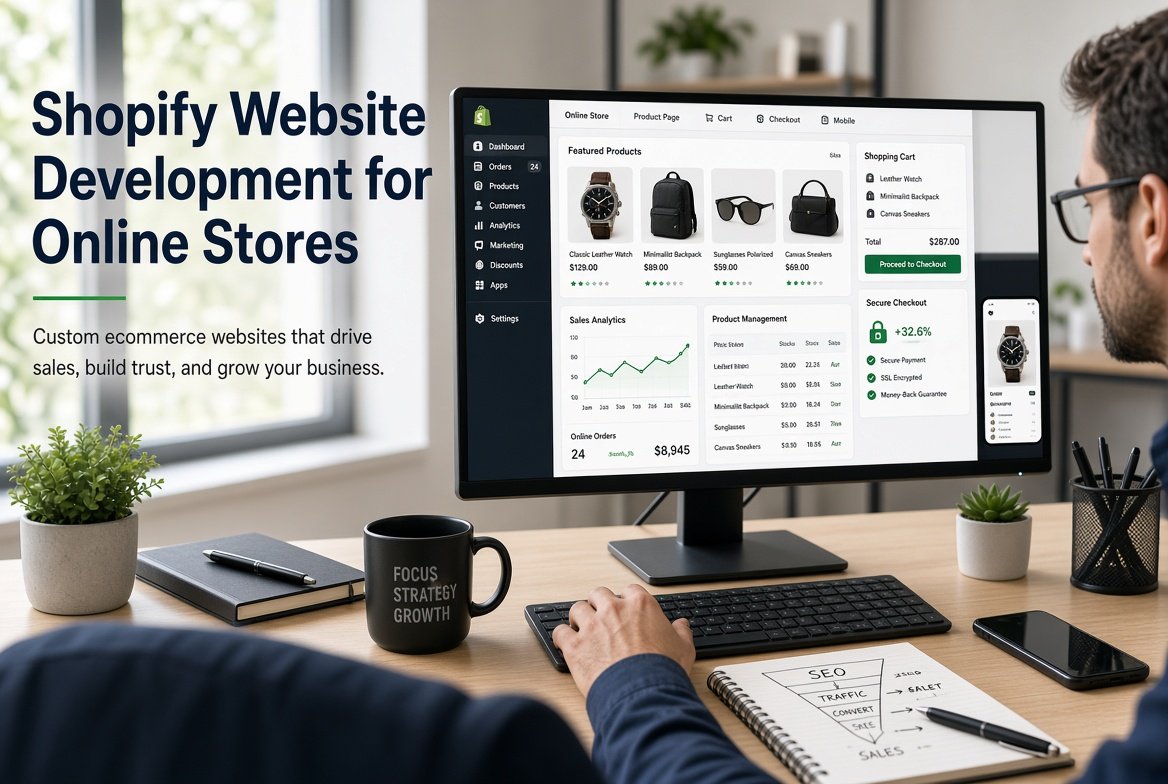
 Shopify Website Development for Online Stores
Shopify Website Development helps businesses create professional online stores that are easy to manage, secure, mobile friendly, and built to support ecommerce growth. A well developed Shopify store can help you showcase products, manage inventory, accept payments, improve customer experience, and generate sales without the complexity of building an ecommerce platform from scratch.
For a successful online store, however, simply creating a Shopify account is not enough. Your website needs a clear structure, attractive design, fast performance, useful product pages, simple navigation, strong calls to action, and an effective search engine optimization strategy. The right development approach connects all of these elements so your store can attract visitors and turn them into customers.
Shopify Website Development is the process of creating, customizing, improving, and maintaining an online store using the Shopify ecommerce platform. It can include store setup, theme customization, product organization, navigation, payment configuration, app integration, custom features, mobile optimization, performance improvements, and search engine optimization.
Shopify provides the technical foundation, while development work shapes that foundation around the needs of a specific business.
A Shopify store can be developed for:
The goal is not simply to create a website. The goal is to create an online store that makes it easy for customers to discover products, understand their value, complete purchases, and return for future orders.
Shopify has become a popular ecommerce platform because it provides businesses with the tools required to launch and manage an online store from one central system.
Instead of managing a completely custom ecommerce infrastructure, business owners can use Shopify for essential ecommerce functions such as product management, checkout, payments, order management, and store administration.
One of Shopify’s biggest advantages is its relatively simple administration system. Store owners can add products, update descriptions, change prices, manage inventory, process orders, and review sales information without needing advanced technical knowledge.
This makes Shopify suitable for businesses that want control over everyday ecommerce operations.
Shopify supports professionally designed themes that can be customized to match a brand’s identity. Developers can adjust layouts, sections, typography, product displays, navigation, and other elements to create a more distinctive store.
A strong Shopify website design should also focus on usability. Customers should be able to understand what the business sells and find the products they need without unnecessary steps.
A large portion of ecommerce traffic comes from smartphones. Therefore, a Shopify store needs to work properly across mobile phones, tablets, laptops, and desktop computers.
Mobile optimization should cover product images, menus, buttons, forms, product variants, checkout interactions, and page loading performance.
Customers need confidence when entering personal and payment information. Shopify provides an ecommerce infrastructure designed to support secure online transactions and store management.
However, businesses still need to configure their store correctly and follow good security practices.
A small business may start with a limited product catalog and later expand into hundreds or thousands of products. Shopify can support businesses as their ecommerce requirements grow.
Developers can also improve store architecture, navigation, collection structures, applications, and integrations as the business becomes more complex.
Shopify Website Development can include everything from initial store setup to advanced customization.
A complete Shopify development project may include the following services.
The first stage is establishing the basic ecommerce environment. This includes configuring important store settings and preparing the website for development.
Store setup may include:
A properly configured store creates a strong foundation for future development.
The theme controls much of the visual appearance and structure of the website. A developer can customize an existing theme or create more advanced layouts according to business requirements.
Theme development may involve:
The design should support both branding and conversion.
Businesses with specific requirements may need custom development rather than relying entirely on standard theme features.
Custom Shopify Website Development can involve specialized layouts, custom sections, unique product experiences, advanced filters, custom integrations, or other functionality.
The purpose of customization should always be connected to a real business requirement. Adding unnecessary features can make a store harder to manage and potentially affect performance.
Product pages are among the most important pages on an ecommerce website because they directly influence purchasing decisions.
An effective product page should provide:
The page should answer customer questions before they reach checkout.
Collection pages help customers browse related products. A logical collection structure also helps search engines understand the relationship between products.
For example, an online clothing store could create collections for:
Collections should be organized around how customers actually search and shop.
Shopify apps can extend store functionality. Depending on business requirements, a store may use applications for reviews, email marketing, customer support, analytics, inventory, shipping, subscriptions, or other ecommerce processes.
However, adding too many applications can create unnecessary complexity. Every app should have a clear purpose.
A visually attractive website is useful, but appearance alone does not create a successful ecommerce store.
The customer journey matters more.
When someone lands on your website, they should quickly understand:
A good Shopify store removes friction from this process.
Navigation should make important product categories easy to find.
For larger stores, a well organized menu can reduce the amount of time customers spend searching for products.
Use descriptive category names rather than confusing creative labels that customers may not understand.
Calls to action should clearly communicate the next step.
Examples include:
The wording should match the purpose of the page.
High quality images are essential for ecommerce. Customers cannot physically touch or examine products through a website, so images need to communicate important details.
Use multiple product angles where appropriate. Lifestyle images can also help customers understand how a product looks or works in real situations.
Reviews can help reduce uncertainty. Product pages should make genuine customer feedback easy to find.
Reviews can provide information about product quality, sizing, usability, delivery, and customer satisfaction.
The purpose of an ecommerce website is ultimately to support business growth.
A Shopify store should therefore be developed around the entire customer journey rather than only its visual appearance.
Customers need multiple ways to discover products. Search, categories, collections, filters, recommendations, and internal links can all contribute to better product discovery.
Once a customer finds a product, the website should provide enough information to help them make a decision.
This includes specifications, benefits, pricing, images, reviews, delivery information, and answers to common questions.
The checkout process should be straightforward. Unnecessary distractions and complicated forms can increase abandonment.
Make important information clear and ensure the purchasing process works properly on mobile devices.
The customer experience does not end after payment. Order confirmation, shipping communication, support, returns, and follow up marketing can influence whether a first time buyer becomes a repeat customer.
A beautiful Shopify store still needs visibility. Search engine optimization helps ecommerce businesses attract people who are actively searching for their products.
Shopify SEO can involve technical optimization, keyword research, product optimization, collection optimization, internal linking, content creation, image optimization, and other activities.
For businesses that need a broader search engine optimization strategy, PulseDigitall also provides search engine optimization services.
Keyword research identifies the terms potential customers use when searching for products or services.
For ecommerce websites, keyword research can target:
A strong keyword strategy can influence product names, collection pages, blog topics, headings, metadata, and website structure.
Businesses can also use keyword research services to identify valuable search opportunities.
Product pages should target relevant search terms naturally.
Important elements can include:
Do not fill product descriptions with repetitive keywords. Search engines and customers both benefit from clear, useful content.
Collection pages can target broader commercial keywords than individual products.
For example, a store selling running shoes might have a collection page targeting a term such as running shoes, while individual product pages target specific product names.
This creates a useful hierarchy between category and product content.
Technical and content elements should work together. Page titles, headings, content, internal links, images, and URLs should communicate the purpose of each page clearly.
PulseDigitall also provides on page SEO services for businesses that need deeper page level optimization.
Technical SEO is particularly important for ecommerce websites because stores can contain large numbers of products, collections, filters, parameters, and URLs.
Technical work can include:
For businesses with larger ecommerce websites, technical SEO can help search engines discover and understand important pages.
Internal links help users move between related pages while also helping search engines understand website structure.
A Shopify store can connect:
A well planned internal linking strategy can support both user experience and organic visibility.
Ecommerce SEO does not have to depend only on product pages.
Content marketing can attract customers earlier in the buying journey.
For example, a skincare store could publish content about:
This type of content can target informational searches and guide visitors toward relevant products.
PulseDigitall provides content writing services that can support ecommerce content strategies.
Shopify can be particularly useful for small businesses that want to start selling online without building a completely custom ecommerce platform.
A small business can begin with a focused product range and expand gradually.
For example, a business selling handmade products might start with:
As sales increase, the store can add additional features and integrations.
Businesses can also combine ecommerce development with a broader SEO strategy for small businesses to improve organic visibility.
Larger ecommerce businesses often have more complex requirements.
They may need:
For these businesses, development should focus heavily on performance, maintainability, scalability, and clear website architecture.
Organic search is not the only way to generate ecommerce traffic.
Paid advertising can help businesses reach potential customers while SEO develops over time.
Google Ads can be used for product searches, brand searches, remarketing, and other commercial opportunities.
PulseDigitall provides Google Ads services for businesses that want to combine paid traffic with ecommerce growth.
Google Shopping can be particularly useful for product based businesses because customers can see product information directly within search results.
Product titles, images, pricing, availability, landing pages, and product feed information all matter.
PulseDigitall also provides Google Shopping Ads services for ecommerce businesses.
Traffic alone does not guarantee sales.
A store needs to turn visitors into customers.
Conversion optimization focuses on identifying and improving areas that may prevent customers from purchasing.
Important areas include:
Testing different layouts, messages, offers, and page elements can help identify what works best for a particular audience.
Website performance can influence both user experience and search visibility.
Large images, unnecessary applications, excessive scripts, poorly optimized code, and heavy page elements can contribute to slower loading.
A Shopify development project should therefore consider performance from the beginning.
Useful practices include:
A faster store can create a smoother shopping experience, especially for mobile visitors.
A professional Shopify development project usually follows a structured process.
Before development begins, the team should understand the business model, target audience, products, competitors, and ecommerce goals.
This prevents unnecessary development work.
The next stage is deciding how customers will navigate the store.
This includes product categories, collections, navigation, important pages, and content structure.
Keyword research helps identify what customers search for and how the website should be structured around search demand.
The visual design should reflect the brand while keeping usability at the center.
Important screens include the homepage, collection pages, product pages, cart, and mobile layouts.
The approved design is then implemented within Shopify.
This can include theme customization, custom sections, product templates, navigation, applications, and other required functionality.
Products, collections, images, descriptions, policies, and other content are added and optimized.
SEO elements are reviewed before launch. This includes page titles, descriptions, headings, URLs, internal links, images, structured data, and indexation.
The store should be tested across devices and browsers.
Important checks include:
After testing and approval, the website can be launched.
The launch stage should include a final technical and SEO review.
Ecommerce development does not end at launch.
Search behavior, customer behavior, sales data, conversion rates, and website performance should be monitored continuously.
Even a good platform can produce poor results if the store is not developed carefully.
A store that looks exactly like hundreds of other websites may fail to communicate a strong brand identity.
Customize important areas while keeping the customer journey simple.
Every application adds another layer to the store. Installing applications without a clear reason can increase complexity and potentially affect performance.
A store that works well on desktop but poorly on mobile can lose valuable customers.
Always test the complete shopping journey on smartphones.
Thin or copied product descriptions provide little value.
Product content should explain what the product is, who it is for, its benefits, specifications, and important purchasing information.
Waiting until after launch to think about SEO can create unnecessary work.
Search engine optimization should be considered while planning website architecture and content.
Customers should not have to click through several confusing menus to find a product.
Keep navigation logical and prioritize important categories.
Without reliable tracking, it becomes difficult to understand where customers come from and what they do on the website.
Analytics can help businesses identify traffic sources, product performance, conversion rates, and customer behavior.
Shopify can support several ecommerce business models.
Brands can sell products directly to customers through their own ecommerce website.
Businesses can use Shopify to manage the customer facing ecommerce experience while products are fulfilled through suppliers.
Businesses selling products regularly can use appropriate subscription functionality to manage recurring purchases.
Businesses selling to other companies may require different pricing structures, customer accounts, and ordering workflows.
Retailers with large catalogs can use collections, filters, search, and structured navigation to make product discovery easier.
The cost of Shopify Website Development depends on the complexity of the store.
A simple store with a standard theme and limited customization will generally require less development work than a large ecommerce website with custom functionality, integrations, advanced filtering, and a large product catalog.
Factors that influence cost include:
Instead of choosing a developer based only on price, businesses should consider the quality of the website, functionality, scalability, performance, and long term business value.
Shopify and custom ecommerce development can both be useful, but they suit different requirements.
Shopify can be a strong option when a business wants a reliable ecommerce platform with faster implementation and easier store management.
Custom development may be more suitable when a business requires highly specialized functionality that cannot be efficiently achieved through Shopify.
The right choice depends on business requirements rather than simply choosing the most technically complex option.
For businesses considering other ecommerce development solutions, PulseDigitall also offers ecommerce development services.
A Shopify store should be built with future growth in mind.
That means the website structure should allow new products, categories, content, campaigns, and integrations to be added without creating unnecessary complexity.
A scalable store can support growth through:
This approach makes the website a long term business asset rather than simply an online catalog.
Shopify makes ecommerce more accessible, but professional development can make a significant difference when a business wants a store designed around specific goals.
A professional Shopify development team can help with strategy, design, development, SEO, performance, integrations, and conversion optimization.
The result should be a store that is easy for customers to use and practical for the business to manage.
For businesses that need additional digital marketing support, PulseDigitall offers services across branding and design, social media marketing, pay per click advertising, and search engine optimization.
Yes. Shopify is a strong ecommerce platform for businesses that want to sell products online through a managed store environment. It supports product management, payments, checkout, inventory, applications, marketing features, and other ecommerce requirements.
The timeline depends on the size and complexity of the project. A simple store can be developed relatively quickly, while a large store with custom design, many products, integrations, and advanced functionality requires more planning and development.
Yes. Shopify stores can be customized through theme settings, theme development, custom sections, applications, and other development methods. The level of customization depends on the business requirements and selected Shopify setup.
Yes. Shopify can be suitable for small businesses because it provides tools for managing products, orders, payments, customers, and other ecommerce functions without requiring the business to build its entire ecommerce infrastructure from scratch.
Yes. Shopify stores can rank in organic search results when they are properly optimized. Keyword research, product content, collection pages, technical SEO, internal linking, structured data, performance, and useful content can all contribute to search visibility.
Yes. Shopify stores can be connected with advertising and analytics systems to support ecommerce marketing and conversion tracking. Proper tracking is important because it allows businesses to measure campaign performance and customer actions.
Yes. Shopify can support stores with large product catalogs. However, larger stores require careful planning for collections, navigation, filtering, search, product organization, performance, and SEO.
The right choice depends on your business requirements. A theme can be a practical starting point for many stores, while custom development can provide greater control when a business needs unique functionality or a highly customized customer experience.
SEO can be included as part of a Shopify development project, although the exact scope depends on the project. Technical SEO, keyword research, product optimization, collection optimization, internal linking, metadata, and content strategy can all be incorporated.
Monitor website traffic, sales, conversion rates, customer behavior, search visibility, product performance, and page speed. Use this information to improve product pages, navigation, content, checkout, SEO, and marketing campaigns over time.
Shopify Website Development provides businesses with a practical way to build and grow an ecommerce store without developing an entire ecommerce platform from the ground up. However, the success of a Shopify store depends on much more than choosing the platform.
A successful online store needs thoughtful structure, strong product pages, clear navigation, mobile friendly design, fast performance, secure purchasing, search engine optimization, useful content, and ongoing improvement.
Whether you are launching your first ecommerce store or improving an existing Shopify website, development should always be connected to your business goals and customer needs. A well planned Shopify store can provide the foundation for organic search growth, paid advertising, customer retention, and long term ecommerce sales.