
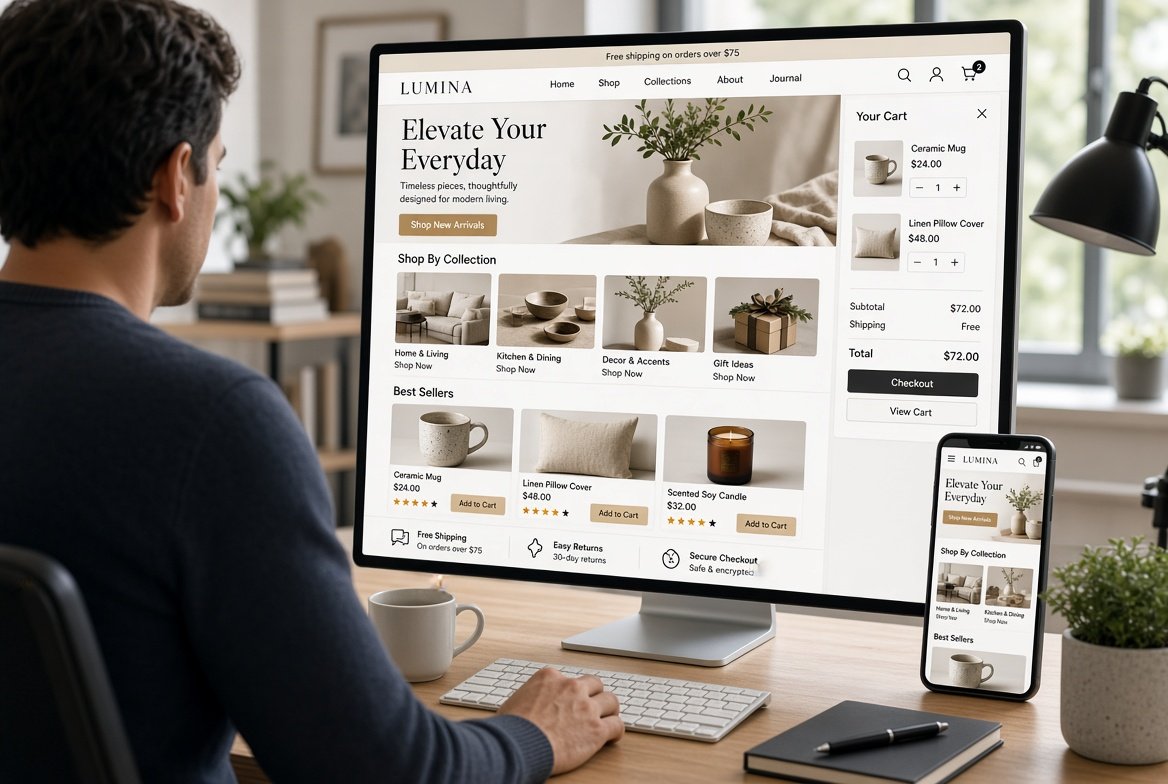
 Shopify Website Design for Online Stores
Shopify Website Design helps businesses create attractive, user friendly, mobile responsive online stores that make it easier for customers to discover products and complete purchases. A strong Shopify store design combines visual branding, simple navigation, clear product presentation, fast performance, and conversion focused layouts to create a better shopping experience.
A successful online store needs more than attractive colors and product images. Customers should immediately understand what the business sells, find relevant products quickly, compare options easily, and complete checkout without unnecessary friction. Shopify provides the platform, while effective website design turns that platform into a store that supports real business goals.
Shopify Website Design is the process of planning and creating the visual structure, layout, user experience, and customer journey of a Shopify ecommerce store.
It includes more than choosing a theme. Professional Shopify website design considers how every major page works together, from the homepage and navigation to collection pages, product pages, cart, checkout, and supporting content.
A Shopify website design project may include:
The objective is to create a store that looks professional while making shopping simple for visitors.
Your website is often the first major interaction a customer has with your ecommerce brand. If the website looks outdated, confusing, slow, or difficult to use, visitors may leave before exploring your products.
Good design can help communicate trust and make the buying process easier.
Visitors form an opinion about an online store very quickly.
A professional homepage should clearly communicate:
Instead of filling the homepage with unnecessary information, focus on the messages that matter most to potential customers.
Good Shopify store design helps customers move through the website naturally.
For example, a customer may arrive on the homepage, browse a collection, open a product, read the details, add the item to the cart, and complete checkout.
Every stage should feel connected.
Trust is particularly important for ecommerce businesses because customers are purchasing products without visiting a physical store.
Professional design can support trust through:
Design directly influences how customers interact with products and calls to action.
A clear product page can make it easier for visitors to understand the product and decide whether to purchase it.
The objective is not to make every page look complicated. Instead, the design should remove distractions and make important information easy to find.
A complete Shopify website design project can include several different design services depending on the store’s requirements.
The homepage introduces your brand and directs customers toward important areas of your store.
A strong homepage can include:
The homepage should not try to display every product. Instead, it should guide visitors toward the most important parts of the store.
Product pages are among the most important pages in an ecommerce store.
Customers need enough information to make an informed decision.
A strong product page can include:
The layout should prioritize the information that helps customers decide whether the product is right for them.
Collection pages organize products into useful categories.
For example, a fashion store may have collections for:
A collection page should make it easy to browse products, use filters, sort products, and open individual product pages.
Navigation plays an important role in ecommerce usability.
Customers should be able to reach important categories without having to search through multiple pages.
A Shopify store can use:
The best navigation structure depends on the number of products and how customers search for them.
Shopify ecommerce website design should focus on the entire shopping experience rather than individual pages.
A customer does not experience your homepage separately from your product pages. They move between different parts of the website as they research and purchase products.
That means design consistency matters.
Your fonts, colors, buttons, images, spacing, and brand elements should feel consistent throughout the store.
A recognizable visual identity can help customers remember your business.
Brand consistency can include:
The design should reflect the personality of the business while remaining easy to use.
Customers should understand what they can do next.
Common ecommerce calls to action include:
Buttons should be visible and positioned where customers naturally expect them.
Product images are critical to ecommerce design because customers cannot physically examine products through a screen.
Use clear, high quality images that show the product from useful angles.
Where appropriate, include:
Good photography can make a product page much more persuasive.
A Shopify store must work properly on mobile devices.
Customers may browse products from smartphones while commuting, relaxing at home, or comparing products in a physical store.
Responsive design ensures that the website adapts to different screen sizes.
Mobile menus should be simple and easy to use.
Important categories should not be hidden behind confusing navigation structures.
Product images, descriptions, variants, pricing, and purchase buttons should be easy to view without excessive scrolling or zooming.
The checkout experience should also be easy to complete on smaller screens.
Forms should be clear, buttons should be accessible, and unnecessary steps should be minimized.
Beautiful design does not automatically produce sales.
A Shopify store should be designed around customer actions.
Conversion rate optimization focuses on improving the percentage of visitors who complete a desired action, such as purchasing a product, submitting a form, or joining an email list.
Important design elements include:
Testing different page layouts can also reveal which design elements work best for a specific audience.
Website design and search engine optimization should work together.
A visually attractive store can still struggle in organic search if its structure makes it difficult for search engines to understand the website.
SEO should therefore be considered during the design process.
PulseDigitall provides search engine optimization services for businesses that want to improve their organic search visibility.
A Shopify store should have a logical hierarchy.
For example:
Homepage → Collection → Product
Supporting content can then connect to relevant collections and products.
This structure helps users and search engines understand the relationship between different pages.
Keyword research helps identify how potential customers search for products.
For ecommerce websites, keywords can target:
Businesses can use keyword research services to identify relevant opportunities before designing content and page structures.
Product pages can target specific commercial keywords.
Important SEO elements include:
The content should remain natural and useful rather than repeating keywords unnecessarily.
Collection pages can target broader search terms than individual products.
For example, a store selling furniture might create a collection targeting bedroom furniture while individual products target specific furniture names.
This allows different pages to serve different search intents.
Design decisions can affect SEO.
Page structure, headings, content placement, internal links, image optimization, and mobile usability should all be considered.
PulseDigitall also provides on page SEO services for businesses that need page level optimization.
Ecommerce stores can contain many URLs, products, collections, filters, and parameters.
A good design and development process should consider:
Technical SEO can become especially important as a Shopify store grows.
Internal linking connects related pages within the same website.
For Shopify stores, internal links can connect:
For example, a blog about choosing running shoes could link naturally to the store’s running shoe collection.
A thoughtful internal linking structure can help customers discover more products while supporting search engine understanding.
A visually impressive store can become frustrating if it loads slowly.
Large images, excessive animations, unnecessary applications, heavy scripts, and poorly optimized theme elements can affect performance.
Good Shopify website design should balance visual quality with speed.
Images should be appropriately sized and compressed before being uploaded.
Avoid using extremely large images when a smaller file can provide the same visual quality.
Every design element should have a purpose.
If an animation, application, popup, or script does not contribute to the customer experience or business objective, consider whether it is necessary.
Applications can add useful functionality, but too many unnecessary applications can increase complexity.
Review installed applications regularly and remove those that are no longer needed.
Some businesses need more than a standard theme.
Shopify custom website design can provide greater control over the appearance and user experience of the store.
Custom design may be useful for businesses with:
However, customization should always serve a purpose.
A website does not become better simply because it contains more custom features.
For businesses that need broader ecommerce development, PulseDigitall also offers ecommerce development services.
Small businesses often need a website that looks professional without creating unnecessary complexity.
A focused Shopify store may only need:
The design should prioritize the products and make it easy for visitors to purchase.
Small businesses can also combine Shopify design with SEO for small businesses to build organic visibility.
Fashion ecommerce websites rely heavily on visual presentation.
Design should make it easy for customers to explore products by:
High quality lifestyle photography can also help customers understand how products look when worn.
Product filters should be simple enough to use on mobile devices.
Beauty stores often need detailed product information.
Customers may want to know:
The design should allow this information to be displayed clearly without making the page overwhelming.
Electronics stores usually require more detailed specifications.
Customers may compare:
A well designed comparison and filtering experience can help customers make decisions faster.
Home and lifestyle stores can benefit from visual merchandising.
Products can be organized into rooms, styles, collections, or use cases.
Lifestyle photography can show how products fit into real environments, helping customers visualize their purchase.
Landing pages are useful for campaigns, promotions, product launches, and paid advertising.
A dedicated landing page can focus on one offer or customer action rather than sending visitors to a general homepage.
An effective ecommerce landing page can include:
Landing pages can also be connected with paid advertising campaigns.
PulseDigitall provides landing page development services that can support campaign focused ecommerce experiences.
Paid advertising can bring targeted visitors to Shopify stores, but the landing experience matters.
If an advertisement promotes a particular product, sending visitors to a relevant product or collection page is usually more useful than sending everyone to the homepage.
Google Ads can support ecommerce businesses through search advertising, display campaigns, shopping campaigns, and other formats.
PulseDigitall provides Google Ads services for businesses that want to combine paid traffic with ecommerce growth.
Google Shopping can help customers discover products through visual search results.
Product information such as images, titles, prices, availability, and other feed information can influence how products appear.
PulseDigitall also provides Google Shopping Ads for ecommerce businesses.
Content can support ecommerce growth by answering questions customers have before making a purchase.
For example, a furniture store could publish articles about:
These articles can attract informational search traffic and guide readers toward relevant products.
Businesses that need ongoing ecommerce content can explore content writing services.
A professional Shopify design project should follow a clear process.
The first step is understanding the business, products, customers, competitors, brand identity, and goals.
Understanding the target customer helps determine how the store should communicate.
Consider customer needs, expectations, objections, buying behavior, and preferred devices.
The next stage is planning pages, categories, collections, navigation, product structures, and content.
Wireframes help establish page structure before detailed visual design begins.
They can show where important elements such as navigation, product information, images, and calls to action will appear.
Brand colors, typography, imagery, buttons, spacing, and other visual elements are introduced during the design stage.
The approved design is implemented within Shopify.
This may involve theme customization, custom sections, templates, applications, and other functionality.
Products, collections, images, descriptions, policies, and supporting content are added.
SEO elements are reviewed before launch.
This can include:
The store should be tested across mobile and desktop devices.
Important checks include:
After approval, the store can go live.
Performance should continue to be monitored after launch so the design can be improved using real customer behavior and business data.
A homepage should guide visitors rather than overwhelm them.
Too many banners, popups, animations, and promotional messages can make the experience confusing.
Low quality images can reduce customer confidence.
Use clear and relevant product photography.
Customers should not struggle to locate important categories.
Keep menus organized and predictable.
A website that looks good on desktop but feels difficult to use on mobile can lose customers.
Always design and test for smaller screens.
Popups can be useful, but excessive interruptions can frustrate visitors.
Use them carefully and make sure they provide genuine value.
Unexpected shipping costs can cause customers to abandon their carts.
Make important delivery information easy to find.
If visitors cannot understand what to do next, the design is creating unnecessary friction.
Use clear and relevant calls to action.
Design and SEO should not be treated as completely separate processes.
A beautiful store still needs a structure that search engines can understand.
The cost of Shopify website design varies depending on the project.
A simple store using an existing theme will generally require less design work than a custom ecommerce website with unique layouts and advanced functionality.
Factors that influence cost include:
Businesses should evaluate design based on usability, quality, performance, scalability, and expected business value rather than choosing an option based only on the lowest price.
Website design and website development are connected but different.
Shopify Website Design focuses mainly on:
Shopify Website Development focuses more on:
A successful Shopify project often requires both design and development.
PulseDigitall also provides Shopify website development for businesses that need a complete ecommerce solution.
A professional Shopify store should feel consistent, clear, trustworthy, and easy to use.
Focus on:
Every element should contribute to the customer’s journey.
Shopify Website Design is the process of creating the visual appearance, layout, structure, and user experience of a Shopify ecommerce store.
Yes. Shopify provides themes, customization options, ecommerce functionality, and tools that allow businesses to create professional online stores.
Yes. Shopify themes can be customized, and businesses can also use custom sections and development for more specialized requirements.
Absolutely. Many ecommerce visitors use smartphones, so responsive mobile design is essential for usability and conversions.
Yes. Website structure, mobile usability, page speed, navigation, content organization, internal links, and other design related factors can influence search engine optimization.
The homepage creates an important first impression and guides visitors toward products and collections. It should clearly communicate the brand and provide useful paths to continue shopping.
Product pages are extremely important because they provide the information customers use to decide whether to purchase. Strong images, descriptions, reviews, pricing, variants, and calls to action can improve the shopping experience.
Yes. Clear navigation, strong product presentation, trust signals, mobile usability, and simple purchasing journeys can help reduce friction and support better conversion rates.
An existing theme can be suitable for many businesses, while custom design can be useful when a brand needs unique layouts, functionality, or customer experiences.
Start by reviewing your homepage, navigation, product pages, mobile experience, calls to action, product images, page speed, and checkout process. Customer behavior and conversion data can then guide further improvements.
Shopify Website Design is about creating an online shopping experience that looks professional and works effectively for both customers and the business. The best stores combine strong branding with simple navigation, clear product presentation, mobile responsiveness, fast performance, and conversion focused layouts.
A successful Shopify store should make every important action easy. Customers should be able to discover products, understand their benefits, compare options, trust the business, and complete purchases without unnecessary obstacles.
When Shopify design is combined with strong development, search engine optimization, content, and digital marketing, the website can become a long term growth channel rather than simply an online product catalog.