
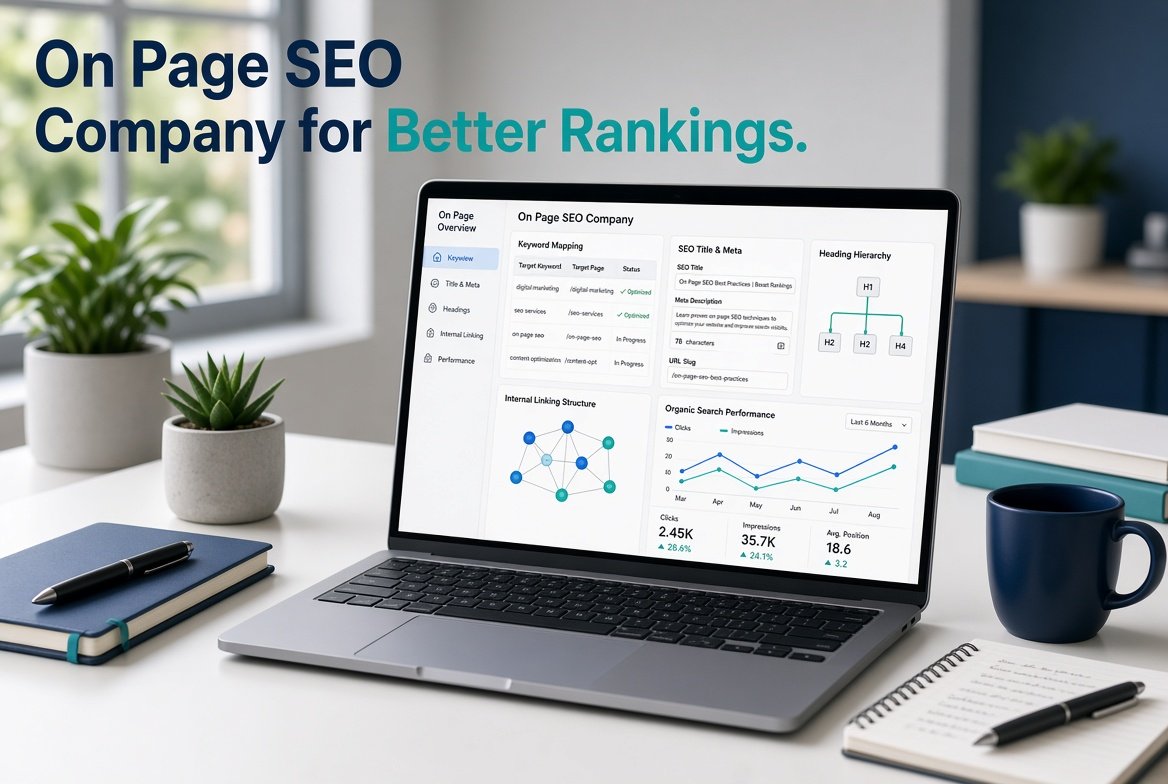
 On Page SEO Company for Better Rankings
An on page SEO company helps businesses improve search engine rankings by optimizing website content, page structure, metadata, internal links, and technical on page elements. Effective on page SEO makes it easier for search engines to understand your website and helps visitors find relevant information, navigate your pages, and take action. Whether you manage a local business, an ecommerce store, or a growing service company, a structured on page SEO strategy can improve organic visibility and attract more qualified traffic.
Choosing the right on page SEO company means working with specialists who understand search intent, keyword placement, content quality, and user experience. Instead of focusing only on rankings, a reliable SEO partner improves the elements that help turn search visibility into meaningful business results.
An on page SEO company optimizes individual website pages so they better match relevant search queries and provide useful information to visitors. The process involves analyzing existing pages, identifying optimization opportunities, and improving the content and HTML elements that influence how search engines interpret each page.
On page SEO is not simply about adding keywords to paragraphs. It requires a clear understanding of what users want to find, how competing pages satisfy that need, and how your website can provide a more useful experience.
A professional company may provide the following services:
These activities help establish a stronger foundation for organic search performance.
A website can offer excellent products or services and still struggle to attract organic traffic if its pages are poorly optimized. Unclear headings, irrelevant keywords, weak page content, and confusing navigation can make it harder for search engines and potential customers to understand what a business offers.
An experienced on page SEO company identifies these issues and develops an actionable optimization plan.
Search engines use page content and other signals to understand the subject and relevance of a webpage. Optimizing titles, headings, content, and internal links can help search engines interpret your pages more accurately.
The objective is to improve the relevance and usefulness of your website for the searches that matter to your business.
Not all website traffic has the same value. Ranking for unrelated searches may increase visits without generating leads or sales.
A focused on page SEO strategy aligns each page with relevant search intent. This helps attract people who are actively looking for your products, services, or expertise.
Visitors should quickly understand what a page offers and where to find the information they need. Clear headings, descriptive links, readable content, and logical page organization make websites easier to use.
A better user experience can support engagement and conversions, although it does not guarantee higher rankings on its own.
Internal links help visitors discover related content and help search engines find important pages. An effective linking structure connects service pages, supporting articles, category pages, and other relevant resources.
Businesses can strengthen this structure through thoughtful on page SEO optimization that supports both usability and search visibility.
Every website has different optimization needs. A new website may require foundational keyword mapping and page structure improvements, while an established website may need content updates, internal linking improvements, or solutions to overlapping pages.
Our approach focuses on identifying the changes most relevant to your website and business objectives.
An on page SEO audit evaluates the elements that influence how individual pages are understood, discovered, and used.
The audit may examine:
After reviewing these elements, an SEO specialist prioritizes the findings according to their potential impact, implementation effort, and relevance to business goals.
The result is an actionable plan rather than a list of technical observations without clear next steps.
Keyword research helps identify the search terms potential customers use when looking for information, products, and services.
However, selecting keywords based only on search volume can lead to poor results. Search intent, competition, relevance, and the purpose of each page also matter.
Our process considers:
A clear keyword map assigns relevant search topics to appropriate pages. This reduces unnecessary overlap and helps each page serve a distinct purpose.
Our keyword research services support this process by identifying opportunities that align with your target audience and business priorities.
SEO titles and meta descriptions help communicate the purpose of a webpage in search results. A clear, relevant title can help search engines and users understand what a page covers, while a compelling meta description may encourage qualified users to visit.
Our optimization process focuses on:
Google may generate a different title link or snippet depending on the query and page content. Therefore, optimized metadata improves clarity and relevance but does not guarantee that the exact text will appear in every search result.
Headings make website content easier to scan and help establish a clear information hierarchy. A well-organized page introduces its main subject and then develops supporting topics in a logical order.
Our on page SEO specialists review heading structures to ensure that:
The goal is not to insert a keyword into every heading. Instead, each heading should help readers understand the page and find useful information quickly.
High quality content answers the questions users bring to a page. It explains relevant concepts, communicates expertise, addresses common concerns, and helps visitors decide what to do next.
A professional on page SEO company reviews content for relevance, clarity, completeness, and alignment with search intent.
Content optimization may include:
When new content is needed, our SEO content writing services can help develop useful pages that support organic search goals.
Internal links connect pages within the same website. They help visitors explore related information and provide search engines with pathways to discover other pages.
An effective internal linking strategy considers the relationship between topics, the importance of destination pages, and the context in which a link appears.
Our internal linking work may involve:
Links should be useful and relevant rather than added simply to increase the number of links on a page.
Images can support user understanding, improve visual presentation, and communicate information that text alone may not explain effectively. However, poorly optimized images can create accessibility and performance problems.
Image optimization may include:
Alt text should describe an image’s purpose or meaningful content. It should not be used as a place to repeat a list of keywords.
Descriptive URLs help users understand the subject of a page before opening it. A clear site structure also makes it easier to navigate between related sections.
Our specialists review URLs and page organization for unnecessary complexity, inconsistent naming, and confusing hierarchy.
Where URL changes are necessary, they should be planned carefully. Relevant redirects, internal links, canonical signals, and sitemap references may need to be updated to reduce disruption.
Not every existing URL needs to change. When a current URL is clear and functioning well, preserving it may be the better option.
Local businesses need pages that clearly communicate their services and the areas they serve. A location page should provide useful, specific information instead of simply replacing a city name in a repeated template.
Local on page optimization may include:
Our local SEO services can support businesses seeking greater visibility in geographically relevant searches.
Each location page should offer genuine value to users in that area. Publishing many near-identical pages can create a poor experience and may not provide meaningful search benefits.
A reliable process helps businesses understand what will be reviewed, which changes are recommended, and how progress will be measured.
We begin by learning about your services, products, target audience, competitive environment, and desired outcomes.
This helps determine which pages are most important and which search opportunities are relevant to the business.
We assess important landing pages and identify optimization gaps. Depending on the project, the review may include website crawling data, search performance, keyword rankings, analytics, and manual content evaluation.
We assign suitable primary and secondary keywords to relevant pages based on search intent and business value.
This creates a clear direction for content improvements and helps identify pages that compete for similar searches.
Not all SEO issues have equal importance. We organize recommendations according to factors such as business impact, page importance, implementation complexity, and available resources.
High priority changes are addressed first where practical.
Depending on the agreed scope, our team may implement changes directly or provide clear recommendations for your developers and content team.
Changes may include metadata, headings, copy, internal links, image alt text, and other relevant page elements.
After implementation, we review available performance data to evaluate changes in organic impressions, clicks, rankings, landing page traffic, and conversions.
SEO results depend on many factors, including competition, website history, technical health, content quality, and search engine updates. Meaningful evaluation therefore requires consistent monitoring rather than relying on a single ranking report.
Choosing an SEO partner is an important business decision. A company should explain its process clearly, demonstrate relevant experience, and connect its work to your website’s goals.
Consider these factors before making a decision.
The provider should explain which pages need attention, why the changes matter, and how recommendations will be prioritized.
Be cautious of vague promises that do not explain the work involved.
Look for experience with websites similar to yours in terms of business model, content requirements, website size, or competitive environment.
A company that understands ecommerce category pages may approach optimization differently from one working primarily with local service businesses.
Before starting, clarify what the engagement includes. This may cover an audit, keyword mapping, content recommendations, metadata updates, internal linking, implementation, or reporting.
Clear deliverables help prevent misunderstandings and make progress easier to evaluate.
Reports should explain completed work, key observations, performance changes, and the next recommended actions.
Useful reporting focuses on business relevant outcomes instead of presenting large volumes of data without interpretation.
No ethical SEO company can guarantee a specific Google ranking or an exact timeline for results.
A trustworthy provider explains what can be controlled, what depends on external factors, and how progress will be assessed.
On page SEO focuses on improving individual website pages and their relationships within the website. A broader SEO campaign may also include technical SEO, digital PR, link acquisition, local search optimization, and other activities.
| Area | Primary focus |
|---|---|
| On page SEO | Content, titles, headings, internal links, and page relevance |
| Technical SEO | Crawling, indexing, website architecture, and technical accessibility |
| Off page SEO | External authority signals, relevant backlinks, and digital PR |
| Local SEO | Visibility for geographically relevant searches |
| Content strategy | Planning useful content around audience needs and search demand |
These areas often complement one another. For example, a page may have excellent content but struggle because search engines cannot access it properly. Another page may be technically sound but fail to satisfy the user’s search intent.
A balanced strategy identifies the actual problem instead of applying the same solution to every website.
On page SEO can support businesses across a wide range of industries, provided their potential customers use search engines to discover relevant information or services.
Service providers can improve important service pages, explain their offerings more clearly, and make contact information easier to find.
Online stores can improve category descriptions, product page content, titles, internal navigation, image information, and the overall shopping experience.
Business to business companies can organize service pages around buyer needs, explain complex solutions, and connect educational content with commercial landing pages.
Software companies can optimize product pages, feature pages, use case content, and educational resources to address different stages of the buying journey.
Larger websites may benefit from resolving keyword overlap, refreshing older content, improving internal links, and prioritizing important pages that receive impressions but attract limited clicks.
The appropriate approach depends on the website’s current performance, industry, resources, and business objectives.
Successful optimization should be evaluated using several indicators rather than one metric alone.
Relevant measurements may include:
Google Search Console helps evaluate search impressions, clicks, queries, and page performance. Analytics platforms can help connect website visits with meaningful actions, provided tracking is configured correctly.
Performance should be compared across appropriate time periods while considering seasonality, search demand, competition, and other changes that may influence results.
Even established websites can lose opportunities through preventable optimization mistakes.
Repeating a target keyword unnaturally can make content difficult to read. Use the primary keyword where it fits and cover related concepts naturally.
Using identical titles and descriptions across many pages can make it harder to distinguish their purpose. Important pages should have metadata that accurately reflects their unique content.
Creating many pages with almost identical information provides little value to visitors. Location pages should include relevant local details and genuinely useful service information.
A page targeting a commercial query should help users evaluate a product or service. A purely informational article may not meet the needs of someone ready to make a purchase.
Adding links without a clear purpose can clutter content and distract visitors. Internal links should help people discover relevant information.
Higher rankings are useful when they attract the right audience, but rankings alone do not explain business performance. Leads, sales, and qualified enquiries are also important where applicable.
Updating pages without recording the changes or reviewing subsequent performance makes it harder to understand what worked. A documented process supports better decisions over time.
PulseDigitall helps businesses build a stronger organic search foundation through practical SEO strategies focused on page relevance, content quality, and website usability.
Our approach connects on page optimization with broader search engine optimization objectives, allowing businesses to improve important landing pages while maintaining a consistent website structure.
We focus on:
Whether you need help with a few important landing pages or a larger website optimization project, the first step is understanding your current website and identifying the improvements that offer the greatest potential value.
An on page SEO company helps businesses optimize website pages by improving content, keyword targeting, metadata, headings, internal links, images, and other relevant page elements. The goal is to make pages more useful to visitors and easier for search engines to understand.
Pricing varies according to website size, the number of pages, the complexity of the project, the level of implementation required, and whether ongoing support is included. A website audit and clear project scope help establish a suitable budget.
The timeline varies. Some changes may be reflected in search data relatively quickly, while meaningful ranking and traffic improvements can take longer. Competition, crawling, indexing, website history, and the quality of implementation all influence results.
On page SEO can improve a page’s relevance and help search engines understand its content. However, rankings depend on multiple factors, so no company can guarantee a particular position for every keyword.
It may be sufficient for some queries and websites, but competitive search terms can require improvements to technical SEO, content depth, site authority, and other areas. An audit helps determine which activities are most relevant.
An audit may review titles, meta descriptions, heading structures, content quality, keyword targeting, internal links, image optimization, URL structure, and search intent. Broader technical checks may also be recommended when they affect page accessibility or performance.
Yes. Existing content can be reviewed for relevance, clarity, outdated information, keyword targeting, heading structure, internal links, and opportunities to better answer user questions.
Yes. Optimizing service pages, location information, page content, and internal links can help local businesses communicate their relevance to geographically focused searches. Results also depend on other local search factors.
Your website should clearly communicate what your business offers and help potential customers find the information they need. A structured on page SEO strategy can address content gaps, improve page organization, and strengthen your website’s foundation for organic search growth.
PulseDigitall can help you identify opportunities, prioritize improvements, and build a practical optimization plan around your business goals.
Ready to improve your website’s search performance? Explore our SEO services or contact PulseDigitall to discuss your website’s on page SEO requirements.