
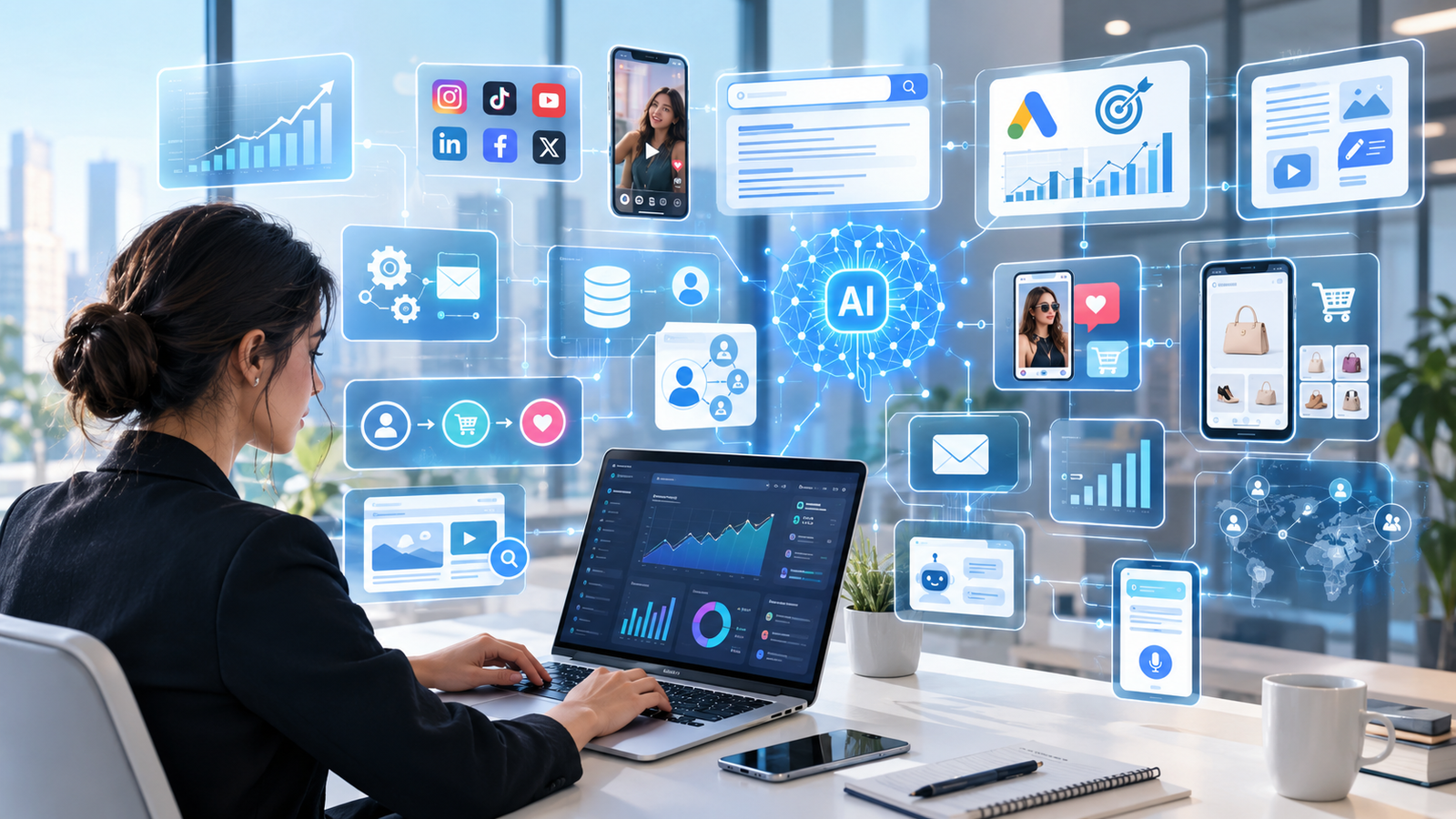
Digital marketing trends in 2026 are being shaped by artificial intelligence, AI powered search, personalized customer experiences, short form video, social commerce, first party data, automation, and privacy focused marketing. The biggest shift is that digital marketing is moving from separate channels toward connected customer journeys where search, social media, content, advertising, email, websites, and data work together. Businesses that want sustainable growth need a flexible digital marketing strategy that combines useful content, accurate data, human creativity, automation, and measurable customer outcomes.
The most important digital marketing trends in 2026 include:
AI adoption has moved beyond experimentation into everyday marketing workflows. Experian reports that 94% of marketers are investing broadly in AI, while first party data activation is becoming a foundational capability.
At the same time, HubSpot’s 2026 marketing research identifies AI powered personalization, automation, brand aligned content, adapting SEO to search changes, and content repurposing among the major trends marketers are working on.
These changes do not mean that traditional marketing channels are disappearing. Search engines, websites, email, social media, paid advertising, and content remain important. What is changing is how these channels work together.
Artificial intelligence is one of the most important digital marketing trends of 2026.
AI is now being used for research, content planning, customer segmentation, advertising optimization, personalization, reporting, creative development, predictive analysis, and automation.
Instead of treating AI as a separate marketing activity, businesses are increasingly using it across the entire customer journey.
AI can help marketers:
However, AI does not remove the need for human strategy.
The quality of the information given to AI strongly affects the quality of the output. Experian’s 2026 digital trends research emphasizes the relationship between AI performance and high quality, trustworthy data.
The strongest approach is therefore human led marketing supported by AI rather than completely automated marketing.
One of the biggest changes in online marketing is the movement from traditional search toward conversational and AI assisted discovery.
People can now ask longer, more specific questions and receive synthesized answers rather than simply scanning a traditional list of links.
This creates new opportunities for businesses to become visible when potential customers are researching products, services, companies, and solutions.
Traditional search marketing often focused heavily on keywords.
Modern search requires a broader understanding of:
HubSpot’s 2026 marketing research reports that adapting SEO to search changes is a major priority for marketers, with many organizations also developing answer engine optimization strategies.
This means businesses should connect their SEO strategy with their broader digital marketing strategy.
Answer Engine Optimization, commonly called AEO, focuses on making information easier for answer engines and AI systems to understand, retrieve, and present.
AEO does not replace SEO.
Instead, it expands the search optimization process.
A modern content strategy should consider:
Businesses can improve their content by:
The goal should not be to write only for AI systems. Content should remain useful for people first.
Customers increasingly expect brands to understand their needs.
Generic marketing messages can still have a place, but personalization allows businesses to deliver more relevant experiences based on customer behavior, interests, previous interactions, location, and stage in the buying journey.
Personalization can include:
AI can make personalization easier to manage at scale.
However, personalization needs responsible data practices. Businesses should make sure customer information is collected and used appropriately.
First party data is information a business collects directly from its customers and website visitors.
Examples include:
First party data is increasingly important because marketers need reliable information they can use across their own marketing systems.
Experian identifies first party data activation as one of the foundational capabilities shaping marketing in 2026.
A business can encourage customers to voluntarily provide information through:
The important point is to provide a clear reason for customers to share information.
Short form video remains an important part of the digital marketing landscape.
Platforms such as Instagram, TikTok, YouTube, and other social networks have made short videos a major format for awareness, education, product discovery, and engagement.
HubSpot’s 2026 social media research identifies short form video as the leading format in both usage and investment among marketers.
Successful short form videos often:
Businesses should not create videos simply because video is trending.
The content should have a clear purpose.
For example, a local service company could create videos explaining common customer problems, showing the service process, answering pricing questions, or demonstrating completed work.
Social media is increasingly becoming more than an awareness channel.
Customers can discover products, research brands, communicate with businesses, and sometimes complete purchases without leaving a social platform.
HubSpot’s 2026 social media research reports that 69% of marketers surveyed expect more shopping to happen directly on social platforms than on brand websites or third party marketplaces.
This makes social commerce an important part of modern online marketing.
Businesses can combine:
For service businesses, social commerce can also mean converting interest into consultations, calls, messages, or bookings rather than direct product purchases.
Influencer marketing continues to evolve.
Large celebrity accounts are not the only option for brands. Smaller creators with specific communities can provide highly relevant audiences.
The emphasis is increasingly moving toward authentic content, expertise, trust, and audience relevance.
Gartner’s 2026 marketing predictions highlight authenticity as an important consideration as AI generated media becomes more common.
Instead of focusing only on follower numbers, businesses can evaluate:
A creator with a smaller but highly relevant audience may provide useful exposure for a specialized product or service.
Content remains a major part of digital marketing.
However, publishing large volumes of generic content is becoming less useful.
The focus is moving toward content that demonstrates:
One strong piece of content can become multiple marketing assets.
For example:
One blog article can become:
This makes content writing services more strategic than simply producing individual articles.
Customers rarely follow a perfectly linear journey.
Someone might:
This is why businesses need connected marketing systems.
An omnichannel strategy connects multiple marketing channels around the same customer journey.
These may include:
The goal is not simply to be present everywhere.
The goal is to make each channel support the next stage of the customer journey.
Businesses increasingly want marketing activities to connect with measurable outcomes.
This means marketers need to understand the difference between:
A campaign can generate large amounts of traffic without producing meaningful business results.
Depending on the business model, important metrics can include:
This is where a properly structured Google Ads strategy can work alongside SEO, social media, and conversion optimization.
Automation allows businesses to complete repetitive tasks without manually managing every interaction.
Examples include:
AI is also making automation more adaptive.
Gartner expects AI agents to play a growing role in customer interactions and marketing operations, including personalized guidance and automated customer engagement.
Automation works best when it handles repetitive processes while humans remain responsible for important conversations and decisions.
Customers should still be able to reach a real person when they need help.
Customers increasingly want immediate answers.
Instead of filling out a long form and waiting several days, they may prefer:
Conversational marketing allows businesses to meet customers where they already communicate.
For many service businesses, a conversation can also become the first stage of the sales process.
People are becoming more comfortable asking complete questions instead of typing short keywords.
For example:
Traditional search:
best dentist Dubai
Conversational search:
Which dentist near me offers emergency dental treatment and accepts appointments today?
This means businesses need content that answers natural language questions.
Focus on:
Conversational search should therefore be considered alongside traditional keyword research.
Local marketing is no longer only about ranking for a city keyword.
Customers may discover a business through:
For businesses serving specific geographic areas, accurate business information remains essential.
A strong Local SEO strategy can help businesses improve their visibility across local discovery experiences.
Businesses should maintain:
A properly optimized Google Business Profile should be part of the local marketing system.
Consumers and regulators continue to place greater attention on how personal information is collected and used.
This makes privacy an important part of the digital marketing future.
Businesses need to understand:
Privacy should not be treated only as a legal issue.
It is also becoming part of customer trust.
A website is still one of the most important assets in digital marketing.
Even when customers discover a brand through social media, AI search, or advertising, they may eventually visit the website before making a decision.
A modern website should be:
A strong responsive website helps businesses provide a consistent experience across devices.
Instead of focusing only on company descriptions, websites should explain:
Search is becoming increasingly visual.
Customers can use images, videos, screenshots, voice, and text together to discover information.
This creates opportunities for businesses to optimize more than written webpages.
Businesses should treat images and video as search and discovery assets rather than decorative additions.
Reviews influence customer confidence, particularly when someone is comparing several businesses.
Reviews can support:
Businesses should encourage genuine feedback and respond professionally to customer reviews.
The goal should be genuine customer experiences rather than manufactured testimonials.
Digital marketing has historically focused heavily on reach.
Now businesses are increasingly interested in building communities.
A community can exist through:
A strong community can help a business generate repeat engagement without relying entirely on paid advertising.
Customers interact with businesses across multiple platforms.
Someone may see a social media post, search the brand later, click an advertisement, return through organic search, and then purchase directly.
This creates attribution challenges.
Last click attribution gives credit to the final measurable interaction.
But earlier marketing activities may have influenced the customer.
A stronger measurement approach can consider:
The objective is to understand the customer journey rather than give every result to a single channel.
AI makes content production faster, but speed does not automatically create quality.
Businesses should review AI assisted content for:
The future of digital marketing is unlikely to be simply human versus AI.
Instead, businesses are increasingly combining human judgment with AI assisted execution.
Advertising platforms are increasingly using machine learning to automate targeting, bidding, placements, and creative combinations.
This changes the marketer’s role.
Instead of manually controlling every campaign setting, marketers increasingly need to focus on:
Automation works best when the underlying conversion data is accurate.
People increasingly use social platforms to discover:
HubSpot’s 2026 social research describes social media as increasingly combining discovery, search, shopping, and customer service.
This means brands should think about social content as searchable content.
Businesses can improve discoverability by using:
The future of digital marketing is not about choosing SEO instead of social media or Google Ads instead of content.
The strongest systems connect multiple channels.
For example:
SEO → Content → Social → Email → Retargeting → Conversion → CRM → Repeat Customer
Each stage can support the next.
This creates a marketing ecosystem rather than a collection of disconnected campaigns.
The digital marketing future will likely involve greater use of AI, automation, conversational interfaces, first party data, personalized experiences, creator content, social commerce, and connected measurement.
Gartner’s 2026 research highlights AI agents, authenticity, AI dependent marketing organizations, ambient technology, and changing AI shopping behavior as important areas to watch.
However, the future will not eliminate the fundamentals of marketing.
Customers will still need:
Technology changes how businesses reach customers. It does not remove the need to understand customers.
A modern digital marketing strategy should begin with business objectives rather than individual platforms.
Decide what the marketing system needs to accomplish.
Examples include:
Research:
Your website should clearly explain your products or services and provide an easy path toward conversion.
Combine traditional SEO with modern search optimization.
This includes:
A complete on page SEO strategy should support both users and search systems.
Create useful content and repurpose it across:
Paid advertising can help businesses reach customers while organic channels develop.
Depending on the business, this may include:
Give customers useful reasons to subscribe, contact, purchase, or create an account.
Use automation where it saves time without damaging the customer experience.
Track leads, sales, revenue, customer acquisition costs, and customer lifetime value rather than focusing only on clicks and impressions.
Digital marketing changes quickly.
Review performance regularly and adjust the strategy based on real customer and business data.
Some trends may develop faster than others. Businesses should therefore avoid changing their entire strategy every time a new platform or technology appears.
Instead, monitor developments in:
AI is likely to remain one of the most important forces shaping marketing operations, search, personalization, content, advertising, and customer service.
AI agents may increasingly perform tasks on behalf of users and businesses.
Search is becoming more conversational, visual, and distributed across traditional search engines, social platforms, and AI systems.
Social platforms are increasingly combining content, discovery, communication, and commerce.
Businesses need stronger systems for collecting and responsibly activating customer data.
As AI generated content becomes easier to produce, authentic expertise and recognizable brand identity can become increasingly valuable.
Even with access to advanced technology, businesses can still make basic marketing mistakes.
Producing more content does not automatically produce more customers.
Traffic is useful only when it supports meaningful business outcomes.
A successful advertisement cannot compensate for a confusing website or poor sales process.
Content needs to provide genuine value and address real customer needs.
Being everywhere is not always better.
Businesses should prioritize channels where their customers actually spend time.
Poor data can lead to poor personalization, inaccurate reporting, and inefficient automation.
Without reliable tracking, it becomes difficult to understand what is producing business results.
SEO remains a central part of digital marketing because search can connect customers with businesses when they are actively looking for information or solutions.
Modern SEO should work together with:
Businesses can also combine SEO with social media marketing to create more consistent visibility across search and social platforms.
For businesses that rely on organic discovery, off page SEO can also support authority and brand visibility when implemented naturally and responsibly.
The most important digital marketing trends can be summarized as follows:
| Trend | What It Means for Businesses |
|---|---|
| AI marketing | Automate and improve research, personalization, content and analysis |
| AI search | Optimize content for conversational and answer based discovery |
| AEO | Structure useful information for answer engines |
| First party data | Build direct customer relationships and responsible data assets |
| Short form video | Use video for discovery, education and engagement |
| Social commerce | Connect social discovery with purchasing |
| Creator marketing | Focus on relevance, authenticity and audience trust |
| Automation | Reduce repetitive marketing work |
| Personalization | Deliver more relevant customer experiences |
| Conversational marketing | Make customer communication faster and easier |
| Local marketing | Improve visibility for location based searches |
| Privacy focused marketing | Build trust through responsible data practices |
| Omnichannel marketing | Connect multiple customer touchpoints |
| Better measurement | Focus on revenue and customer outcomes |
| Human plus AI workflows | Combine automation with human strategy and judgment |
The major digital marketing trends in 2026 include artificial intelligence, AI search, personalization, first party data, short form video, social commerce, creator marketing, automation, conversational marketing, privacy focused marketing, and omnichannel customer experiences.
The future of digital marketing is expected to involve more AI assisted marketing, personalized customer experiences, automated workflows, conversational search, social commerce, first party data, and connected measurement. Human creativity, trust, strategy, and customer understanding will continue to remain important.
AI is automating many repetitive marketing tasks, but it does not eliminate the need for marketing strategy, customer understanding, creative judgment, brand positioning, data governance, and business decision making. Many businesses are using AI as a support system rather than treating it as a complete replacement for marketers.
AI is changing digital marketing by helping marketers analyze data, create content variations, personalize experiences, automate tasks, optimize campaigns, understand customer intent, and support customer interactions.
First party data gives businesses information collected directly through their own customer relationships and digital properties. It can support personalization, audience segmentation, customer retention, measurement, and marketing automation when collected and used responsibly.
Yes. Social media remains important for brand discovery, content distribution, community building, customer service, creator marketing, advertising, and social commerce. Its role is increasingly extending beyond audience engagement into search and purchasing.
Yes. SEO remains important, but search optimization is expanding beyond traditional keyword rankings. Businesses increasingly need to consider AI search, answer engines, conversational queries, local discovery, topical authority, useful content, and brand visibility.
An effective digital marketing strategy connects business objectives with customer needs and the right marketing channels. It can combine SEO, content, paid advertising, social media, email, automation, analytics, and conversion optimization based on the company’s goals and audience.
Small businesses can focus on a few high value areas instead of trying to use every trend. A practical starting point can include local SEO, useful content, social media, short form video, customer reviews, first party data, and targeted paid advertising.
Some marketing processes will become increasingly automated, but fully automated marketing still has limitations. Human oversight remains important for strategy, brand voice, customer relationships, ethical decisions, data governance, and quality control.
Digital marketing in 2026 is becoming more connected, intelligent, personalized, and data driven. Artificial intelligence is changing how marketers research, create, advertise, and communicate, while AI search and social discovery are changing how customers find businesses.
At the same time, the fundamentals remain important. Businesses still need useful content, trustworthy information, strong websites, clear offers, good customer experiences, and consistent communication.
The most practical approach is not to chase every new marketing trend. Instead, businesses should build a strong foundation and then use emerging technologies to improve how customers discover, understand, and interact with the brand.
If your business needs a structured strategy for SEO, paid advertising, content, social media, and modern search, start with a Get Free Strategy Session or Request Proposal.