
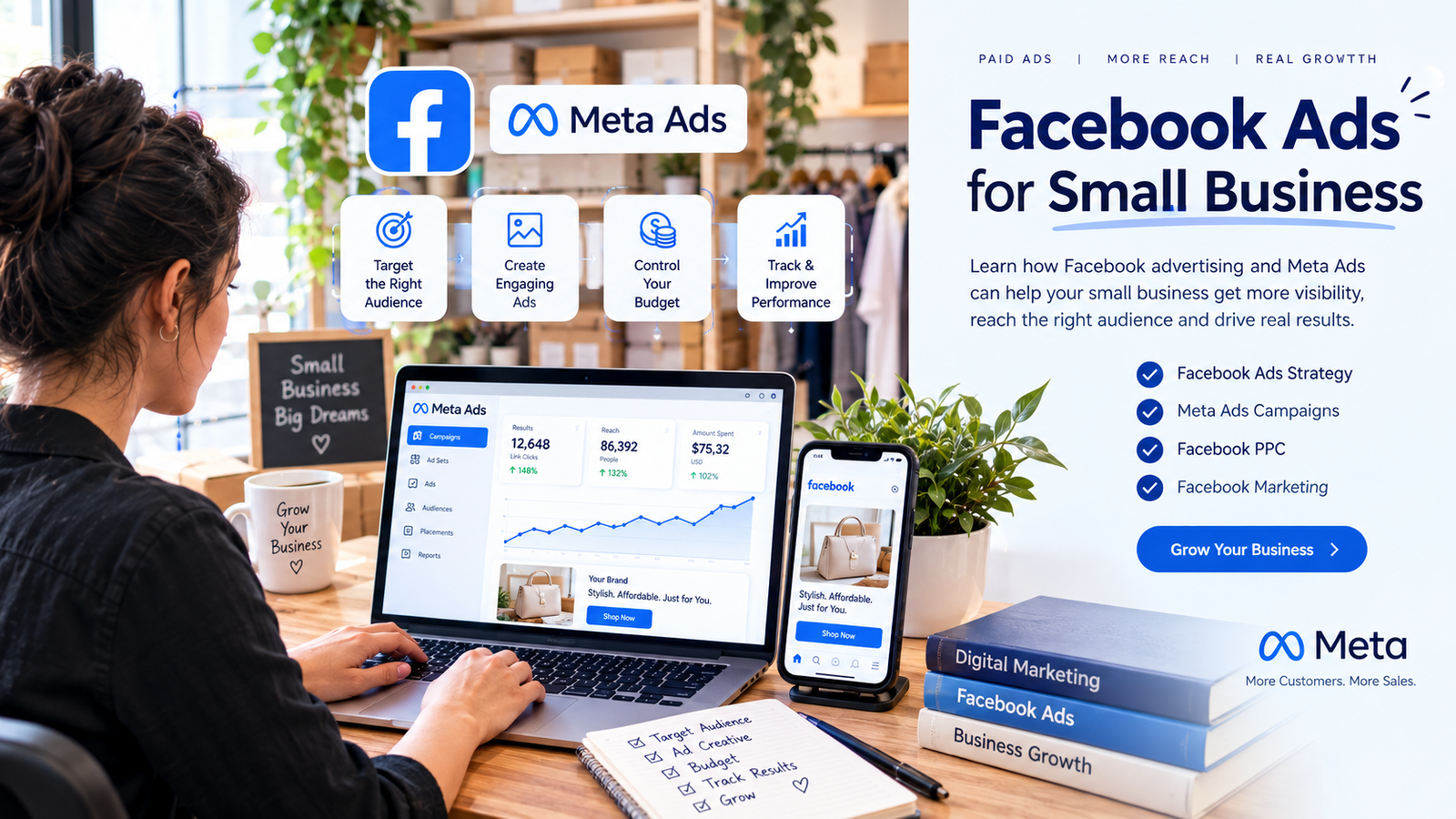
 Facebook Ads for Small Business: A Practical Guide to Facebook Advertising
Facebook Ads for small business can help local companies, service providers, ecommerce stores, startups, and professional businesses reach specific audiences without relying only on organic social media reach. An effective campaign starts with a clear business objective, a defined audience, strong creative, relevant messaging, accurate conversion tracking, and continuous optimization. The goal is not simply to get more clicks or likes. A well planned Facebook advertising strategy should generate measurable business outcomes such as qualified leads, purchases, bookings, inquiries, or website traffic.
Small businesses often assume that paid advertising requires a large budget. In reality, the more important question is whether the campaign is structured around the right audience, offer, creative, landing experience, and conversion goal. A smaller campaign with focused targeting and a strong offer can provide more useful information than a large campaign built around vague objectives.
This guide explains how small businesses can approach Facebook Ads, how Meta Ads fit into a broader marketing strategy, how to build a practical Facebook Ads strategy, what to measure, which mistakes to avoid, and how to connect Facebook advertising with SEO, websites, PPC, branding, and lead generation.
Facebook Ads are paid advertisements delivered through Meta’s advertising ecosystem. Small businesses can use paid social campaigns to promote products, services, content, events, offers, lead forms, websites, and other business objectives.
Depending on the campaign setup and available platform features, businesses may work with different advertising placements and formats across Meta platforms. Common creative formats include images, videos, carousels, Stories, Reels, and other mobile focused experiences.
The most useful way to think about Facebook advertising is as a customer acquisition system rather than a simple posting tool.
A typical journey may look like this:
Small businesses often compete with larger companies that have bigger marketing budgets. Facebook advertising gives businesses a way to put specific offers and messages in front of selected audience groups instead of waiting for people to discover the business organically.
Facebook Ads can support several objectives:
However, advertising does not automatically solve a weak offer, poor website, unclear messaging, or ineffective sales process. Paid traffic can increase exposure, but the rest of the customer journey still needs to work.
One of the biggest mistakes in small business advertising is launching a campaign before deciding what success means.
Ask one simple question:
What action should the customer take after seeing this advertisement?
The answer might be:
The campaign objective, advertisement, landing page, and measurement system should all support that action.
Awareness campaigns are designed to introduce a business or offer to relevant audiences. They can be useful for new businesses, new products, local brands, and businesses entering new markets.
Traffic focused campaigns can send users toward a website, landing page, article, or other destination. Traffic alone is not the same as business success, so businesses should also examine what visitors do after arriving.
Lead generation campaigns are designed to encourage potential customers to provide contact information or initiate a conversation. They can be useful for service businesses where a sale requires consultation or follow up.
Sales focused campaigns are designed around measurable purchase or conversion activity. Ecommerce businesses can use product focused creative, customer reviews, demonstrations, offers, and other conversion elements.
A strong Facebook Ads strategy begins with customer research. Instead of targeting everyone who might possibly need your product, identify the people most likely to value the offer.
Consider:
For a local dentist, the audience and message may revolve around location, convenience, services, trust, and appointment availability. For an ecommerce clothing company, the campaign may focus on product style, audience interests, seasonal collections, and shopping behavior.
Local businesses can use Facebook advertising to introduce their services to people in relevant geographic areas. A local campaign might promote a restaurant, dental practice, flooring company, home service provider, salon, real estate business, gym, clinic, or professional service.
Local advertising becomes more useful when the advertisement communicates the reason someone should choose the business.
Instead of a generic message such as “We provide quality services,” a local business could focus on a specific customer problem, service, location, benefit, or offer.
The landing page should reinforce the same local message and make it easy for the visitor to call, book, request a quote, or submit a form.
Facebook PPC is commonly used to describe paid social advertising where businesses spend money to reach audiences and generate desired actions. The exact pricing and delivery mechanics depend on campaign configuration, audience, competition, creative, objective, placement, and platform behavior.
The important point for small businesses is that the advertising budget should be connected to business economics.
For example, if a business earns a healthy profit from each new customer, it may be able to justify a higher customer acquisition cost than a business with a very small profit margin.
This means a campaign should not be judged only by its cost per click. A cheaper click is not necessarily more valuable if it produces no qualified leads or customers.
There is no universal Facebook Ads budget that works for every business.
A practical starting budget depends on:
A small business can start with a controlled test budget, collect useful performance data, and then decide whether the campaign should be adjusted or scaled.
The objective of the first stage should be learning as well as performance. You want to understand which audience, message, creative, and offer produce meaningful results.
An advertisement cannot compensate for an offer that customers do not understand.
A strong offer clearly communicates:
Depending on the business, an offer could be a free consultation, introductory service, product bundle, seasonal promotion, free estimate, product demonstration, downloadable guide, or appointment.
Small businesses often make advertisements too formal. Social media users are accustomed to conversational content, so advertising copy should communicate quickly and clearly.
A useful structure is:
For example, a home service business could begin by addressing a common household problem, explain how its service solves the issue, mention the service area, and invite the customer to request an estimate.
Creative is one of the most important components of a Facebook advertising campaign. The audience needs to understand the advertisement quickly, especially in mobile environments.
Useful creative formats include:
The creative should communicate one central idea rather than trying to explain everything about the business in one advertisement.
Video can demonstrate products, explain services, answer customer questions, show processes, and introduce people behind the business.
A simple short video structure can be:
Hook → Problem → Solution → Proof → Call to action
The opening should establish relevance quickly. For example, a cleaning company might begin with a common cleaning problem instead of starting with a long company introduction.
People often want evidence before contacting an unfamiliar business. Testimonials, reviews, customer stories, demonstrations, and case studies can reduce uncertainty.
Social proof works best when it is specific. Instead of a vague statement such as “Excellent service,” a detailed customer experience can explain what problem was solved and what the customer valued.
Businesses should obtain appropriate permission before using customer content in advertisements.
One of the most overlooked parts of Facebook advertising is the landing page. You can have strong targeting and creative, but a confusing landing page can still prevent conversions.
A campaign landing page should generally have:
If a campaign needs a dedicated conversion page, landing page development services can help create a focused destination for paid traffic.
Advertising can send users to your website, but the website has to convert that attention into action.
Important elements include navigation, page speed, mobile responsiveness, service information, product details, contact options, trust signals, forms, and checkout functionality.
Businesses that need a responsive customer experience can explore responsive website development.
For businesses using WordPress, WordPress development can support landing pages, service pages, content publishing, and other website requirements.
Meta Ads can use different audience approaches depending on campaign goals and available platform functionality. Businesses may work with geographic targeting, demographic information, interest based signals where available, custom audiences, website interactions, customer data where permitted, and other audience tools.
Targeting should be based on customer research rather than assumptions.
For example, a luxury wedding photographer may need a very different audience strategy from a local plumbing company. One may focus heavily on visual inspiration and life stage signals, while the other may depend more on location, urgency, and service need.
A common question is whether a small business should target a very narrow audience.
Narrow targeting can make sense when the product or service is highly specialized or geographically limited. Broader targeting can provide more room for the platform’s delivery system to find relevant users when the campaign has sufficient conversion signals and a clear offer.
The appropriate approach depends on the campaign, audience size, geography, objective, and available data. Testing can help determine which setup produces useful results.
Not every customer converts after the first interaction. Someone may visit your website, view a product, read a service page, watch a video, or interact with your social profile and then leave.
Retargeting can help businesses reconnect with eligible audiences who have already interacted with their brand.
For example, an ecommerce company could create a campaign for people who previously viewed products. A service business could create a follow up campaign for eligible website visitors.
Retargeting should remain relevant and should comply with platform rules, privacy requirements, and applicable laws.
Ecommerce businesses can use Facebook advertising to introduce products, highlight collections, demonstrate product benefits, promote seasonal offers, and reconnect with interested shoppers.
Strong ecommerce creative often answers questions before the customer asks them:
The store experience also matters. If the website has poor navigation or a difficult checkout process, increasing advertising spend may not solve the underlying issue.
Businesses that need ecommerce infrastructure can explore ecommerce development or Shopify website development.
Service businesses often need a different funnel from ecommerce companies. Instead of an immediate purchase, the desired action may be a phone call, quote request, consultation, appointment, or lead form submission.
A service campaign should therefore make the following information easy to understand:
For lead generation campaigns, the sales follow up process is just as important as the advertisement. A low cost lead has limited value if the lead is not contacted promptly or is not relevant to the service.
Local businesses can combine paid social with local SEO and Google Business Profile optimization to create a broader acquisition system.
For businesses that depend on local customers, local SEO services can complement social advertising by helping the business become more visible when customers search for relevant services.
A customer might discover a business through Facebook and later search for its name on Google. Another customer might search directly for the service and find the business through local search. Supporting both pathways can reduce dependence on a single channel.
Facebook marketing and SEO have different functions, but they can support the same content strategy.
A business can turn one customer question into multiple assets:
Businesses can use SEO services in the USA to support broader organic search visibility. Related services can include keyword research, on page SEO, off page SEO, content writing, and Google Business Profile optimization.
Facebook advertising creates demand and reaches audiences while they are browsing social content. Google PPC can capture people who actively search for products, services, brands, and solutions.
Consider a simple customer journey:
Attribution can be complicated because customers often interact with several channels before converting. This is why small businesses should avoid judging a channel entirely on one metric.
Businesses that want to combine paid social and search can explore PPC and Google Ads services, including search advertising, display advertising, and lead generation.
Clicks tell you that someone interacted with an advertisement. They do not necessarily tell you whether the campaign generated business value.
Depending on the business, meaningful conversions can include:
Conversion tracking should be configured carefully so that campaign decisions are based on useful information.
Reach indicates how many people were exposed to the advertisement or content according to the platform’s reporting.
Impressions represent the number of times advertisements or content were displayed.
Click through rate indicates how often people clicked after seeing an advertisement. It can provide insight into the relevance of creative and messaging.
Cost per click shows the average amount spent for a click under the relevant campaign measurement.
Cost per lead is particularly useful for service businesses and lead generation campaigns.
Conversion rate measures the percentage of relevant visitors or users who complete a desired action.
Customer acquisition cost connects marketing expenditure with the cost of acquiring customers.
ROAS compares advertising revenue with advertising expenditure. It can be useful for ecommerce and other businesses where revenue can be directly attributed to advertising activity.
A campaign can receive thousands of impressions and hundreds of clicks while generating very few customers.
That is why small businesses should connect campaign metrics with actual business outcomes.
For example:
1,000 clicks + 0 customers is a different business result from 200 clicks + 10 customers.
The second campaign may have received fewer clicks but generated more meaningful business activity.
Testing helps businesses learn which variables influence performance. You can test creative, hooks, headlines, offers, calls to action, landing pages, audience approaches, and other campaign elements.
Do not change every variable at the same time. If the audience, creative, offer, landing page, and budget all change simultaneously, it becomes difficult to identify the reason for a performance change.
A better approach is to start with a clear hypothesis.
For example:
Hypothesis: A short customer testimonial video will generate more qualified leads than a static promotional graphic.
After collecting sufficient data, compare the results against the campaign objective.
Without a defined objective, it becomes difficult to decide whether a campaign is working.
Broad targeting is not automatically wrong, but it should be based on a deliberate strategy rather than a lack of customer research.
Even strong targeting cannot fully compensate for creative that fails to communicate the offer.
A campaign specific landing page can provide a more relevant experience.
Social advertising is heavily mobile oriented, so landing pages need to work well on smaller screens.
Campaigns need enough time and data for meaningful evaluation, although poor performance should not be ignored.
Frequent uncontrolled changes make it difficult to understand what is affecting performance.
A large number of inexpensive leads does not necessarily mean the campaign is producing valuable prospects.
For service businesses, slow or inconsistent lead follow up can reduce the value of otherwise useful advertising.
Choose the specific result the campaign needs to support.
Document the audience, location, needs, objections, and buying behavior.
Give the audience a clear reason to take action.
Determine whether the campaign is designed for awareness, traffic, leads, sales, or another appropriate objective.
Develop several relevant images, videos, or other formats that communicate the central message.
Make the message clear, specific, useful, and aligned with the offer.
Use a relevant landing page, product page, lead form, or other conversion destination.
Ensure that important actions can be measured accurately.
Start with a controlled budget that matches the business economics.
Review delivery, engagement, traffic, leads, conversions, and customer quality.
Use evidence to improve creative, messaging, targeting, landing pages, and budget allocation.
Increase investment only when performance is sustainable and aligned with the business’s ability to fulfill demand.
Advertising introduces people to your brand, so the brand experience matters. If the advertisement looks professional but the website and social profile feel inconsistent, the customer may lose confidence.
Brand consistency includes:
Businesses working on their visual identity can explore branding and design services, including logo design, company branding, social media post design, and video editing.
Paid social rarely operates in isolation. A customer may discover a business through Facebook, search Google for the company, visit the website, read a blog article, check reviews, return through another advertisement, and eventually become a customer.
This is why a broader digital marketing strategy can connect:
Pulse Digitall provides a range of digital marketing solutions through its digital marketing services, allowing businesses to build connected acquisition strategies rather than treating every channel as a separate activity.
Some businesses manage their own advertising successfully. Others benefit from specialist support when campaign complexity increases.
Professional support may be useful when:
The key is not simply outsourcing campaign management. The business should still understand the objective, economics, reporting, and expected outcomes.
Facebook Ads for small business work best when advertising is treated as a complete customer acquisition process rather than simply buying clicks.
A strong Facebook Ads strategy begins with the right audience and offer. It continues with relevant creative, clear messaging, a useful landing experience, accurate measurement, and consistent optimization.
Facebook advertising can support awareness, lead generation, ecommerce, local marketing, and customer acquisition. Meta Ads can become more valuable when they are connected with the broader marketing system, including SEO, Google PPC, websites, branding, content, and lead follow up.
The most important principle is simple: do not optimize for activity alone. Optimize toward meaningful business outcomes.
Audience → Offer → Creative → Click or Interaction → Landing Experience → Conversion → Follow Up → Customer
When every stage is connected, a small business can make better use of its advertising budget and build a marketing system that can be measured, tested, and improved over time.
Facebook Ads can be useful for small businesses when the campaign has a clear objective, relevant audience, strong offer, appropriate creative, and a conversion process that supports the desired business outcome. Results vary by industry, market, offer, budget, and execution.
There is no universal budget. A suitable starting amount depends on customer value, profit margin, market size, campaign objective, expected conversion rate, and the business’s ability to handle new demand.
A practical strategy starts with a specific business objective, defines the target customer, develops a compelling offer, creates relevant creative, sends users to an appropriate destination, tracks conversions, and continuously improves the campaign using performance data.
Facebook PPC generally refers to paid advertising on Facebook where businesses spend money to reach audiences and generate desired actions. Costs and delivery depend on the campaign setup, audience, competition, creative, objective, and other factors.
Meta Ads refers to paid advertising through Meta’s advertising ecosystem. Businesses can use Meta’s advertising tools to create campaigns, define audiences, manage creative, control budgets, and measure campaign performance.
Yes. Businesses can use Facebook advertising to generate leads through suitable campaign setups, lead forms, website forms, calls, messages, consultations, and other conversion paths.
Facebook advertising can contribute to sales by promoting products, reaching potential customers, generating website visits, supporting remarketing, and encouraging conversions. Actual results depend on the product, offer, audience, creative, website, and customer journey.
Facebook Ads and Google PPC serve different purposes. Facebook can reach people based on available audience signals while they are browsing social content, while Google PPC can reach people actively searching for relevant products and services. Many businesses can use both as part of a broader acquisition strategy.
There is no fixed timeframe. Results depend on campaign objective, audience size, budget, creative quality, offer, conversion process, and sales cycle. Campaigns need sufficient data for meaningful evaluation, while poor performance should be addressed rather than ignored.
The appropriate approach depends on the business, audience, geography, campaign objective, available data, and platform capabilities. Highly specialized businesses may require more focused audience definitions, while broader approaches can sometimes provide more room for delivery and learning.
Measure metrics that correspond to the campaign objective. These may include reach, impressions, click through rate, cost per click, leads, cost per lead, conversions, customer acquisition cost, revenue, and return on advertising spend.
No. Cost per click only describes the cost associated with clicks. A business should also evaluate whether those clicks produce qualified leads, purchases, bookings, or other meaningful outcomes.
Cost can sometimes improve through better creative, clearer offers, more relevant audiences, stronger landing pages, better conversion rates, and systematic testing. There is no single optimization that guarantees lower costs.
Not always. Depending on the campaign and available tools, businesses can use different conversion destinations. However, a website can provide valuable space for detailed information, product pages, service pages, forms, tracking, and conversions.
Not necessarily. A campaign specific landing page or relevant product or service page can provide a more consistent experience and make the desired action clearer.
A good advertisement is relevant to its audience, communicates a clear benefit, uses appropriate creative, presents a credible offer, and gives the customer an obvious next step.
Yes. Local businesses can use paid social campaigns to promote services, offers, events, products, and local brand awareness to relevant geographic audiences.
Video can be useful for demonstrating products, explaining services, presenting customer stories, answering questions, and communicating brand personality. The best format depends on the audience and campaign objective.
Facebook retargeting is a form of advertising that can reconnect with eligible audiences who have previously interacted with a business, website, content, or other permitted source. Availability and audience options depend on platform functionality and applicable policies.
There is no universal schedule. Changes should be guided by performance data, audience response, creative fatigue, campaign objectives, and available testing opportunities. Constant uncontrolled changes can make results harder to interpret.
Yes. Facebook advertising can distribute content and generate awareness while SEO can build organic search visibility. Both channels can support the same content and customer acquisition strategy.
Yes. Facebook advertising can introduce audiences to a business while Google Ads can capture users who later search for relevant products, services, or brands. Together they can support different stages of the customer journey.
Professional support may be useful when campaign complexity, advertising spend, tracking requirements, creative testing, lead generation, or optimization needs exceed the business’s available time and expertise.