
 What Is Generative Engine Optimization (GEO)?
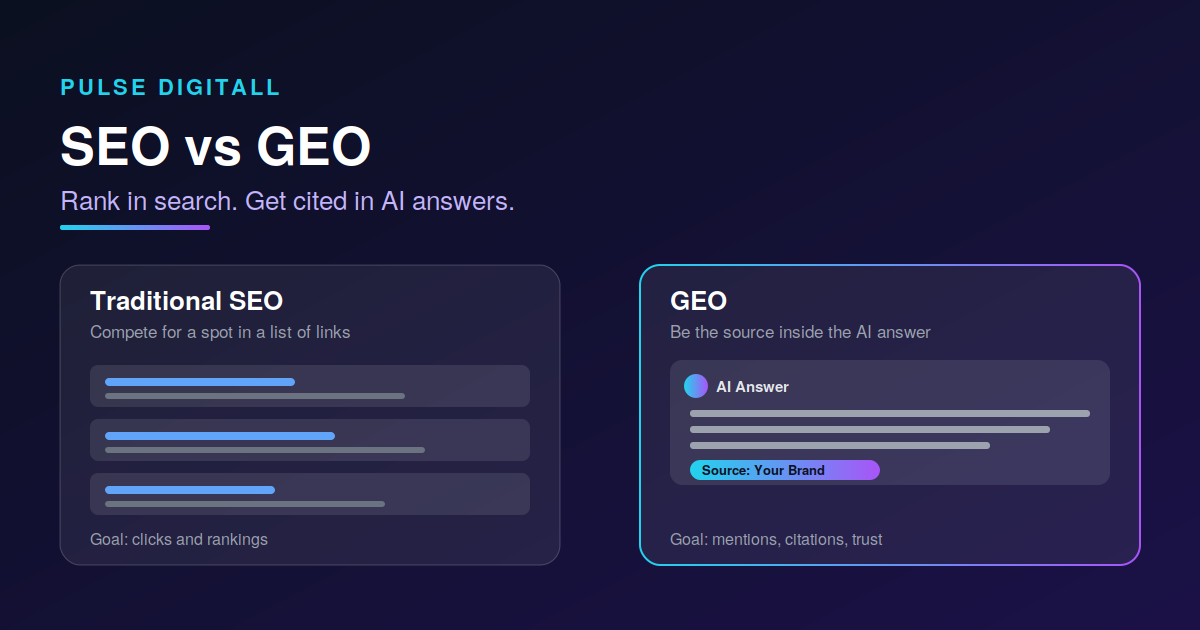
Generative engine optimization is the work of making your brand’s information easy for AI tools like ChatGPT, Google’s AI Overviews, Gemini, and Perplexity to find, trust, and quote when they write an answer. Traditional SEO competes for a spot in a list of blue links. GEO competes for a mention inside the answer itself.
AI systems don’t read a page the way a person does. They pull out short, self-contained facts, compare them against other sources, and lean toward information that comes from credible, consistent places. In practice, that means answering the question clearly near the top of your page, backing claims with data and named sources, and keeping your business details the same everywhere they appear online.
This matters because more people now get what they need without clicking any result. If the AI’s answer names your company, you gain visibility and trust even when no visit happens.
A GEO optimization strategy is the process of structuring, writing, and promoting content so that artificial intelligence systems such as ChatGPT, Google AI Overviews, Perplexity, and Gemini can understand it, trust it, and cite it directly in their generated answers. Unlike traditional SEO, which focuses on ranking a blue link on a search results page, generative engine optimization focuses on becoming the source that an AI model quotes, summarizes, or recommends when a user asks a question. If you are trying to stay visible as search behavior shifts from typing keywords to asking full questions, building a strong GEO optimization strategy is no longer optional. It is quickly becoming the foundation of digital visibility.
In this guide, we will break down what generative engine optimization actually means, why it matters right now, and how you can build a practical, step by step plan that works alongside your existing search engine optimization, content marketing, and paid advertising efforts.

GEO stands for Generative Engine Optimization. A GEO optimization strategy refers to the specific techniques, content formats, and technical adjustments used to increase the chances that generative AI tools pull your brand, your data, or your exact wording into their answers.
Search engines used to work in a simple way. A user typed a query, the algorithm crawled billions of pages, and it returned ten blue links ranked by relevance and authority. Generative engines work differently. They read across many sources, synthesize the information, and produce a single conversational answer. If your content is not written in a way that AI models can easily extract and trust, you simply will not appear in that answer, even if you rank on page one of a traditional search engine.
This is why brands running campaigns through a full service digital marketing agency are now asking for GEO alongside their existing SEO and PPC packages. It closes the gap between old search behavior and the new AI driven search experience.
Search behavior has changed faster in the last two years than it did in the previous decade. People are asking AI assistants full questions instead of typing short keyword phrases into Google. A few realities are pushing this shift:
If your website is not built with clear headings, direct answers, and trustworthy data, an AI model will simply skip past it and cite a competitor instead. A well planned GEO optimization strategy protects your visibility no matter which platform a customer uses to search.
Many business owners confuse GEO, SEO, and AEO because they overlap in several areas. The table below breaks down how each one functions and what it prioritizes.
| Factor | SEO (Search Engine Optimization) | AEO (Answer Engine Optimization) | GEO (Generative Engine Optimization) |
|---|---|---|---|
| Primary Goal | Rank in traditional search results | Appear in featured snippets and voice answers | Get cited inside AI generated responses |
| Main Platforms | Google, Bing | Google, Siri, Alexa | ChatGPT, Gemini, Perplexity, AI Overviews |
| Content Style | Keyword focused, long form pages | Short, direct question and answer format | Structured, factual, source backed content |
| Ranking Signal | Backlinks, keywords, technical SEO | Clear answers, schema markup | Authority, citations, semantic clarity |
| Measurement | Rankings, organic traffic | Snippet visibility | Brand mentions inside AI answers |
These three approaches are not competitors. They work together. A page that ranks well in traditional search, answers questions clearly, and is written with strong topical authority will naturally perform across all three systems at once.
A successful generative engine optimization plan is built on five main pillars. Each one plays a different role in helping AI models trust and cite your content.
Schema markup gives search engines and AI crawlers a machine readable version of your content. Adding FAQ schema, article schema, organization schema, and review schema helps AI systems quickly understand what your page is about, who wrote it, and why it should be trusted.
AI models reward content that fully covers a topic rather than pages built around a single keyword. This means answering related questions, covering different angles of a subject, and using natural language variations of your main topic throughout the page.
Experience, expertise, authoritativeness, and trust remain central to how AI systems decide which sources to cite. Author bios, verifiable credentials, original data, and real case studies all strengthen this signal.
Generative engines are built to answer questions. Structuring sections around real user questions, with direct answers in the first sentence or two, dramatically increases the chance of being pulled into an AI generated response.
Brand mentions, engagement, and consistent messaging across social platforms feed into how AI models assess your authority. A strong presence built through professional social media marketing services supports your written content by reinforcing the same topics and expertise across multiple channels. AI systems also increasingly reference video transcripts and image data, so investing in professional video editing and consistent visual branding through custom logo design helps reinforce brand recognition across platforms AI tools pull data from.
Being present and consistent across search, social, and paid channels tells AI models that your brand is active, real, and worth citing repeatedly.
Below is a practical framework you can follow to build your own generative engine optimization plan from the ground up.
Start with the questions your audience is actually asking. Use tools that show related questions, comparison searches, and long tail phrases. A thorough keyword research process will reveal exactly what language your customers use, which is critical because AI models often quote content word for word.
Proper heading structure tells both search engines and AI crawlers how your content is organized. Each section should build logically on the one before it, with a single main title followed by clearly nested subheadings. Meta titles and descriptions matter too, since AI crawlers use them as an early signal of what a page covers. Working with a team that handles on page SEO ensures these details are never overlooked.
A fast, mobile friendly, well coded website is the backbone of any GEO optimization strategy. This includes clean site architecture, proper indexing, and reliable hosting. Whether your site runs on WordPress development services or a fully custom build, technical health directly affects whether AI crawlers can access and understand your pages at all. Businesses moving platforms should also consider professional website migration services to avoid losing indexed content during the switch.
For ecommerce brands, platform choice matters just as much. Strong Shopify website development combined with reliable ecommerce development services creates the kind of structured product data that AI shopping assistants increasingly rely on.
AI models weigh authority heavily. Earning mentions from reputable sites, along with a consistent off page SEO strategy, builds the kind of external trust signals that generative engines look for before citing a source.
Once content is published, it needs distribution. Sharing it through the right channels increases engagement signals that AI systems can detect.
Social platforms are no longer just for engagement. They are now data sources that AI models actively reference. A coordinated presence across platforms strengthens your generative engine optimization results in several ways:
Consistent branding across every platform, supported by company branding strategy and well designed social media post design, ensures your identity looks the same wherever an AI model finds it, which reinforces trust and recognition.
Search engine optimization and paid advertising still play a major role in feeding data that generative engines rely on.
A complete search engine optimization services package covering local SEO optimization, an optimized Google Business Profile optimization, and consistent professional content writing gives AI models a reliable, well maintained source to pull from.
Paid channels matter too. A structured PPC Google Ads services plan, including targeted search advertising campaigns, broad reach display advertising strategy, conversion focused lead generation campaigns, and product visibility through Google Shopping Ads, all generate additional data points that reinforce brand relevance and popularity signals used by AI ranking systems.
Your website is where all of this comes together. A few technical and design factors that directly support generative engine optimization include:
Working with an experienced digital marketing agency that understands how all these pieces connect makes it far easier to build a generative engine optimization plan that actually performs, rather than treating each channel separately.
Tracking generative engine optimization results looks different from tracking traditional rankings. Below is a breakdown of the key performance indicators worth monitoring and their typical weight in overall assessment.
| KPI | What It Measures | Approximate Importance |
|---|---|---|
| AI Citation Frequency | How often your brand appears inside AI generated answers | 30 percent |
| Branded Search Volume | Growth in direct searches for your brand name | 20 percent |
| Organic Traffic from Long Tail Queries | Traffic driven by natural, question based searches | 20 percent |
| Backlink Quality and Volume | Authority signals from external sources | 15 percent |
| Engagement Across Social Channels | Consistency and activity across platforms | 15 percent |
Monitoring these indicators over three to six month periods gives a realistic picture of how your generative engine optimization efforts are performing.
As more users shift toward AI assistants for research, shopping, and decision making, generative engine optimization will continue to grow in importance alongside, not instead of, traditional search engine optimization. Brands that build a strong foundation now, covering structured content, technical health, social presence, and authority building, will be the ones AI models trust and recommend as this shift continues.
What is GEO in digital marketing?
GEO stands for Generative Engine Optimization. It refers to optimizing content so that AI tools like ChatGPT, Gemini, and Google AI Overviews can understand, trust, and cite it directly within their generated answers.
Is GEO the same thing as SEO?
No. Search engine optimization focuses on ranking web pages in traditional search results, while generative engine optimization focuses on being quoted or referenced inside AI generated summaries. The two work best when combined together.
Does a GEO optimization strategy replace traditional SEO?
No, it does not. A strong technical and content foundation built through search engine optimization is still required. Generative engine optimization builds on top of that foundation to target AI driven search experiences specifically.
How long does it take to see results from GEO optimization?
Most brands begin noticing changes in AI citation frequency and branded search volume within three to six months, depending on how much existing authority and content depth the website already has.
Do I need schema markup for generative engine optimization?
Yes. Structured data helps AI crawlers quickly understand what a page covers, who published it, and why it can be trusted, which significantly increases the likelihood of being cited.
Which platforms should a GEO optimization strategy focus on?
A complete strategy should account for Google AI Overviews, ChatGPT, Perplexity, and Gemini, along with supporting visibility across social platforms and traditional search engines.
How much does a professional GEO optimization strategy cost?
Pricing varies based on website size, current content quality, and how many additional services such as SEO, social media marketing, and paid advertising are included in the overall plan.
A strong GEO optimization strategy is quickly becoming just as important as traditional search engine optimization. As more people turn to AI tools to research products, compare services, and make decisions, the brands that structure their content clearly, build real authority, and stay consistent across every channel will be the ones that stay visible. Combining generative engine optimization with solid SEO, thoughtful branding, targeted advertising, and a well built website creates a complete system that keeps a brand discoverable no matter how search behavior continues to evolve.