
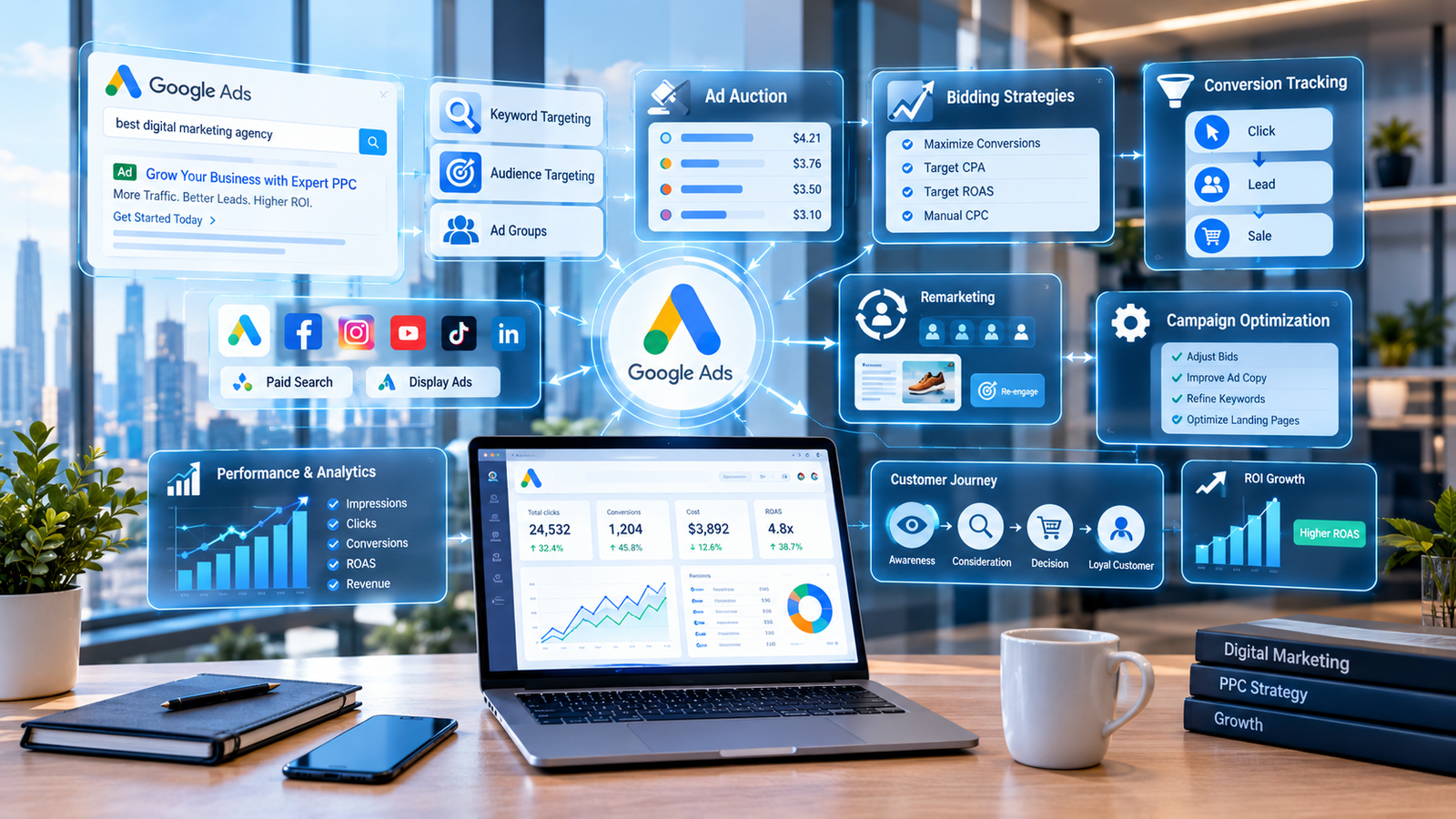
 Google Ads Techniques: Strategies to Improve PPC Performance
The most effective Google Ads techniques combine high intent keyword targeting, strong campaign structure, relevant ad copy, accurate conversion tracking, intelligent bidding, negative keyword management, landing page optimization, audience targeting, and continuous performance analysis. A successful Google Ads campaign is not simply about increasing clicks. It is about getting the right people to click, guiding them toward a valuable action, and using reliable data to improve performance over time.
Google Ads has become far more sophisticated than simply choosing keywords and setting a daily budget. Modern Google PPC requires advertisers to understand search intent, automated bidding, audience signals, conversion data, ad relevance, landing page experience, and the relationship between every stage of the customer journey. The strongest campaigns treat paid search as a complete acquisition system rather than an isolated advertising channel.
For businesses competing in the United States and other competitive markets, this distinction matters. Two companies can spend the same amount on Google advertising and achieve completely different results because their targeting, messaging, tracking, and optimization processes are different.
This guide explains the most important Google Ads techniques you can use to build, manage, optimize, and scale profitable PPC campaigns.
Google Ads techniques are the strategic methods used to improve the targeting, relevance, efficiency, and profitability of advertising campaigns on Google. These techniques cover everything from keyword research and campaign structure to bidding, ad creation, conversion tracking, audience segmentation, remarketing, and landing page optimization.
The objective is not to generate the highest possible number of clicks.
The objective is to generate valuable conversions at an economically sustainable cost.
Depending on the business model, a conversion could mean:
This is why effective Google Ads management starts with business objectives rather than advertising settings.
Organic search can generate valuable long term traffic, but it often requires time before a new website or page establishes meaningful visibility. Paid search gives businesses an opportunity to appear when potential customers are actively looking for products, services, or solutions.
For example, someone searching for:
“emergency plumber near me”
has a very different level of intent from someone casually reading an article about plumbing problems.
A well structured Google Ads campaign can place a relevant business in front of the first user at the moment when the need already exists.
That makes intent one of the most important concepts in Google advertising.
Pulse Digitall’s PPC and Google Ads services for USA businesses focus on conversion oriented campaign strategy, keyword targeting, tracking, bid optimization, and ongoing performance improvement.
One of the most important Google Ads techniques is understanding why someone is searching, not simply what they are searching for.
Consider these searches:
All of these searches relate to the same broad topic, but they represent different stages of the buying journey.
A campaign should distinguish between informational, commercial, and transactional intent.
The person wants to learn something.
Examples:
These searches may be useful for content marketing, but they do not always represent immediate buying intent.
The person is researching potential solutions.
Examples:
These users may be comparing providers.
The person is closer to taking action.
Examples:
These searches can be particularly valuable for lead generation campaigns.
The goal is not to automatically reject informational searches. Instead, advertisers should understand the economics and expected conversion behavior of each intent category.
Campaign structure directly affects how efficiently you can manage budgets, targeting, ads, and performance.
A common mistake is placing hundreds of unrelated keywords into one campaign or one ad group.
Instead, organize campaigns around meaningful business categories.
For example, a digital marketing agency might separate campaigns into:
Within a Google Ads campaign, ad groups should represent closely related themes.
A PPC campaign for an agency might include separate groups for:
This creates a stronger relationship between the search query, keyword, advertisement, and landing page.
Pulse Digitall also provides search advertising services designed around search intent and conversion focused advertising.
Google Ads currently provides broad match, phrase match, and exact match keyword options. Each serves a different purpose, and their behavior has evolved considerably as Google has incorporated more machine learning into keyword matching.
Broad match can help advertisers discover a wider range of relevant searches.
For example:
Google Ads agency
may match with searches that are closely related in meaning rather than containing exactly the same wording.
Broad match can be particularly useful when combined with strong conversion tracking and Smart Bidding because the system can use additional contextual signals when deciding which searches are relevant.
Phrase match provides more control than broad match while still allowing the campaign to reach searches that contain the meaning of the keyword.
It can be useful when you want to maintain a clearer relationship between the keyword theme and the search query.
Exact match provides the greatest steering over which searches can trigger an ad among the three positive keyword match options, although it can still match searches with the same meaning or intent rather than requiring identical wording.
The important lesson is simple:
Do not choose a match type simply because it sounds more precise. Choose it based on your campaign objective, conversion data, budget, and ability to manage search term quality.
Negative keywords are one of the most practical Google Ads techniques for reducing irrelevant traffic.
Suppose a company sells premium business software.
A keyword such as:
business software
could potentially attract searches related to:
Some of these searches may have little commercial value.
The Search terms report allows advertisers to examine actual searches that triggered their ads and identify irrelevant terms that could be excluded. Google specifically recommends using search terms data to discover negative keyword opportunities.
A strong optimization routine should regularly review:
Negative keyword management should not be treated as a one time setup task.
Search behavior changes.
New irrelevant queries appear.
Customer language evolves.
Your negative keyword list should evolve with it.
A common mistake in Google advertising is writing advertisements that describe the company instead of addressing the customer’s need.
Weak messaging might focus on:
“Professional Digital Marketing Company”
Stronger messaging can communicate a specific benefit:
“Generate More Qualified Leads With Data Driven PPC”
The strongest message depends on the actual customer and offer, but the principle remains consistent.
Your advertisement should quickly answer:
For service businesses, useful messaging can include:
The advertisement should make a clear promise without making unsupported claims.
Getting a click is only the beginning.
If an advertisement promises Google Ads management but sends the visitor to a generic homepage, the experience may feel disconnected.
A dedicated landing page can continue the same message from the search query to the advertisement and then to the conversion action.
For example:
Search query:
Google Ads management USA
Advertisement:
Google Ads Management for USA Businesses
Landing page:
A dedicated page explaining Google Ads management, campaign strategy, reporting, pricing factors, and the next step.
This consistency can improve user experience and help visitors understand immediately that they reached the right place.
If your existing landing page does not support your advertising objectives, landing page development services can help create pages specifically designed around conversion pathways.
One of the biggest Google Ads management mistakes is making optimization decisions based only on clicks.
A campaign with 1,000 clicks is not necessarily better than a campaign with 300 clicks.
The important question is:
What happened after the click?
Track meaningful actions such as:
Google Ads uses conversion data to help advertisers understand campaign performance and guide optimization decisions. Conversion value can also help businesses measure the economic value generated by campaigns rather than simply counting conversions.
For businesses with different customer values, assigning appropriate conversion values can make campaign optimization significantly more useful.
Modern advertising increasingly depends on reliable measurement.
Google’s enhanced conversions feature supplements existing conversion tracking by using hashed first party customer data to improve conversion measurement.
For eligible businesses, improved conversion measurement can provide stronger data for campaign optimization and automated bidding.
This is especially important when a business receives leads through multiple channels.
For example:
A user clicks a Google advertisement, submits a form, speaks with a sales representative, and eventually becomes a customer.
The advertising system needs as much reliable information as possible about which actions actually matter.
Better measurement creates better optimization opportunities.
Bidding is another critical part of Google Ads management.
Google Smart Bidding uses AI to optimize bids at auction time based on the advertiser’s selected objective. Current Smart Bidding options include strategies such as Target CPA, Target ROAS, Maximize Conversions, and Maximize Conversion Value.
The appropriate strategy depends on the campaign.
For lead generation, advertisers may focus on:
For ecommerce, important objectives may include:
Google recommends setting up accurate conversion data and aligning the bidding strategy with the campaign objective.
The key point is that automation works best when it has useful data.
Automation cannot compensate for fundamentally incorrect conversion tracking.
Clicks are an intermediate metric.
Revenue is a business outcome.
Imagine two campaigns:
Campaign A:
Campaign B:
Campaign A generated more traffic.
Campaign B generated more customers.
This is why experienced Google Ads management focuses on the entire conversion journey rather than maximizing traffic for its own sake.
The metrics you should monitor depend on the business model, but commonly include:
The Search terms report is not only an optimization tool.
It is also a customer research tool.
Actual searches reveal the language people use when they are trying to solve a problem.
For example, a company might discover that customers repeatedly search:
“affordable commercial flooring installation”
while the company’s website primarily uses:
“commercial flooring solutions.”
That difference can inform:
Google states that search terms data can help advertisers discover new keyword ideas and improve creative and landing page alignment.
This creates an important connection between PPC and SEO.
Paid search and organic search should not operate in completely separate silos.
Your PPC data can reveal:
Those insights can influence your organic strategy.
Similarly, your SEO research can identify valuable topics and queries that deserve paid testing.
Pulse Digitall offers SEO services in the USA covering areas such as keyword research, on page SEO, off page SEO, and local SEO.
When paid and organic teams share insights, businesses can build a more complete search strategy.
Increasing ad spend on a weak landing page can simply increase wasted spend.
Before scaling a campaign, examine:
Does the landing page clearly match the search intent?
Does the page continue the promise made in the advertisement?
Does the page load quickly enough for visitors?
Can users easily read, navigate, and convert from a mobile device?
Is the next step obvious?
Does the page provide enough evidence for a visitor to feel comfortable taking action?
Trust elements can include:
If the underlying website experience needs improvement, responsive website development can support a stronger experience across desktop and mobile devices.
Geographic targeting can be extremely important for local and regional businesses.
A business serving customers only in Texas should not necessarily treat every US location identically.
Depending on the business model, you may want separate campaign structures for:
Separate geographic campaigns can provide greater control over budgets and messaging.
For example, a business may discover that its cost per qualified lead differs substantially between New York, Dallas, and Los Angeles.
That information can influence budget allocation.
Not every visitor converts on the first visit.
A customer may:
Remarketing can help businesses reconnect with users who have already interacted with their brand, subject to applicable platform policies and audience eligibility.
Remarketing can be especially useful for:
Pulse Digitall also provides display advertising services with audience targeting, remarketing, creative testing, and conversion tracking.
For ecommerce businesses, Google Shopping can connect product information with purchase focused search behavior.
Product data, pricing, images, availability, and Merchant Center information can all influence the quality of an ecommerce advertising system.
Pulse Digitall’s Google Shopping Ads services cover product feed optimization, Merchant Center management, campaign setup, bidding, conversion tracking, and performance optimization.
A strong Shopping strategy should pay attention to:
For ecommerce companies, PPC should ultimately be evaluated against profitable sales rather than traffic volume alone.
For service companies, generating a click is only useful if that visitor becomes a qualified prospect.
A complete PPC lead generation system may involve:
Pulse Digitall’s lead generation services combine paid advertising, audience targeting, conversion tracking, landing page strategy, and lead nurturing.
This approach recognizes an important reality:
A cheap lead is not automatically a valuable lead.
A campaign producing fewer but better qualified leads may create more revenue than one producing large numbers of low quality inquiries.
PPC optimization requires experimentation, but random changes make performance difficult to interpret.
Useful testing areas include:
For example, if you change the advertisement, landing page, bidding strategy, targeting, and budget simultaneously, it becomes difficult to understand which change caused the performance difference.
A disciplined testing process creates clearer learning.
One of the most damaging Google Ads techniques is making major decisions from tiny data samples.
Suppose an advertisement receives 20 clicks and generates one conversion.
It may be tempting to declare the ad a winner.
But the sample may be too small to support a meaningful conclusion.
Instead, examine trends over an appropriate period while considering:
Good Google Ads management requires patience as well as analysis.
Google Ads increasingly uses automation for bidding, matching, targeting, and campaign optimization.
That does not mean advertisers should stop managing their accounts.
Automation can process enormous amounts of data, but humans still need to define:
Google itself recommends pairing Smart Bidding with accurate conversion data and appropriate campaign structures.
The strongest approach is not humans versus automation.
It is strategic human decision making supported by automation.
A successful Google advertising system should create alignment between four major components:
Search query → Advertisement → Landing page → Conversion
If one part is disconnected, performance can suffer.
For example:
Search query:
Google Ads management for dentists
Advertisement:
Google Ads Management for Dental Practices
Landing page:
Google Ads services for healthcare and dental businesses
Conversion:
Request a consultation
This creates a coherent journey.
When the visitor sees exactly what they expected, the transition from search to action becomes much more natural.
Paid advertising can also reveal which messages resonate with customers.
Suppose your campaigns consistently show stronger engagement for messaging around:
These patterns can influence other marketing channels.
Your company branding services can help establish consistent messaging across your broader digital presence.
You can also connect paid campaigns with social media marketing services when your customer journey extends beyond Google search.
Google PPC captures existing demand.
Social advertising can help create and influence demand.
For example, a potential customer might first discover a company through:
Later, the same person might search for the company on Google.
This is why modern digital marketing often works best as a connected system rather than a collection of isolated channels.
Depending on the audience, businesses can also explore Facebook advertising, Instagram advertising, TikTok advertising, and YouTube advertising.
Even a perfectly optimized Google Ads campaign cannot fix every website problem.
If visitors encounter:
the advertising investment can suffer.
Your website is where the advertising promise becomes a customer experience.
Businesses that need a stronger digital foundation can explore website design and development services, including WordPress development and ecommerce development.
A strong Google Ads management process should have a repeatable schedule.
Depending on account size and spend, review:
Review:
Conduct a deeper review of:
This prevents campaign management from becoming a reaction to individual numbers.
If you want to simplify the entire strategy, focus on these core areas:
Not every business should use exactly the same PPC strategy.
Prioritize:
Combining paid search with Google Business Profile services and local SEO can create a broader local acquisition strategy.
Focus on:
B2B campaigns often need more attention to:
Important areas may include:
There is no universal Google Ads budget that works for every business.
The right budget depends on:
A better question than “How much should I spend?” is:
How much can I sustainably spend to acquire a customer while maintaining acceptable profitability?
For example, if a business earns substantial gross profit from a new customer, it may tolerate a higher acquisition cost than a business with very small margins.
Budget should therefore be connected to economics rather than an arbitrary monthly number.
Even experienced advertisers can fall into recurring PPC mistakes.
Different search intents often require different landing experiences.
Without reviewing actual search behavior, irrelevant traffic can remain hidden.
Not every click, page view, or low value interaction represents business success.
Constant changes can make performance difficult to evaluate.
A high click through rate does not automatically mean high profitability.
Ten low quality leads may be less valuable than three qualified prospects.
Increasing budget before measurement is trustworthy can increase uncertainty rather than improve growth.
Automated bidding is powerful, but it depends on the quality of the goals and data behind it.
Effective Google Ads management is a continuous process rather than a one time campaign setup.
It normally includes:
Research
Understand customers, competitors, products, services, and search intent.
Planning
Build campaign structures, budgets, keyword themes, audiences, and conversion goals.
Implementation
Create campaigns, advertisements, assets, tracking, and landing page pathways.
Measurement
Monitor conversions, revenue, lead quality, search terms, and other meaningful metrics.
Optimization
Improve keywords, negative keywords, advertisements, bids, audiences, budgets, and landing pages.
Scaling
Increase investment in areas that demonstrate sustainable business value while controlling wasted spend.
Pulse Digitall describes its PPC process around discovery, strategy, campaign setup, launch, optimization, and scaling, with an emphasis on conversion tracking and ongoing performance monitoring.
The best Google Ads techniques are not isolated tricks.
They work together.
Strong keyword research without conversion tracking leaves you uncertain about business impact. Great advertisements without relevant landing pages waste valuable clicks. Advanced bidding without accurate conversion data can optimize toward the wrong outcome. High traffic without qualified leads can create impressive reports without meaningful growth.
A successful Google Ads campaign connects every stage:
Intent → Keyword → Advertisement → Click → Landing Page → Conversion → Customer → Revenue
That is the foundation of effective Google PPC.
Businesses that approach paid search as a complete customer acquisition system can make better decisions about where to spend, what to test, what to improve, and when to scale.
Google advertising is increasingly automated, but strategy remains essential. The advertisers who understand their customers, measure meaningful outcomes, manage search intent carefully, and continuously improve the entire funnel are better positioned to turn advertising spend into measurable business results.
For businesses that need a complete digital growth strategy rather than PPC in isolation, Pulse Digitall combines PPC with SEO, social media, branding, web development, and lead generation services.
The most important techniques include search intent analysis, strategic keyword targeting, negative keyword management, relevant ad copy, conversion tracking, Smart Bidding, landing page optimization, audience targeting, remarketing, and continuous performance analysis.
Accurate conversion tracking should be one of the first priorities. Without reliable conversion data, it becomes difficult to determine which campaigns, keywords, advertisements, and audiences are actually producing valuable business results.
Google Ads currently provides broad match, phrase match, and exact match for positive keyword targeting. Broad match generally reaches a wider range of related searches, while phrase and exact match provide progressively greater control over matching.
Negative keywords prevent advertisements from showing for searches that are not relevant to the business. The Search terms report can help advertisers identify irrelevant searches and turn them into negative keyword opportunities.
Google Ads management involves planning, creating, monitoring, analyzing, and optimizing advertising campaigns. It can include keyword research, campaign structure, advertisement creation, bidding, negative keywords, conversion tracking, audience targeting, reporting, and budget optimization.
Smart Bidding uses Google AI to set bids at auction time based on the advertiser’s selected conversion or conversion value objective. Current strategies include Target CPA, Target ROAS, Maximize Conversions, and Maximize Conversion Value.
Yes. Google PPC can be suitable for small businesses when campaigns are structured around realistic budgets, high intent searches, accurate conversion tracking, and profitable customer acquisition economics.
A campaign can begin generating traffic soon after it becomes eligible to serve, but meaningful performance evaluation requires enough conversion and search data. The appropriate evaluation period depends on the business, budget, competition, conversion cycle, and campaign objective.
Important metrics can include impressions, clicks, click through rate, cost per click, conversions, conversion rate, cost per conversion, conversion value, ROAS, revenue, and lead quality. The most important metrics depend on the business objective.
No. A high click through rate can indicate that an advertisement attracts attention, but it does not automatically mean the traffic is profitable. Conversion quality and business outcomes are more important than clicks alone.
Start by reviewing search terms, excluding irrelevant queries, improving keyword targeting, strengthening advertisement relevance, improving landing pages, and analyzing campaign level conversion performance.
Broad match can be useful when combined with appropriate conversion based bidding and reliable conversion data. It can help discover relevant searches beyond a narrowly defined keyword list.
ROAS means Return on Ad Spend. It compares the value generated from advertising with the amount spent on advertising. For ecommerce businesses, it can be particularly useful when reliable conversion values are available.
Google Ads is paid advertising that can provide visibility through advertising placements, while SEO focuses on improving organic search visibility. Many businesses use both because they serve different roles within the broader search strategy.
Yes. Google Ads can be used to reach people actively searching for relevant services and direct them to conversion focused landing pages, forms, calls, booking systems, or other lead pathways.
Not necessarily, but landing pages should closely match the advertisement and search intent. Dedicated landing pages can be particularly useful when the campaign targets a specific service, audience, offer, or geographic market.
Enhanced conversions is a Google Ads measurement feature that uses hashed first party customer data to improve conversion measurement. It can supplement existing conversion tags and support more accurate advertising measurement.
There is no universal schedule. Important issues such as tracking failures, disapproved ads, unusual spending, or major performance changes should be checked promptly. Search terms, keywords, advertisements, audiences, and budgets can then be reviewed regularly according to account size and campaign activity.
Yes. Google Ads can capture existing search demand, while social platforms can help build awareness, engagement, and remarketing opportunities. Businesses can integrate channels such as Facebook advertising, Instagram advertising, and YouTube advertising into a broader customer acquisition strategy.
Professional management can be useful when an account has significant advertising spend, complex campaigns, multiple locations, competitive keywords, ecommerce products, tracking requirements, or insufficient internal PPC expertise.
A successful campaign connects the right audience with the right message at the right moment and measures the resulting business outcome accurately. Strong performance usually requires alignment between search intent, keywords, advertisements, landing pages, conversion tracking, bidding, and ongoing optimization.