
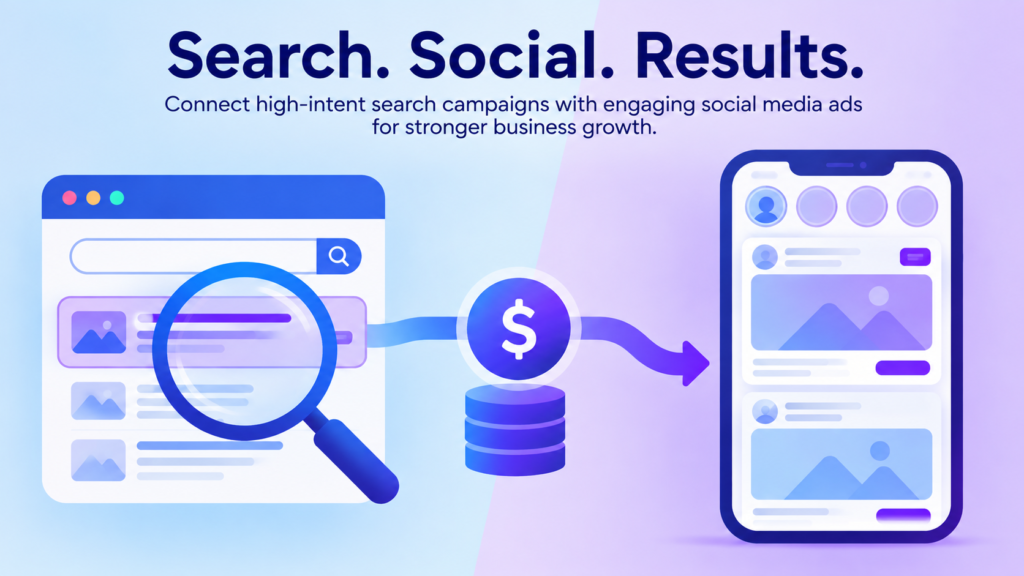
You have a marketing budget ready to go, and now comes the hard part. Where should it actually go? Google Ads and Facebook Ads are the two biggest players in digital advertising, and both promise to bring you customers. But they work in fundamentally different ways, and putting your budget in the wrong place can mean wasted spend and missed opportunities.
This is one of the most common questions business owners ask when they start scaling their marketing efforts. The truth is that there is no single right answer for everyone. The best platform for your budget depends on your business type, your goals, your audience, and even the stage of the customer journey you are trying to target. Some businesses see incredible results from Google Ads and barely make Facebook Ads work, while others build entire brands almost exclusively through Facebook and Instagram.
In this guide, we will break down exactly how Google Ads and Facebook Ads work, compare them across the factors that actually matter, and help you figure out where your specific business should be spending its advertising budget. We will also look at how successful businesses often use both platforms together, rather than treating this as an either-or decision.
Google Ads is a pay-per-click advertising platform that allows businesses to display ads across Google Search, Google Maps, YouTube, and millions of partner websites through the Google Display Network. It operates primarily on intent-based targeting, meaning your ads appear when someone actively searches for something related to what you offer.
Think of Google Ads as raising your hand at the exact moment someone is asking a question you can answer. Someone types “emergency plumber near me,” and if you run Google Ads correctly, your business appears right there, ready to solve their immediate need.
Google Ads operates on an auction system where advertisers bid on keywords relevant to their business. When someone searches for a term you are bidding on, Google runs an instant auction that considers your bid amount alongside your Quality Score, which measures the relevance of your ad and landing page. This means the highest bidder does not always win. A highly relevant, well-optimized ad can outperform a competitor with a bigger budget but a poorly matched offer.
Facebook Ads, which also includes Instagram through Meta’s advertising platform, works on interest and behavior-based targeting rather than search intent. Instead of waiting for someone to search for what you offer, Facebook Ads puts your business in front of people based on their demographics, interests, behaviors, and connections, while they are scrolling through their feed.
Think of Facebook Ads as tapping someone on the shoulder in a crowded room and showing them something they did not know they needed yet. It is discovery-driven advertising rather than intent-driven advertising.
Meta’s advertising algorithm is built around machine learning that continuously optimizes ad delivery based on how users interact with your campaigns. The more data the algorithm gathers, through clicks, video views, purchases, and other engagement signals, the better it becomes at finding people likely to convert. This is why Facebook Ads often improve in performance over the first few weeks of a campaign, as the system moves out of its initial learning phase.
Now let us compare both platforms across the factors that matter most when deciding where to invest your advertising budget.
This is the most fundamental difference between the two platforms, and it shapes almost everything else about how they perform.
Google Ads is built around search intent. Someone is actively looking for a solution, and your ad appears as a potential answer. This means the person seeing your ad is often already aware of their need and may be close to making a decision.
Facebook Ads is built around audience targeting. You define who your ideal customer is, based on demographics, interests, and behaviors, and Facebook shows your ad to people matching that profile, regardless of whether they are actively searching for anything at that moment.
If your product or service solves an urgent, well-defined need, such as emergency repairs, legal services, or medical care, Google Ads often performs better because people are already searching for exactly that solution. If your product benefits from visual discovery, such as fashion, home decor, or new consumer products people did not know they wanted, Facebook Ads often performs better because it can introduce your offering before the customer even knows they need it.
Consider two different businesses to see this play out in practice. An emergency locksmith service benefits enormously from Google Ads, since almost every customer is searching in a moment of urgent need, phone in hand, ready to call the first credible option that appears. A new skincare brand with beautifully photographed products, on the other hand, often struggles on Google Search simply because very few people are actively searching for a brand they have never heard of. Facebook Ads allows that same skincare brand to introduce itself through compelling visuals to an audience that fits its ideal customer profile, well before those people ever think to search for it.
Both platforms use auction-based pricing, but the cost dynamics differ significantly.
Google Ads pricing is largely driven by keyword competition. Highly competitive industries, such as insurance, legal services, and finance, can see cost-per-click rates that are significantly higher than less competitive niches.
Several elements affect how much you pay per click, including your Quality Score, competition for your target keywords, and the relevance of your ad copy and landing page.
Google rewards advertisers with relevant, high-quality ads and landing pages by lowering their cost per click. Investing in ad relevance genuinely saves you money over time.
Facebook Ads generally offers a lower average cost per click compared to Google Ads, particularly in competitive industries. However, cost efficiency depends heavily on audience targeting precision and ad creative quality.
Verdict: Facebook Ads often provides a lower entry cost, making it attractive for smaller budgets and testing. Google Ads can deliver a stronger return on investment for high-intent, conversion-ready searches, even at a higher cost per click.
It is worth noting that cost per click alone does not tell the full story. A ten dollar click that converts into a five hundred dollar sale is far more valuable than a one dollar click that never converts at all. When comparing costs across platforms, always evaluate cost per acquisition and overall return on ad spend, rather than judging performance by click price in isolation.
The type of content each platform rewards is quite different, and this affects how much creative effort you will need to invest.
If your business does not have strong visual assets or the resources to create engaging video and image content regularly, Google Search Ads may be easier to manage initially. If you have compelling product photography or the ability to produce engaging video content, Facebook Ads can perform exceptionally well.
Google Ads, particularly Search campaigns, often generates faster conversions because you are reaching people who are already close to making a purchasing decision. Facebook Ads typically requires more time to build awareness and trust before converting, especially for cold audiences who are seeing your brand for the first time.
That said, Facebook’s retargeting capabilities can accelerate conversions significantly for people who have already visited your website or interacted with your content previously.
Patience is an important factor to plan for, particularly with Facebook Ads. Businesses that expect immediate results comparable to Google Search Ads often abandon Facebook campaigns too early, before the algorithm has gathered enough data to optimize properly. Giving a new Facebook campaign at least one to two weeks before making major judgments tends to produce far more reliable performance insights.
If you have a very specific niche audience in mind, particularly one defined by interests or demographics rather than active search behavior, Facebook’s targeting depth gives you tools that Google Search simply does not offer.
Understanding where each platform fits in your marketing funnel helps clarify how to use them together rather than choosing one over the other entirely.
Both platforms offer robust analytics, but they measure success differently.
Google Ads provides detailed conversion tracking directly tied to specific keywords and search queries, making it easier to understand exactly what drove a sale. Facebook Ads offers strong engagement metrics and conversion tracking through the Meta Pixel, though attribution has become more complex following privacy changes like Apple’s App Tracking Transparency framework, which limits some cross-platform tracking capabilities.
Different industries naturally lean toward one platform over the other, based on how customers typically search for and discover their products or services.
For many businesses, the most effective strategy is not choosing one platform exclusively, but using both strategically based on their strengths.
A common and effective approach is allocating a larger portion of your budget toward Google Ads for direct response and immediate conversions, while dedicating a smaller portion to Facebook Ads for brand building and retargeting, adjusting the split based on performance data over time.
A practical example of this combined approach looks like this. A home renovation company might run Google Search Ads targeting terms like “kitchen remodeling contractor,” capturing homeowners actively ready to hire. At the same time, they run Facebook Ads showcasing before-and-after project photos to a broader local audience, building brand recognition so that when those same homeowners eventually do search on Google, they already recognize and trust the company name.
If you are working with a limited budget and need to choose one platform to start with, consider these guiding questions.
Choosing between Google Ads and Facebook Ads is not really about picking a winner. It is about understanding how each platform fits into your specific business model and customer journey. Google Ads captures demand that already exists, while Facebook Ads creates demand by introducing your business to the right people at the right time.
The smartest advertisers do not think in terms of Google versus Facebook. They think in terms of which platform serves which purpose, and how to build a strategy that uses both effectively, based on real performance data rather than assumptions.
Not sure where your budget should go? Get in touch with our team. We help businesses build data-driven advertising strategies across Google Ads, Facebook Ads, and beyond.
1. Which is better for beginners, Google Ads or Facebook Ads?
Facebook Ads is often considered more beginner-friendly due to its visually intuitive interface and lower entry cost. However, Google Ads can deliver faster, more direct results for businesses with clear, searchable services.
2. Can I run both Google Ads and Facebook Ads at the same time?
Yes, and many successful businesses do exactly this. Using both platforms together allows you to capture active search demand through Google while building awareness and retargeting through Facebook.
3. Which platform is cheaper, Google Ads or Facebook Ads?
Facebook Ads generally has a lower average cost per click across most industries. However, Google Ads can offer a stronger return on investment for high-intent searches, even at a higher cost per click.
4. Is Facebook Ads still effective after privacy changes like iOS updates?
Yes, though tracking has become more complex. Facebook has adapted with tools like aggregated event measurement, and many businesses still see strong results, particularly when combined with first-party data strategies.
5. Which platform is better for e-commerce businesses?
Both platforms work well for e-commerce. Google Shopping Ads capture purchase-ready searches, while Facebook Ads excel at product discovery and retargeting abandoned cart visitors.
6. How much budget do I need to start advertising on Google or Facebook?
There is no fixed minimum, but starting with a modest test budget, even a few hundred dollars, allows you to gather data and identify what works before scaling up your investment.
7. Does Google Ads or Facebook Ads work better for B2B businesses?
Google Ads often performs well for B2B businesses due to high-intent search queries related to specific products or services, while Facebook Ads can be effective for building awareness among decision-makers over time.
8. How long does it take to see results from Google Ads or Facebook Ads?
Google Search Ads can generate leads or sales within days due to high purchase intent. Facebook Ads typically require a longer runway, often several weeks, to build awareness and optimize targeting effectively.
9. Do I need a professional to manage my Google Ads or Facebook Ads campaigns?
While both platforms are accessible to beginners, professional management often improves results significantly by avoiding wasted spend, refining targeting, and continuously optimizing based on performance data.
10. Which platform is better for local businesses?
Google Ads is generally stronger for local businesses, since customers actively search for local services with clear intent, such as “electrician near me,” making it easier to capture ready-to-convert leads.