
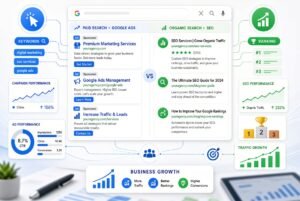
Google Ads and SEO serve different purposes, so the better choice depends on your business goals, budget, timeline, and customer journey. Google Ads can generate targeted traffic and potential leads quickly because you pay to appear in search results, while SEO focuses on improving your organic visibility so that your website can attract relevant traffic without paying for every click. For businesses that need immediate results, Google Ads can be useful, while SEO is often more valuable for building sustainable visibility and long term organic growth. In many cases, using Google Ads and SEO together creates a stronger search marketing strategy than relying on only one.
When people search for products, services, or solutions on Google, they may see both paid advertisements and organic search results.
Google Ads allows businesses to pay for advertising placements on Google. Advertisers choose keywords, audiences, locations, budgets, and bidding strategies. When someone searches for a relevant term, an eligible advertisement may appear above or among the organic results.
SEO, or search engine optimization, focuses on improving a website so search engines can understand, trust, and rank its pages organically. Instead of paying Google for each click, businesses invest in content, technical improvements, authority, user experience, and relevance.
The basic difference is simple:
| Google Ads | SEO |
|---|---|
| Paid search visibility | Organic search visibility |
| Can generate traffic quickly | Usually requires more time |
| You pay for advertising clicks or interactions depending on campaign setup | You do not pay Google for organic clicks |
| Traffic can stop when campaigns stop | Rankings can continue after investment |
| Strong control over targeting and budget | Strong focus on relevance and authority |
| Useful for immediate demand | Useful for sustainable visibility |
| Requires ongoing advertising budget | Requires ongoing optimization and content investment |
This is why the Google Ads vs SEO debate should not be treated as a simple question of which channel is universally better.
The more useful question is:
Which channel matches your current business objective?
The right choice depends on what you are trying to accomplish.
If your business has just launched a new service and needs qualified visitors immediately, Google Ads can provide a direct route to search visibility.
If your goal is to build organic traffic around important topics, services, products, and locations over time, SEO can provide a strong foundation.
Consider these situations:
Google Ads can be particularly useful when:
For example, a local emergency service may not want to wait several months for organic rankings before generating enquiries. A properly structured search campaign can put the business in front of people who are actively searching for the service.
SEO can be more appropriate when your business wants to build long term search visibility.
It can help you:
A business selling a complex product, for example, may benefit from publishing detailed guides that answer customer questions before those customers are ready to buy.
That content can introduce the business to potential customers earlier in the buying journey.
SEO vs PPC is often presented as an either or decision. In practice, the two channels can address different stages of the customer journey.
Someone searching for:
“emergency tyre fitting near me”
may have strong commercial intent and need a service immediately.
Someone searching for:
“how does mobile tyre fitting work”
may still be researching.
Someone searching for:
“best tyres for motorway driving”
could be comparing options.
Someone searching for:
“mobile tyre fitting Manchester price”
may be much closer to contacting a provider.
These searches can all represent valuable opportunities, but they do not necessarily require the same marketing approach.
Google Ads can be highly useful for capturing direct commercial intent.
SEO can help a business appear across a wider range of informational, commercial, navigational, and local searches.
Paid search and organic search also differ in how visibility is obtained.
With paid search, an advertiser participates in an auction and pays according to the campaign model when users interact with advertisements.
With organic search, Google determines which pages are relevant enough to appear in its unpaid search results.
That means businesses need different strategies.
Paid search requires attention to:
SEO requires attention to:
The two channels overlap in one important area: understanding what customers are actually searching for.
Google Ads offers several advantages, particularly for businesses that need targeted search visibility.
One of the biggest Google Ads benefits is speed.
A properly configured campaign can begin generating impressions and clicks shortly after launch, although performance depends on factors such as budget, competition, targeting, relevance, bidding, account history, and search demand.
SEO generally requires more time because search engines need to discover, understand, evaluate, and rank pages.
For a new business that needs enquiries now, this difference can matter.
Google Ads can be useful for businesses serving specific locations.
For example, a company operating only in selected cities can structure campaigns around those service areas rather than trying to attract visitors from an entire country.
This is particularly relevant to:
A local business can also combine paid campaigns with a strong local SEO strategy to build visibility through both paid and organic search.
Google Ads allows advertisers to establish campaign budgets and make adjustments based on performance.
Businesses can increase investment in campaigns that generate valuable conversions and reduce spending where performance does not meet expectations.
However, budget control does not automatically mean profitable advertising.
A campaign can spend money quickly if keyword targeting, conversion tracking, landing pages, bidding, or search terms are poorly managed.
That is why campaign management matters as much as the advertising budget itself.
Search advertising can capture users who are already looking for a solution.
Someone searching for:
“Google Ads agency USA”
is demonstrating a very different level of intent from someone casually browsing a marketing article.
The ability to target commercial searches is one reason search advertising remains important for businesses competing for high value customers.
Businesses can also use search advertising campaigns to target specific commercial queries and direct users to relevant landing pages.
Google Ads can provide useful data about:
This data can inform other marketing activities.
For example, if a particular phrase consistently attracts qualified leads through paid search, that insight may help guide future SEO content.
SEO has a different value proposition.
Instead of paying for every advertising interaction, businesses work toward earning organic visibility.
One of the biggest SEO benefits is the possibility of building search visibility that continues to generate traffic after the initial optimization work.
This does not mean SEO is free.
Businesses may invest in:
However, organic traffic does not carry a direct advertising cost for every click.
A Google Ads campaign may focus heavily on commercially valuable keywords.
SEO can expand visibility across hundreds or thousands of related searches.
For example, a flooring company could create useful content around:
A well planned SEO content strategy can help a business address these different search intents.
Modern SEO is not simply about placing a keyword on a page repeatedly.
Search engines need to understand what a website is about and whether its content genuinely satisfies user intent.
A business that consistently publishes useful, accurate, relevant content around a specific subject can build stronger topical coverage.
For example, a business offering SEO services could create content covering:
A structured keyword research process can help identify the topics and queries worth targeting.
Some users deliberately skip advertisements and look at organic results first.
Strong organic visibility can therefore complement paid advertising by giving a business additional opportunities to appear when potential customers search.
Organic results also allow companies to demonstrate expertise through detailed guides, service pages, case studies, and educational resources.
For businesses serving specific geographic areas, local SEO can be particularly valuable.
A properly optimized Google Business Profile, relevant location pages, consistent business information, reviews, and locally relevant content can contribute to local visibility.
Businesses can also use Google Business Profile optimization as part of a broader local search strategy.
Cost is one of the most important considerations when comparing Google Ads vs SEO.
The two channels have different cost structures.
With Google Ads, businesses generally pay for advertising interactions according to the campaign model. The cost can vary significantly based on keyword competition, industry, location, audience, and campaign quality.
For example, legal, insurance, financial, healthcare, and some home service keywords can be highly competitive.
SEO usually involves upfront and ongoing investment rather than paying Google directly for every organic click.
SEO costs can include:
Therefore, comparing only the monthly advertising spend with an SEO retainer does not provide a complete picture.
The better comparison is:
How much does each channel contribute to qualified business outcomes?
Google Ads is generally faster at generating paid search visibility.
SEO normally takes longer because organic rankings develop through ongoing optimization, content creation, technical improvements, authority building, and search engine evaluation.
However, speed should not be confused with guaranteed results.
A poorly managed Google Ads campaign can generate clicks without producing profitable customers.
Likewise, an SEO campaign can publish large amounts of content without generating meaningful organic traffic if the strategy does not match search intent or competitive conditions.
The objective should not simply be to generate traffic.
The objective should be to generate relevant traffic that contributes to business growth.
Google Ads does not directly purchase higher organic rankings.
However, paid search can provide useful marketing data that can support SEO decisions.
For example, a business can analyze:
These insights can help inform SEO planning.
Google Ads can therefore complement SEO even though paid advertising and organic rankings operate differently.
Potentially, yes.
If a website develops strong organic visibility for valuable commercial keywords, the business may be able to generate more organic leads without paying for every click.
However, this does not mean a business should automatically stop advertising.
Paid search can still provide:
The most effective strategy depends on the business model and customer acquisition economics.
The strongest search strategy is often not Google Ads versus SEO.
It is Google Ads and SEO.
Imagine a business launching a new service.
During the first few months, Google Ads can help generate visibility while the business builds organic content and authority.
At the same time, the company can publish optimized service pages and educational resources.
The paid campaign generates data.
The SEO campaign builds organic visibility.
The website improves.
Conversion data reveals what customers respond to.
Over time, the business can develop a search strategy based on real customer behavior rather than assumptions.
For broader digital growth, search marketing can also work alongside social media marketing and other acquisition channels.
A practical combined strategy can follow a simple framework.
Start by deciding what the business needs.
Is the goal:
The answer determines the strategy.
Do not begin with keywords alone.
Understand what people want when they search.
A keyword can have informational, commercial, transactional, navigational, or local intent.
Search intent should influence both paid campaigns and SEO content.
Each important service should have a clear and relevant destination.
A user searching for a specific service should not be sent to an unrelated homepage.
A focused landing page can improve both user experience and campaign relevance.
Businesses that need dedicated landing pages can also consider landing page development as part of their conversion strategy.
Start with tightly relevant search terms.
Monitor:
Do not optimize only for clicks.
A campaign that receives many inexpensive clicks but produces poor leads may be less useful than a campaign with fewer clicks and stronger conversion quality.
Create pages around the most important services, products, locations, and customer questions.
Use on page SEO to improve relevance and clarity.
Then strengthen the site with supporting content and internal links.
Search visibility also depends on how efficiently search engines can access and understand a website.
Technical SEO can include:
Technical improvements are particularly important when a website has hundreds or thousands of pages.
Organic visibility can also be influenced by the broader authority and reputation of a website.
A strategic off page SEO campaign can support authority building through relevant and credible external signals.
The objective should be quality and relevance rather than simply collecting large numbers of links.
Small businesses often have limited marketing budgets, which makes the decision more complicated.
A local business may benefit from Google Ads if it needs immediate leads.
At the same time, SEO can help the business gradually build organic visibility for valuable local searches.
For example, a local dental clinic may use Google Ads for high intent searches while developing organic pages around treatments, costs, FAQs, locations, and patient questions.
A home service company may advertise emergency searches while building location pages and educational content.
The important point is to avoid spreading a limited budget across too many channels without a measurable objective.
Ecommerce businesses can use both channels in different ways.
Google Ads can provide immediate visibility for products through formats such as Shopping campaigns.
Organic SEO can support category pages, product pages, buying guides, comparisons, and informational content.
Businesses can also explore Google Shopping Ads when product based advertising aligns with their business model.
An ecommerce SEO strategy should also consider:
New websites face a common problem.
They need traffic, but they have little search authority.
Google Ads can provide immediate paid visibility while SEO work begins.
At the same time, the business should establish a strong technical foundation, create useful service and product pages, and develop content around important search topics.
This combined approach can prevent the business from waiting for organic rankings before testing its offer.
Search is evolving beyond traditional blue links.
Users increasingly interact with AI generated answers, conversational search experiences, and answer engines.
This makes AEO and GEO important considerations for modern SEO.
Answer Engine Optimization focuses on creating content that clearly answers specific questions.
Generative Engine Optimization focuses on making information useful, understandable, authoritative, and easy for generative systems to interpret and potentially reference.
For this reason, modern SEO content should:
This article follows the same principle by answering the central Google Ads vs SEO question early and then expanding into practical scenarios.
Choosing between Google Ads and SEO becomes easier when measurement is connected to business outcomes.
Important metrics can include:
SEO measurement can include:
Do not judge either channel using one metric.
A high ranking is not necessarily valuable if the keyword has no commercial relevance.
A low cost per click is not necessarily valuable if the traffic never converts.
The strongest measurement framework connects search activity to actual business outcomes.
Launching advertisements is only the beginning.
Search terms need monitoring, budgets need evaluation, ads need testing, and conversion tracking needs validation.
SEO is usually a process rather than an instant traffic source.
Competitive industries may require sustained investment before significant organic visibility develops.
More keywords do not automatically mean better results.
Relevance matters.
A page can rank for a keyword and still fail to satisfy the person searching.
Content should answer the actual question behind the query.
A relevant search deserves a relevant destination.
A dedicated service or product page can provide a much clearer path to conversion.
Without reliable tracking, businesses cannot properly understand what their marketing is producing.
Conversion tracking should be tested rather than simply assumed to be working.
If you are still unsure which approach fits your business, consider these questions:
Do you need leads immediately?
Google Ads may provide a faster route to paid visibility.
Do you want to build long term organic traffic?
SEO should be part of the strategy.
Do you operate in a competitive local market?
Consider combining paid search with local SEO services.
Do you sell physical products online?
Consider SEO alongside Shopping and other paid campaigns.
Do you have a limited budget?
Prioritize the channels that align most closely with your highest value customer opportunities.
Do you want to understand which keywords convert?
Paid search data can provide useful commercial insights.
Do you want visibility across many informational searches?
SEO and content can provide broader coverage.
There is no universal winner between Google Ads and SEO because they solve different marketing problems.
Google Ads is built around paid visibility and immediate access to targeted search traffic.
SEO is built around organic visibility, relevance, authority, and sustainable search presence.
If a business needs immediate enquiries, Google Ads can be an important acquisition channel.
If a business wants to build long term organic visibility, SEO can become a valuable growth asset.
For many businesses, the most practical approach is to use both strategically.
Use Google Ads to capture existing demand.
Use SEO to build lasting visibility.
Use conversion data to understand what customers value.
Then use those insights to improve the entire search strategy.
Google Ads is not universally better than SEO. Google Ads can provide faster paid visibility, while SEO can help build long term organic search visibility. The appropriate choice depends on business goals, budget, competition, customer intent, and timeline.
SEO does not require payment to Google for each organic click, but professional SEO still requires investment in strategy, content, technical optimization, authority building, and ongoing management. Google Ads requires an advertising budget as well as campaign management.
SEO timelines vary significantly. Factors include website authority, competition, technical condition, content quality, search intent, industry, location, and the level of ongoing optimization. Some improvements can appear relatively quickly, while competitive keywords can require sustained effort.
Google Ads can begin generating impressions and clicks soon after campaigns become eligible, provided there is sufficient search demand and the campaign is properly configured. Actual conversions and profitability depend on targeting, competition, landing pages, offer quality, budget, and conversion tracking.
Yes. Using both can provide paid and organic visibility at the same time. Google Ads can help capture immediate demand while SEO builds organic visibility for the future.
Paying for Google Ads does not directly purchase higher organic rankings. Paid advertising and organic search rankings are separate systems.
The answer depends on the business. A small business that needs immediate enquiries may benefit from Google Ads, while a business focused on long term organic growth may prioritize SEO. Many small businesses can benefit from a combination of both.
Yes. Search behavior is evolving, but businesses still need useful, well structured, trustworthy information that can satisfy user questions. AEO and GEO add new considerations to traditional SEO rather than making search optimization irrelevant.
Not necessarily. Paid search can continue providing incremental visibility, testing opportunities, seasonal promotion, and coverage for valuable commercial searches. The decision should be based on performance and business objectives.
Yes. Search terms, conversion data, customer behavior, and high performing commercial queries from Google Ads can provide useful insights for SEO planning.
SEO focuses on earning organic search visibility, while PPC generally refers to paid advertising where advertisers pay based on user interactions according to the campaign model. Google Ads is one of the major platforms used for PPC advertising.
Neither is universally more valuable. Paid search can provide immediate targeted visibility, while organic search can create sustainable visibility and broader content opportunities. Their value depends on the business model and marketing objective.
Start with the business objective. If immediate customer acquisition is the priority, evaluate Google Ads. If long term organic growth is the priority, build an SEO strategy. If resources allow, a coordinated approach can address both immediate and long term demand.
The Google Ads vs SEO decision should not be reduced to a simple choice between paid and free traffic.
Google Ads gives businesses a way to compete for immediate search visibility.
SEO gives businesses an opportunity to build organic visibility, topical authority, and sustainable search traffic.
The strongest strategy starts with customer intent rather than the marketing channel itself.
Understand what your customers search for. Identify which searches have commercial value. Create useful landing pages. Build relevant content. Track conversions. Test your assumptions. Then invest more heavily in the areas that produce meaningful business outcomes.
For businesses that want a complete search marketing strategy, combining SEO services with Google Ads management can create a connected approach to both immediate acquisition and long term organic growth.
Search marketing works best when paid and organic strategies are treated as complementary parts of the same customer journey rather than completely separate channels.