
 Optimize for AEO: A Complete Guide to Answer Engine Optimization
To optimize for AEO, businesses need to create content that answers real user questions clearly, directly, and accurately while making the information easy for search engines and AI powered answer systems to understand. A strong answer engine optimization strategy combines traditional SEO with answer first content, conversational search optimization, clear headings, structured information, relevant internal linking, topical authority, and trustworthy information. The goal is not simply to rank for keywords. It is to become a useful and understandable source when people search for answers.
Search is changing quickly. People are no longer relying only on short keyword phrases. They increasingly search using complete questions, detailed prompts, conversational language, and specific situations. At the same time, modern search experiences can summarize information, answer questions directly, compare options, and guide users toward the next step.
This creates an important opportunity for businesses.
Instead of creating content only around keywords such as “AEO” or “answer engine optimization,” brands can build content around the actual questions their customers ask. When content provides a direct answer first and then gives useful context, examples, explanations, and supporting information, it becomes more useful for both people and modern search systems.
Answer Engine Optimization, or AEO, is the process of creating and structuring content so that answer focused search systems can understand, retrieve, and potentially use the information when responding to relevant user questions.
Traditional SEO focuses heavily on helping websites become discoverable in search engines. AEO adds another layer by focusing on how clearly information can be understood and presented as an answer.
For example, imagine someone searches:
“What is answer engine optimization?”
A conventional article might begin with several paragraphs about the history of search before defining AEO.
An AEO focused article should answer the question immediately:
Answer engine optimization is the practice of structuring useful online content so search engines and AI powered answer systems can better understand and respond to relevant user questions.
The explanation can then become deeper.
This answer first approach is useful because the reader gets the information immediately, while the rest of the article provides the context needed to understand the subject properly.
A strong AEO page generally includes:
Answer engine SEO matters because search behavior is becoming increasingly conversational.
A user may search for:
These queries are different from traditional searches such as:
AEO strategy
The second query represents a topic. The first group represents specific information needs.
A good AEO strategy connects both.
The objective is not to predict every possible question word for word. Instead, the website should build comprehensive topical coverage so that important questions are answered naturally within relevant pages.
This is why AEO should be treated as part of a broader search strategy rather than a replacement for SEO.
Technical SEO still matters.
Keyword research still matters.
Content quality still matters.
Internal linking still matters.
Website architecture still matters.
AEO brings these elements together around a stronger focus on questions, answers, context, and information accessibility.
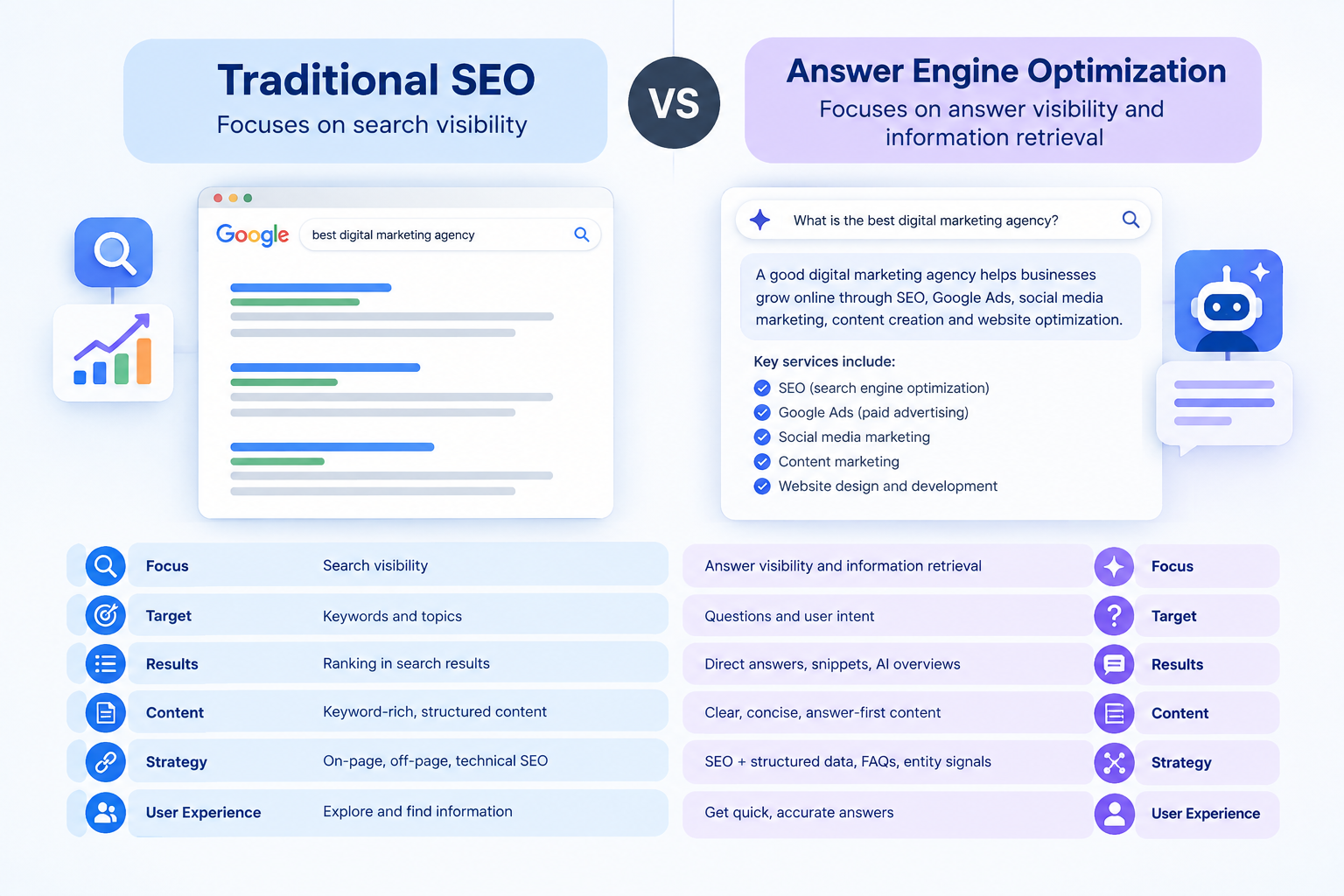
AEO and traditional SEO overlap significantly, but they place emphasis on different aspects of search visibility.
| Traditional SEO | Answer Engine Optimization |
|---|---|
| Focuses on search visibility | Focuses strongly on answer visibility and information retrieval |
| Targets keywords and topics | Targets questions, topics, entities, and intent |
| Optimizes pages for search discovery | Makes information easier to understand and extract |
| Uses titles, headings, links, and content | Uses these elements with direct answer structures |
| Measures rankings and organic traffic | Can also consider visibility across answer focused search experiences |
| Focuses on website discoverability | Focuses on discoverability plus answer usefulness |
The two approaches should not be separated.
A website can have excellent AEO content but still struggle if its pages are technically inaccessible to search engines.
Similarly, a website can have excellent technical SEO but weak AEO performance if its content does not clearly answer user questions.
The strongest strategy combines both.
To optimize for AEO, start with the questions your audience actually asks.
Do not begin by inserting keywords into an article.
Begin with the information problem.
Ask:
What does the customer want to know?
Why do they need this information?
What would they ask before contacting a business?
What objections might they have?
What comparison would help them make a decision?
What information would prevent them from searching again?
These questions can reveal much stronger content opportunities than keyword volume alone.
Question research is one of the foundations of an effective AEO strategy.
Useful sources include:
For example, a company offering SEO services may discover that customers do not only ask:
“SEO services”
They also ask:
These questions can become individual sections, supporting articles, FAQs, or complete topic clusters.
One of the most important AEO writing principles is simple:
Do not make the reader wait for the answer.
If the heading asks:
What Is AEO?
The answer should appear immediately below it.
A useful structure is:
Question → Direct answer → Explanation → Example → Related information
This format works well for both readers and structured search experiences.
The direct answer should usually be concise.
The deeper explanation can follow underneath.
This allows readers who need a quick answer to get it immediately while giving readers who want more detail a comprehensive resource.
Question based headings help establish a clear relationship between the query and the answer.
Useful examples include:
These headings should sound natural.
Do not create awkward headings simply because they contain an exact keyword.
Natural language is more important than mechanical keyword placement.
An effective AEO strategy should be based on audience intent, topical relevance, content quality, and information architecture.
A practical process looks like this:
This approach prevents the website from publishing dozens of disconnected articles.
Instead, every piece of content has a purpose.
Search intent is critical for AEO.
Consider these four searches:
What is SEO?
This is informational.
How does SEO work?
This is educational.
SEO services for small business
This has commercial intent.
Best SEO agency for my business
This is closer to decision making.
Each query requires a different type of content.
Trying to answer all four with one generic paragraph usually creates a weak experience.
Instead, build content that matches the question.
A definition page should define the subject.
A guide should explain the process.
A service page should explain the service and its value.
A comparison page should help users evaluate options.
This is one of the most important principles when you optimize for answer engines.
Answer first content is one of the simplest ways to make information more useful.
Suppose a page has the heading:
What Is Answer Engine Optimization?
Start with:
Answer engine optimization is the practice of structuring online content so search engines and AI powered answer systems can better understand and use the information when responding to relevant questions.
Then explain:
This structure is much more useful than a long introduction that delays the definition.
Definitions are especially valuable because many searches begin with:
When defining a technical subject, use plain language first.
For example:
Semantic SEO is the practice of optimizing content around topics, meaning, entities, relationships, and search intent rather than relying only on exact keyword repetition.
Then provide deeper details.
This creates a clear information hierarchy.
Modern search behavior often resembles natural conversation.
Instead of searching:
AEO optimization
A user might ask:
How can I optimize my website for AI answers?
Instead of:
AEO strategy
They might ask:
What should an AEO strategy include?
This means content should cover natural language variations without keyword stuffing.
Include the questions people naturally ask.
For example:
The goal is not to repeat these phrases endlessly.
The goal is to answer them naturally.
To optimize for answer engines, make your content easy to understand at multiple levels.
Search systems need to identify:
Useful practices include:
The content should remain useful to humans first.
Structured data can help search engines interpret information about a page.
Depending on the content, relevant schema types may include:
Structured data should accurately represent visible page content.
It should not be treated as a guarantee of search visibility or AI inclusion.
The most important foundation remains useful content combined with technically accessible pages.
A well written FAQ section can address genuine questions that were not fully covered elsewhere on the page.
For example, an AEO guide can answer:
Does AEO replace SEO?
How long should AEO content be?
Can small businesses use AEO?
Does structured data guarantee AI visibility?
How can AEO be measured?
Each answer should provide useful information rather than simply repeating a keyword.
FAQ sections are most effective when they reflect real customer intent.
A single article cannot cover every aspect of a broad subject.
A better approach is to create a topic cluster.
For AEO, supporting topics might include:
The main AEO guide can link to detailed supporting pages.
Those supporting pages can link back to the main guide.
This creates a connected information ecosystem.
Internal linking is particularly useful when building topical depth.
For example, a digital marketing agency discussing AEO can naturally link to its SEO services when explaining broader search optimization.
When discussing content quality, it can reference content writing services.
When discussing keyword research, it can link to keyword research services.
When explaining on page optimization, a relevant link can point to on page SEO.
For local search, readers can explore local SEO and Google Business Profile services.
The important point is relevance.
Do not add an internal link simply because the page exists.
Link when the destination genuinely helps the reader.
Trust is important for content that people use to make decisions.
Useful ways to strengthen credibility include:
AEO should not be treated as a shortcut around quality.
If the information is unreliable, simply restructuring it for answer engines does not make it trustworthy.
Some topics remain stable for years.
Others change rapidly.
Technology, software features, advertising platforms, regulations, pricing, and search behavior can change frequently.
Review content when:
Updating content should mean improving it.
Simply changing the date without improving the information does not create meaningful freshness.
Local businesses can use AEO to answer questions about:
For example, a flooring company could answer:
What flooring is best for a Dubai villa?
Is SPC flooring waterproof?
What flooring is suitable for commercial offices?
How long does flooring installation take?
These answers can support a broader local SEO strategy.
Local businesses should also maintain accurate business information and optimize relevant location pages.
Service businesses have a major opportunity because customers usually have many questions before contacting a provider.
A service page can answer:
For example, a digital agency can build supporting content around SEO, PPC, social media marketing, branding, web development, and lead generation.
Relevant Pulse Digital service resources include social media marketing, PPC and Google Ads, branding and design, and website design and development.
Content marketing and AEO work well together because both depend on understanding the audience.
Instead of publishing articles only because a keyword has search volume, build content around the questions customers ask throughout their journey.
What is digital marketing?
Which digital marketing channels should a small business use?
How much does digital marketing cost?
What should I look for in a digital marketing agency?
How should I measure digital marketing performance?
This approach creates a content library that supports different stages of the customer journey.
AEO primarily concerns organic content and answer focused visibility, but PPC data can provide useful insights for content strategy.
Paid search campaigns can reveal:
These insights can then inform organic content.
Businesses can also use Google Ads and PPC services, including search advertising, display advertising, and lead generation as part of a broader digital marketing strategy.
Repeating “answer engine optimization” in every paragraph does not make a page more useful.
Use keywords naturally.
People are still the primary audience.
Write content that is clear and useful to humans.
A direct answer is valuable, but complex topics often need explanations, examples, limitations, and context.
Content that simply repeats information already available everywhere may provide little additional value.
Add practical insights, examples, original explanations, experience, and useful context.
A well written article cannot compensate for serious crawling, indexing, rendering, or accessibility problems.
Do not say that a specific technique will guarantee AI visibility.
Search systems are complex and continuously changing.
A page can contain hundreds of related keywords and still fail to satisfy the actual question.
Measuring AEO can be more complex than checking a traditional keyword position.
Useful metrics include:
Use multiple signals rather than relying on a single metric.
For example, an informational article may generate fewer immediate sales but introduce a large number of potential customers to the brand.
Find real customer questions.
Group them by topic and search intent.
Decide which questions belong on service pages, blog posts, FAQs, comparison pages, or category pages.
Write a direct answer first.
Add explanations, examples, supporting information, and related questions.
Add relevant internal links.
Check accuracy, structure, links, readability, and technical accessibility.
Use performance data and new customer questions to update the content.
Before publishing a page, ask:
AEO should not exist separately from SEO.
Technical SEO helps search engines access and understand a website.
Keyword research identifies relevant search demand.
On page SEO improves page structure.
Content writing provides useful information.
Internal linking connects related pages.
Local SEO supports location based searches.
Off page SEO can contribute to authority and visibility.
AEO adds a stronger focus on questions, direct answers, conversational search, and machine understandable information.
Businesses can build this foundation through keyword research, on page SEO, off page SEO, content writing, and a broader SEO strategy.
To optimize for AEO, focus on the questions behind the search rather than focusing only on keywords.
Give readers direct answers.
Use clear headings.
Understand search intent.
Build topical depth.
Create useful supporting content.
Connect related pages with internal links.
Maintain technical SEO.
Use accurate information.
Demonstrate genuine expertise.
Keep content updated when necessary.
The strongest AEO strategy is not about trying to manipulate an answer engine. It is about making valuable information easier for both humans and machines to understand.
When a page gives a clear answer, provides useful context, addresses related questions, and helps the visitor take the next logical step, it becomes useful across traditional search, conversational search, and emerging AI answer experiences.
AEO stands for Answer Engine Optimization. It is the practice of creating and structuring content so answer focused search systems can better understand and potentially use the information when responding to relevant questions.
Start by researching real user questions. Provide direct answers, use clear headings, cover related topics, match search intent, strengthen internal linking, maintain technical SEO, and publish accurate and useful information.
Answer engine optimization is an approach to search optimization that focuses on making information clear, structured, relevant, and useful for question based search and answer experiences.
Answer engine SEO refers to SEO practices that make website content easier for answer focused search systems to understand and retrieve. It overlaps with traditional SEO, semantic SEO, content optimization, and search intent optimization.
No. AEO complements SEO. Technical SEO, crawlability, indexing, content quality, internal linking, authority, and website structure remain important.
An AEO strategy is a plan for identifying user questions, creating direct answers, organizing related content, strengthening topical authority, improving website accessibility, and measuring search visibility.
AEO can make information easier to understand by using direct answers, descriptive headings, logical structure, relevant context, and useful supporting information. However, no particular format guarantees inclusion in an AI generated answer.
No. FAQs should be used when genuine related questions exist. A FAQ section should provide additional value rather than exist only for keyword placement.
Yes, but optimization should focus on topics, entities, questions, relationships, and search intent instead of repeating exact keywords unnaturally.
There is no universal AEO word count. Content should be long enough to answer the relevant questions comprehensively without adding unnecessary information.
Yes. Small businesses can create content answering questions about their services, products, locations, processes, pricing factors, customer problems, and frequently asked questions.
AEO generally refers to Answer Engine Optimization, while GEO is commonly used for Generative Engine Optimization. The two concepts overlap because both focus on visibility and usefulness within modern AI powered search and answer experiences.
Create useful and authoritative content, answer specific questions clearly, organize information logically, strengthen internal linking, maintain technical SEO, use accurate information, and demonstrate relevant expertise.
No. Structured data can help provide machine readable context, but it does not guarantee rankings, enhanced search results, or inclusion in AI generated answers.
Measure AEO using a combination of organic impressions, clicks, search queries, relevant traffic, conversions, engagement, search visibility, and performance across important question topics.
No. Service businesses, ecommerce websites, local businesses, SaaS companies, publishers, and professional organizations can all use AEO principles where they match user intent.
Clear answers, definitions, lists, tables, and logical structures can make information easier for search systems to interpret. However, featured result placement is not guaranteed.
Internal linking connects related information and helps users navigate from a broad answer to more detailed resources. It also provides additional context about relationships between pages.
Update content when the underlying information changes, important links become outdated, new evidence becomes available, or user questions indicate that the page needs improvement.
Yes. Local businesses can answer questions about services, locations, service areas, pricing factors, processes, and customer needs while maintaining a strong local SEO foundation.
Yes. Service pages can answer questions about what a service includes, who needs it, how the process works, what affects pricing, and what customers can expect. This can make commercial pages more useful while supporting broader search visibility.