
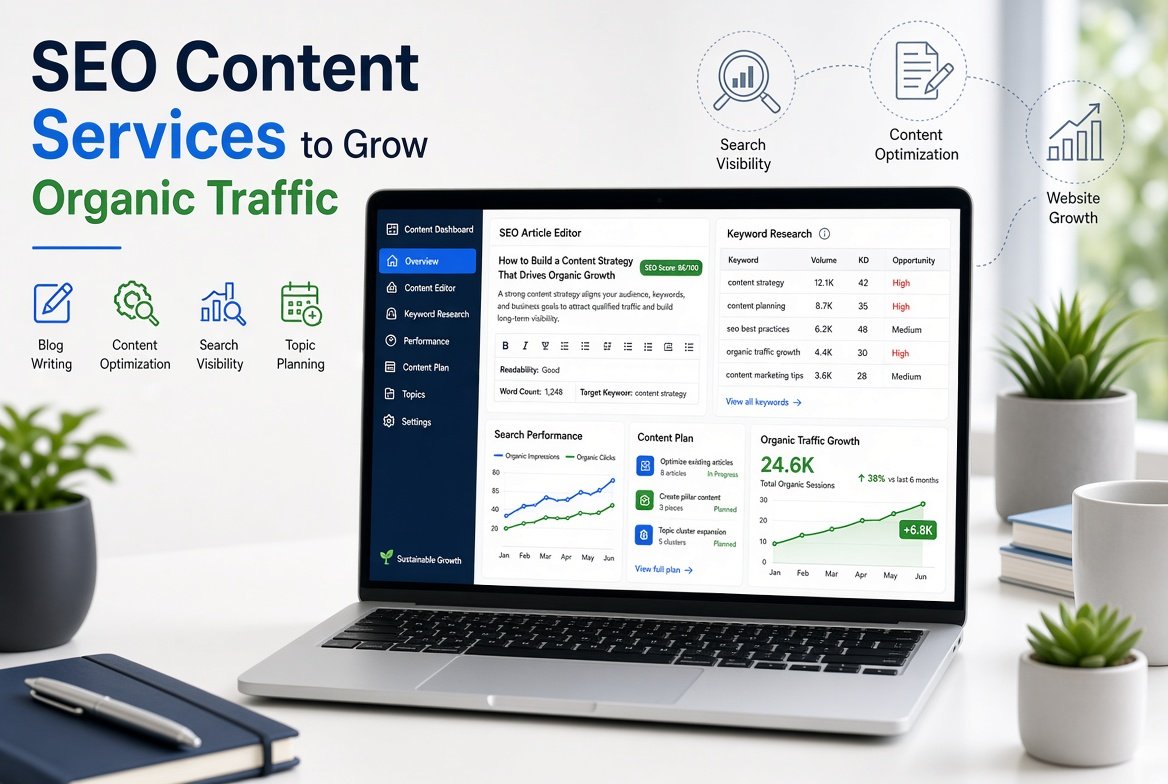
SEO content services help businesses attract relevant visitors from search engines by creating, optimizing, and improving content around what their target audience is searching for. From keyword research and blog writing to service page optimization and content updates, a structured SEO content strategy helps businesses improve search visibility, build topical authority, and generate qualified leads over time.
Publishing content regularly is not enough to achieve sustainable SEO growth. Your content must answer search intent, provide useful information, demonstrate expertise, and make it easy for visitors to take the next step. Professional SEO content services bring these elements together to help businesses turn organic search traffic into meaningful business results.
SEO content services involve planning, creating, optimizing, and maintaining website content to improve its visibility in search engine results. The goal is to produce useful content that meets audience needs while helping search engines understand the relevance and purpose of each page.
These services combine content strategy with search engine optimization. Instead of writing articles around keywords alone, SEO specialists research customer questions, analyze competitors, identify content gaps, and create pages that satisfy search intent.
SEO content services may include:
SEO keyword research and search intent analysis
Blog post writing and optimization
Website service page content
Landing page content development
Product and category page optimization
Content audits and existing page updates
Internal linking and content structure improvements
Topic cluster planning and topical authority development
On-page SEO recommendations
Content performance tracking and reporting
Businesses looking to improve their overall search visibility can combine content development with professional SEO services for businesses. This creates a more coordinated strategy in which technical performance, page optimization, content quality, and keyword targeting support the same organic growth objectives.
Organic traffic consists of visitors who reach your website through unpaid search engine results. Unlike traffic generated exclusively through advertising, organic visibility can continue to attract visitors after a page has been published, provided it remains relevant, competitive, and technically accessible.
SEO content services help businesses develop content that matches real search demand and supports long-term growth.
Search engines need to understand what your pages cover and how well they answer a user’s query. Clearly structured, relevant content helps communicate the topic, purpose, and value of each page.
SEO content specialists optimize titles, headings, introductions, body copy, and related page elements. They also ensure that content addresses the subject comprehensively without unnecessary repetition or keyword stuffing.
These improvements can help search engines interpret your pages and determine when they may be relevant to a search query.
More website traffic does not always mean more customers. A page can receive thousands of visits without generating qualified leads if its content attracts the wrong audience.
Effective SEO content services focus on relevant search terms and the intent behind them. For example, someone searching for general SEO advice may be looking for information, while someone searching for professional SEO content services may be comparing providers.
Matching content to these different needs helps businesses attract visitors who are more likely to engage with their services.
Useful, accurate, and well-organized content helps demonstrate a business’s knowledge of its industry. Readers are more likely to trust pages that answer their questions directly, explain important details, and provide practical guidance.
Content should reflect genuine expertise, include appropriate examples, and avoid unsupported promises. Author information, relevant case studies, transparent service details, and useful supporting resources can further strengthen credibility.
SEO content can support customers throughout the buying journey, from their initial research to their final purchasing decision.
Informational blog posts introduce readers to a problem. Comparison articles help them evaluate possible solutions. Service pages explain how your business can help and provide a clear next step.
A strong content strategy connects these page types so visitors can move naturally from learning about a problem to exploring your services.
Paid advertising can generate immediate visibility while a campaign is active. SEO content, on the other hand, can continue to attract search traffic over time.
Organic performance is not guaranteed, and rankings may change as competitors, search algorithms, and user needs evolve. However, maintaining useful content and improving pages based on performance data can create a sustainable source of relevant website visits.
Every website has different content requirements. The right mix depends on the business model, target audience, industry, competition, and customer journey.
Blog writing helps businesses answer questions, explain complex topics, and target informational search queries. It can also support broader service pages by covering related subjects in greater depth.
Professional SEO blog writing includes topic research, keyword mapping, content outlines, heading structure, competitor analysis, and on-page optimization.
Effective blog content should:
Address a clearly defined audience need.
Answer the main question early in the article.
Use relevant keywords naturally.
Include meaningful examples and practical advice.
Link to related pages where useful.
Provide an appropriate next step for readers.
Publishing random articles without a clear strategy can create overlapping topics and inconsistent results. A planned editorial calendar helps ensure that each article serves a specific purpose.
Service pages are essential for businesses that want to turn organic traffic into enquiries and sales. These pages explain what a company offers, who its services are for, and why potential customers should consider working with it.
SEO content services improve service page relevance by aligning headings, descriptions, benefits, supporting information, and calls to action with customer intent.
Businesses can also strengthen service pages through relevant content writing services that balance search optimization with clear, persuasive communication.
A strong service page should explain the service, address common customer concerns, demonstrate credibility, and make the next action easy to understand.
Landing pages are designed around a specific offer, audience, campaign, or conversion goal. Their content should communicate value quickly and remove unnecessary barriers to action.
SEO-focused landing pages need a clear topic, relevant headings, useful supporting information, and an appropriate structure. They should also avoid duplicating other pages that target the same search intent.
Businesses running paid campaigns can align organic landing page content with their advertising strategy. For example, a company investing in Google Ads campaign management can use consistent messaging across advertisements and landing pages to provide a more relevant visitor experience.
Online stores often have hundreds or thousands of product and category pages. Thin descriptions, duplicate copy, missing category information, and unclear page structure can limit their usefulness to shoppers and search engines.
SEO content services for e-commerce websites may include:
Unique product descriptions
Search-focused category introductions
Product feature and benefit explanations
Buying guides and comparison articles
Frequently asked questions
Internal links between related products and categories
Content should help customers make informed decisions rather than simply repeat manufacturer descriptions. Product specifications, compatibility details, use cases, and genuine differentiators can make pages more useful.
Local businesses need content that explains their services and helps customers understand the areas they serve. Relevant location pages can support local search visibility when they provide meaningful information for each location.
For businesses targeting customers in specific cities or service areas, local SEO services can complement content development through location targeting, business profile optimization, and local search strategy.
Location pages should contain genuinely useful, area-specific information. Creating many nearly identical pages by replacing only the city name can lead to poor user experiences and weak differentiation.
Long-form guides help businesses address complex topics and answer several related questions within a structured resource.
These guides may explain processes, compare solutions, clarify technical concepts, or help customers evaluate their options. They can also support related blog posts and service pages through contextual internal links.
Longer content is not automatically better. The appropriate length depends on the topic, search intent, and information required to answer the user’s question fully.
Keyword research identifies the terms people use when searching for information, products, and services. It helps content teams understand demand, identify opportunities, and prioritize topics that are relevant to business objectives.
Without research, businesses may invest in articles that attract little interest or target phrases that do not match their offerings.
A primary keyword represents the central topic or search phrase a page targets. Secondary keywords cover closely related concepts, questions, and variations that help complete the topic.
For example, a page about SEO content services may naturally discuss content optimization, SEO blog writing, organic traffic growth, content strategy, and search intent.
These terms should fit the content naturally. There is no need to insert every variation repeatedly or follow an arbitrary keyword density.
Businesses can develop a more structured approach with dedicated keyword research services that identify relevant search opportunities and connect them to specific pages.
Search intent describes what a person wants to accomplish through a search.
The main intent categories include:
Informational: The user wants to learn about a subject.
Navigational: The user wants to find a particular website or brand.
Commercial investigation: The user is comparing options before making a decision.
Transactional: The user is ready to take an action, such as purchasing a service.
The best content format depends on this intent. A beginner’s guide may suit an informational query, while a service page may better serve someone searching for a provider.
Reviewing search results can help determine which format is most appropriate for a target keyword.
Competitor research can reveal topics that competing websites cover, questions they answer, and information they may be missing.
The objective is not to copy competitors. Instead, identify opportunities to create more helpful, accurate, original, and better-organized content.
Look for missing explanations, outdated information, unanswered questions, weak examples, and unclear service details. Use those observations to build a more useful resource.
A keyword-to-page map assigns target topics to the most suitable pages on a website. This helps prevent several pages from competing unnecessarily for the same search intent.
For example, a detailed article about SEO content strategy and a commercial page selling SEO content services may target related but distinct user needs.
Mapping keywords to pages makes it easier to establish page purpose, choose appropriate internal links, and identify gaps in the content plan.
High-quality writing needs a clear page structure and appropriate on-page optimization. On-page SEO helps search engines and users understand a page’s content, organization, and relevance.
Businesses can strengthen their content strategy through on-page SEO optimization that improves the way important page elements are presented.
The title tag should communicate the page’s main topic and give searchers a clear reason to consider visiting. It should be specific, relevant, and distinct from titles used on other pages.
Meta descriptions summarize the page and may influence whether someone chooses to click. They should accurately describe the content and highlight its value without making unsupported claims.
Search engines may generate different title links or snippets depending on the query, so these elements do not guarantee a particular search appearance.
Headings organize content into logical sections and help readers find the information they need.
Use one clear main heading, followed by descriptive subheadings that reflect the page’s structure. Related questions and supporting concepts should appear in sections where they make sense.
Avoid adding headings merely to repeat keywords. Each heading should introduce useful information or help readers navigate the page.
Online readers often scan content before deciding which sections deserve their attention. Short paragraphs, descriptive headings, meaningful lists, and straightforward language improve usability.
Avoid excessive jargon and unnecessary introductions. Explain technical terms when needed and provide examples when they clarify the subject.
Internal links connect pages within the same website. They help visitors discover related information and provide search engines with additional context about the relationship between pages.
For an SEO content article, relevant internal links may point to keyword research, on-page SEO, content writing, or broader SEO service pages.
Anchor text should describe the destination naturally. Use links where they help readers continue their journey rather than adding links solely to increase their number.
Some subjects change frequently, while others remain relatively stable. Review content periodically to identify outdated information, broken links, obsolete examples, and opportunities to improve clarity.
Updates should add genuine value. Changing a publication date without making meaningful improvements is not a substitute for maintaining useful content.
Internal linking is an important part of content architecture. It helps create meaningful connections between related pages and makes it easier for users to navigate a website.
A well-planned internal linking strategy can support several objectives.
Improve content discovery: Links help visitors find related articles and service information without having to return to search results.
Clarify topical relationships: Linking a detailed article to a relevant service page can help establish the relationship between educational information and the service offered.
Support website navigation: Contextual links provide natural next steps for readers who want to explore a subject further.
Help search engines discover pages: Internal links provide crawlable paths to other pages on a site, although they do not guarantee indexing or ranking improvements.
For example, a blog post explaining keyword research can link to a dedicated keyword research service when the reader may benefit from professional assistance. Similarly, an article discussing content optimization can reference a relevant on-page SEO service.
Internal links should be relevant, descriptive, and useful. Avoid linking every mention of a keyword, repeating identical anchors unnecessarily, or directing users to unrelated pages.
Publishing new content is only one part of a successful SEO strategy. Existing pages may already have impressions, backlinks, search visibility, or valuable information that can be improved.
A content audit evaluates the quality and performance of current website content to determine which pages should be maintained, updated, consolidated, or removed.
Review organic clicks, impressions, click-through rates, and ranking trends to identify pages that may need attention.
A decline does not automatically mean the content is poor. Search demand, seasonality, competition, technical issues, and changes in search results can all affect performance.
Investigate the cause before making significant changes.
Some pages receive impressions but attract relatively few clicks. Others receive visits but fail to answer the user’s question or generate engagement.
Potential improvements include clearer titles, stronger introductions, more useful examples, updated information, improved heading structure, and better links to relevant resources.
When several pages cover nearly identical topics, they may compete for similar queries or provide a confusing user experience.
Review their purpose, search performance, and existing links before deciding whether to combine them. If consolidation is appropriate, implement redirects carefully where necessary and update internal links to point to the preferred destination.
Not every similar page needs to be merged. Separate pages can be useful when they address genuinely different audiences or search intents.
Search experiences increasingly include AI-generated answers, summaries, and conversational interfaces. Businesses therefore need content that is clear, accurate, well organized, and useful beyond traditional search snippets.
Answer Engine Optimization (AEO) focuses on making information easy to identify and use when systems respond to questions. Generative Engine Optimization (GEO) focuses on improving the visibility and usefulness of content in generative search experiences.
Helpful practices include:
Answering the main question directly.
Using descriptive headings and logical sections.
Providing original insights and specific examples.
Explaining terminology clearly.
Supporting factual statements with credible sources when appropriate.
Keeping business and service information consistent.
Maintaining accurate, useful content.
These practices can improve clarity and accessibility, but no content format guarantees inclusion in an AI-generated answer or recommendation.
Businesses should prioritize reliable information and genuine audience value instead of creating pages solely to target a particular AI system.
Professional SEO content services usually follow a structured workflow. The exact process depends on the project size, website condition, and business goals.
The process begins with understanding the company’s services, target customers, differentiators, and commercial priorities.
This helps the content team determine which topics are relevant and which actions the website should encourage.
The team researches relevant keywords, search demand, user questions, and competing pages. Opportunities are prioritized according to relevance, competition, potential value, and the website’s existing authority.
Research findings are organized into a content plan. This may include new blog topics, service page improvements, content clusters, and updates to existing pages.
Each planned page should have a clear purpose and avoid unnecessary overlap with other content.
A content brief defines the target audience, primary topic, search intent, required sections, supporting questions, relevant internal links, and desired action.
A useful brief provides direction without forcing the writer to include unnecessary keywords or repetitive wording.
Writers create content that answers the intended question and reflects the business’s expertise. SEO specialists review page structure, keyword relevance, internal linking, metadata, and readability.
Fact-checking and editorial review are important, particularly for technical, financial, medical, or other sensitive subjects.
Before publishing, review the content for formatting, working links, spelling, metadata, mobile usability, and any relevant structured data.
Confirm that the page can be accessed by users and search engines. Where appropriate, include it in the website’s XML sitemap.
After publication, monitor performance using tools such as Google Search Console and Google Analytics.
Evaluate whether the page is earning impressions, attracting relevant visitors, and contributing to business goals. Use the findings to guide future updates and content decisions.
Content performance should be evaluated using a combination of search, engagement, and business metrics. Rankings alone do not provide a complete picture of success.
Google Search Console provides data about how often pages appear in Google Search and how many clicks they receive.
Impressions can indicate growing visibility, while clicks show how frequently searchers visit the website from those results.
Click-through rate measures the percentage of impressions that result in clicks. A page with many impressions but a low click-through rate may benefit from a clearer title or more compelling description, although query intent and search result features also affect performance.
Measure traffic to the pages that support your business goals. Segment performance by landing page, topic, location, and other useful dimensions to understand which content attracts the right audience.
Track enquiries, form submissions, calls, purchases, and other meaningful actions where relevant. Conversion tracking helps connect content performance to business outcomes.
Depending on the analytics setup, useful indicators may include engaged sessions, landing page engagement, and progression to other important pages.
Interpret engagement metrics in context. A visitor who finds a direct answer quickly may have a successful experience without browsing several pages.
Monitor how target pages perform over time. Look for sustained changes rather than reacting to every short-term ranking movement.
A reliable reporting process connects content activity to measurable outcomes and identifies practical next steps.
Even well-intentioned content strategies can underperform when they focus on publishing volume rather than usefulness.
Repeating the same phrase unnaturally makes content difficult to read and does not guarantee better rankings. Use primary and related keywords where they fit naturally.
Pages that provide little information or simply repeat existing material may offer limited value. Expand content when additional detail genuinely helps the reader.
An article may target the correct keyword but still fail if it does not match what users want. Examine the query and the likely task behind it before choosing the content format.
Replacing city names across nearly identical pages can create repetitive content that offers little local value. Make location pages distinct and useful, or reconsider whether separate pages are necessary.
Pages that lack useful internal links may be harder for visitors to discover and navigate. Connect relevant content using descriptive anchors and logical relationships.
AI tools can assist with research, outlining, and drafting, but generated material may contain errors, generic statements, or unsupported claims. Human review, subject expertise, originality, and fact-checking remain important.
Without performance tracking, businesses cannot reliably determine which topics attract qualified traffic or contribute to leads. Establish baseline measurements and review results regularly.
The cost of SEO content services varies according to the scope of work, content complexity, research requirements, industry competition, and the experience of the provider.
Common pricing models include:
Per article: Suitable for businesses that need individual blog posts or guides. Prices depend on research depth, length, subject complexity, and editorial requirements.
Monthly retainer: Appropriate for businesses that need ongoing content planning, writing, optimization, publishing support, and reporting.
Project-based pricing: Useful for content audits, website rewrites, service page development, or a defined content strategy project.
Per-page optimization: Suitable for updating existing service pages, landing pages, category pages, or other important URLs.
When comparing providers, review the actual deliverables rather than choosing solely by price. Confirm whether keyword research, editing, optimization, internal linking, revisions, and performance reporting are included.
The right investment should reflect the business’s objectives, available resources, and expected value of attracting qualified organic visitors.
Selecting an SEO content partner requires more than reviewing writing samples. Businesses should look for a provider that understands search intent, content strategy, website structure, and measurable business outcomes.
Consider the following factors.
SEO expertise: The provider should understand keyword research, on-page optimization, search intent, and internal linking.
Industry understanding: Relevant experience can help the team communicate complex services accurately and address customer concerns.
Content quality: Review samples for clarity, originality, factual accuracy, useful examples, and readability.
Transparent process: A reliable provider should explain research, planning, writing, approval, publishing, and reporting workflows.
Performance measurement: The provider should discuss meaningful indicators such as organic visibility, relevant traffic, enquiries, and conversions.
Realistic expectations: No agency or writer can guarantee a specific ranking or a fixed amount of organic traffic within a particular period.
Clear deliverables: Agree on content volume, optimization requirements, revision limits, deadlines, and reporting responsibilities before starting.
The best provider will develop a strategy around your business rather than offering the same collection of generic articles to every client.
PulseDigitall helps businesses approach digital growth through coordinated SEO and marketing services. A strong content strategy should support the website’s broader objectives, from improving organic visibility to explaining services and generating qualified enquiries.
Businesses can explore professional SEO solutions to understand how content development fits into a broader search strategy.
A focused content plan can include keyword research, blog writing, service page optimization, internal linking, content audits, and performance measurement. Each activity should serve a defined purpose and contribute to a website that is useful for both visitors and search engines.
For companies that need content across multiple channels, organic search can also work alongside relevant social media marketing services. This allows businesses to distribute useful resources, reach audiences through different platforms, and maintain consistent messaging.
The objective is not simply to publish more pages. It is to create useful content that answers real questions, supports customer decisions, and contributes to measurable business growth.
SEO content services include researching, creating, optimizing, and updating website content to improve its relevance to search queries. They may cover blog posts, service pages, landing pages, product descriptions, content audits, keyword research, and internal linking.
They help businesses identify relevant search topics, create content that matches user intent, improve existing pages, and strengthen website structure. These activities can improve search visibility and attract relevant visitors, although results depend on competition, website quality, and other factors.
The timeline varies according to website authority, competition, content quality, technical condition, and search demand. Some pages may gain visibility relatively quickly, while others require several months of improvement and ongoing work. There is no universal ranking timeline.
SEO content writing considers search intent, keyword relevance, page structure, and internal linking alongside readability and usefulness. Regular content writing may focus primarily on communication or storytelling without a defined organic search objective.
There is no ideal publishing frequency for every website. Businesses should choose a realistic schedule that allows them to research, create, review, and maintain useful content consistently. A smaller number of high-quality pages can be more valuable than publishing large volumes of repetitive articles.
Longer content does not automatically rank better. The appropriate length depends on the topic and what users need to know. Content should be as comprehensive as necessary without adding irrelevant sections simply to increase word count.
Yes. Relevant internal links help users navigate related pages and help search engines discover content and understand relationships between pages. Links should use descriptive anchor text and connect genuinely related information.
AI can assist with outlining, drafting, research organization, and editing. However, content should be checked for factual accuracy, originality, usefulness, and alignment with the audience’s needs. Automated production without meaningful review can result in generic or unreliable content.
Businesses can review organic clicks, impressions, click-through rates, relevant landing page traffic, leads, and conversions. The most useful metrics depend on the page’s purpose and the business outcome it is intended to support.
Yes. Small businesses can use SEO content to answer customer questions, explain services, target relevant local searches, and build visibility over time. A focused strategy that prioritizes the most valuable topics can help businesses make better use of limited resources.
SEO content services work best when every page has a clear purpose, answers a genuine audience need, and supports the website’s wider marketing strategy. Keyword research, useful writing, on-page optimization, internal linking, and ongoing performance analysis help businesses build a stronger foundation for organic search growth.
Instead of publishing content without a plan, focus on the topics your customers care about, improve the pages that matter most, and connect related resources through useful internal links.
Ready to improve your website’s organic visibility and attract more relevant visitors? Get Free Strategy Session with PulseDigitall to discuss a content strategy aligned with your business goals.