
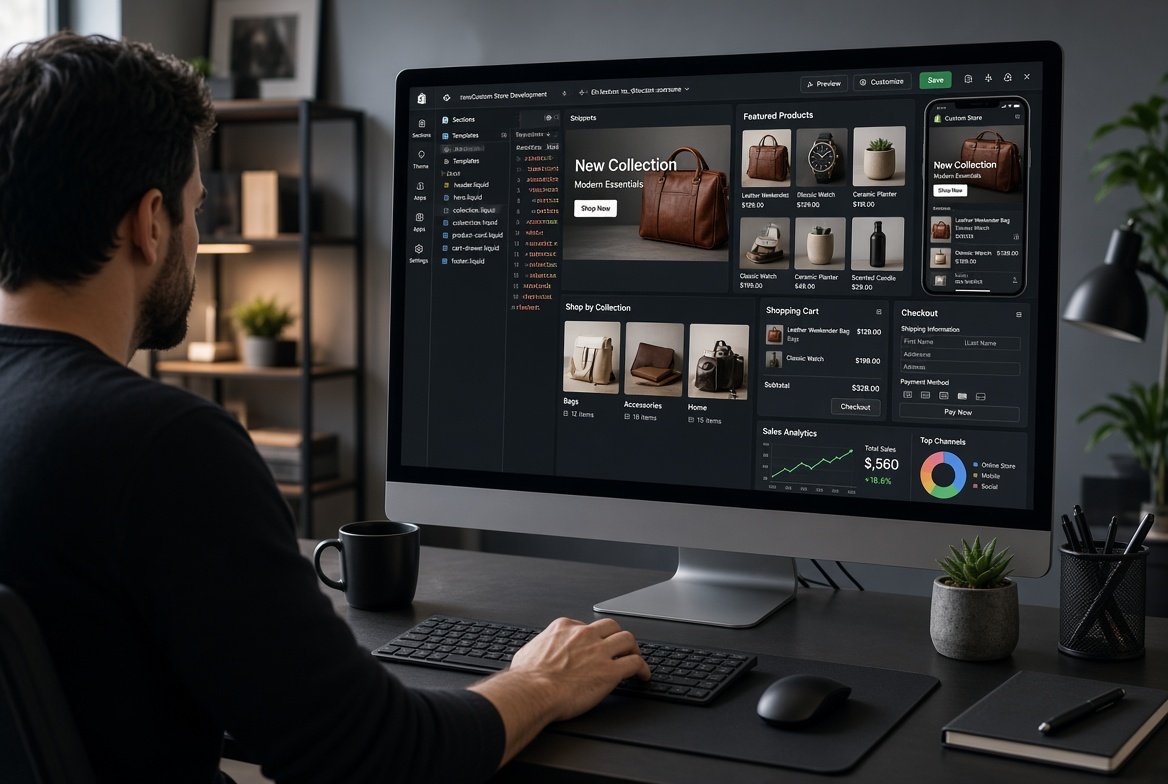
 Shopify Website Developer for Custom Stores
A Shopify Website Developer helps businesses build, customize, and improve online stores with features designed around specific ecommerce requirements. A professional Shopify developer can customize themes, create unique layouts, integrate third party tools, improve store performance, build custom functionality, and create a shopping experience that fits the brand and its customers.
Shopify provides a strong ecommerce platform, but every business has different products, customers, workflows, and growth goals. A custom Shopify store can therefore provide a more suitable experience than relying entirely on a standard theme. The right developer can turn a basic Shopify setup into a professional ecommerce website that is easier to use, manage, and grow.
A Shopify Website Developer is a professional who specializes in building and customizing ecommerce websites using the Shopify platform.
A developer can work on both the visible parts of a store and the technical functionality behind them.
Typical Shopify development work can include:
The exact scope depends on the business and the complexity of the ecommerce project.
Shopify makes it possible for businesses to create stores without extensive technical knowledge. However, businesses with specific requirements may eventually need professional development.
A Shopify developer can help solve problems that cannot be handled effectively through standard settings alone.
Every ecommerce business is different.
One business may need a custom product configurator, while another may require advanced filtering, unique product layouts, subscription functionality, or integration with an external system.
A Shopify developer can evaluate the requirement and build an appropriate solution.
A professional developer can structure the store around the way customers actually shop.
This can include:
The goal is to reduce unnecessary friction throughout the customer journey.
A standard Shopify theme may not fully represent an established brand.
Custom development can allow businesses to create a more distinctive website while maintaining Shopify’s ecommerce functionality.
For businesses that also need visual branding, PulseDigitall provides branding and design services.
The responsibilities of a Shopify developer can vary considerably depending on the project.
Themes control much of the appearance and structure of a Shopify store.
A developer can customize an existing theme or create custom theme elements according to business requirements.
Theme development can involve:
The objective is to create a consistent and usable store.
Custom sections allow businesses to display content in ways that may not be available through standard theme settings.
For example, a business might need:
A developer can create these sections so the business can manage them through the Shopify administration system.
Store customization can range from small visual changes to significant functionality.
Examples include:
The right level of customization depends on the store’s goals.
A custom Shopify store is useful when a business needs an ecommerce website that goes beyond standard templates.
Custom development may be appropriate for:
Custom development should always solve a specific business problem. Adding features simply because they are technically possible can make a store harder to manage.
Shopify ecommerce development covers the technical work required to create a functional online store.
This can include:
For businesses that need broader ecommerce solutions, PulseDigitall also provides ecommerce development services.
Mobile responsiveness is essential for modern ecommerce stores.
Customers may browse products using smartphones, tablets, laptops, and desktop computers. The store should provide a consistent experience across these devices.
A Shopify developer can optimize:
Mobile menus should be simple and easy to understand.
Customers should be able to reach important categories without navigating through unnecessary steps.
Product information should remain readable on smaller screens.
Important elements such as pricing, product variants, images, reviews, and purchase buttons should be easy to access.
The checkout experience should also be tested carefully on mobile devices.
Forms should be clear, buttons should be accessible, and unnecessary fields should be avoided.
A custom Shopify theme provides greater control over the appearance and functionality of a store.
Businesses may choose custom theme development when they want:
However, custom themes require careful planning and development.
The theme should remain maintainable so future updates do not become unnecessarily difficult.
Product pages are central to ecommerce.
A Shopify developer can create custom product layouts that make important information easy to understand.
A strong product page can include:
The layout should be designed around the information customers need before purchasing.
Collections help organize products into meaningful categories.
A Shopify developer can create collection layouts with:
A logical collection structure also helps search engines understand the relationship between products.
Shopify applications can extend the functionality of an online store.
Businesses may use applications for:
A developer can help integrate applications correctly and ensure they work with the existing store.
However, businesses should avoid installing unnecessary applications.
Too many applications can create technical complexity and may affect website performance.
Some businesses need their Shopify store to communicate with external systems.
For example, a store may need integration with:
A Shopify developer can help plan and implement these integrations according to the technical requirements of the business.
Development and search engine optimization should work together.
Technical decisions can affect how search engines crawl, understand, and index a Shopify website.
PulseDigitall provides search engine optimization services that can be combined with Shopify development.
Before creating product and collection structures, it is useful to understand how customers search.
Keyword research can identify:
Businesses can use keyword research services to identify relevant search opportunities.
A Shopify developer should consider SEO friendly structures during implementation.
Important areas include:
PulseDigitall also offers on page SEO services for ecommerce websites.
Large ecommerce stores can create thousands of URLs through products, collections, filters, and other functions.
Technical SEO may involve reviewing:
Technical SEO should be considered during development rather than treated as an afterthought.
Store performance can affect both customer experience and ecommerce results.
A developer can review technical elements that may contribute to slower page loading.
These can include:
Product images are essential, but extremely large image files can affect performance.
Images should be properly sized and optimized without unnecessarily reducing their visual quality.
Applications can provide valuable functionality, but unnecessary applications should be removed.
Regular reviews can help keep the store simpler and easier to maintain.
Custom code should be structured carefully.
Poorly implemented code can create performance issues and make future maintenance more difficult.
A Shopify developer can also support conversion focused improvements.
Conversion optimization aims to make it easier for visitors to complete important actions.
This can include:
The best approach depends on customer behavior and business data.
Some businesses sell products that require more information or customization before purchase.
For example:
A Shopify developer can build or integrate functionality that allows customers to select relevant options before adding products to their cart.
This can improve the shopping experience when standard product variants are not sufficient.
Small businesses often need a store that is professional but simple to manage.
A Shopify developer can build a focused ecommerce website around the business’s most important requirements.
A small store may need:
The development should avoid unnecessary complexity while leaving room for future growth.
Businesses can also combine Shopify development with SEO for small businesses to attract organic traffic.
Larger stores often require more advanced functionality.
A Shopify developer may work on:
Large ecommerce projects require careful planning because small technical problems can affect many pages.
Paid advertising can generate targeted traffic for Shopify stores.
Google Ads can be used to promote products, categories, brands, and special offers.
The destination page should match the advertisement.
For example, an advertisement for a specific product should generally take users to a relevant product page rather than a generic homepage.
PulseDigitall provides Google Ads services for businesses that want to drive qualified traffic to their ecommerce stores.
Google Shopping can help ecommerce businesses display products to people actively searching for them.
Product images, titles, prices, availability, and landing pages all contribute to the customer experience.
PulseDigitall provides Google Shopping Ads for ecommerce businesses.
Content plays an important role in ecommerce.
Product descriptions should explain products clearly, while supporting content can answer customer questions.
For example, an online furniture store could publish:
These resources can support both customers and organic search visibility.
Businesses can also use content writing services to develop useful ecommerce content.
Internal links connect related pages and help customers discover more products.
A Shopify developer can help create structures that connect:
Internal linking can also support SEO by helping search engines understand website relationships.
A professional Shopify development project should follow a structured process.
The first step is understanding the business, products, customers, existing website, technical requirements, and goals.
The development team plans the website structure, navigation, collections, product templates, and important functionality.
Design establishes the visual direction of the store.
This includes layouts, typography, colors, buttons, imagery, spacing, and user experience.
The approved design is implemented in Shopify.
This can involve theme customization, custom sections, templates, applications, and integrations.
Products, collections, variants, images, descriptions, and other content are added.
Required applications and third party systems are connected and tested.
SEO elements are reviewed before launch.
This may include titles, descriptions, headings, URLs, internal links, image alt text, and technical SEO.
The website should be tested across devices and browsers.
Important checks include:
After testing and approval, the store can be launched.
A final review should be completed before the website becomes publicly accessible.
After launch, businesses may need ongoing development for new products, features, applications, integrations, and performance improvements.
Not every available Shopify feature needs to be used.
Development should focus on business requirements.
Too many applications can make a store difficult to manage and may affect performance.
Every major store feature should work properly on mobile devices.
Products should be organized into logical collections and categories.
SEO should be considered during development rather than after launch.
A highly complicated store can make shopping more difficult.
Keep the customer journey simple.
Even a well developed website can contain broken links, mobile problems, checkout issues, or integration errors if it is not tested properly.
The cost of hiring a Shopify Website Developer depends on the scope of the project.
A basic theme customization project generally requires less development than a fully custom Shopify store with advanced functionality.
Factors that can affect cost include:
Businesses should consider technical quality, experience, communication, scalability, and long term value when choosing a Shopify developer.
A Shopify theme provides the visual foundation of the store, while a developer can customize or extend that foundation.
A theme may provide:
A developer can provide:
Therefore, a theme and a developer serve different purposes.
A Shopify designer focuses primarily on visual appearance and user experience.
A Shopify developer focuses more heavily on implementation, functionality, technical customization, integrations, and code.
For larger ecommerce projects, both roles can work together.
The designer establishes how the store should look and function from the customer’s perspective, while the developer implements those requirements within Shopify.
Choosing the right developer can have a significant impact on the final store.
Consider the following factors.
Look for experience with Shopify rather than only general website development.
A developer who understands ecommerce can consider customer journeys, product structures, checkout experiences, and conversion requirements.
If your project requires unique functionality, ask whether the developer has experience with custom Shopify development.
Make sure the developer understands mobile ecommerce requirements.
Basic SEO awareness can help prevent technical problems during development.
Good communication is important for understanding requirements and resolving issues during the project.
Ask how the developer tests websites before launch.
A clear testing process can prevent many avoidable problems.
Custom Shopify development can provide several advantages when used appropriately.
Custom layouts can make the store more closely match the brand identity.
Businesses can implement features that may not be available through standard theme settings.
Custom development can address specific customer needs.
A well planned store can be expanded as the business grows.
A customized website can help a brand stand apart from competitors using identical layouts.
A Shopify Website Developer builds, customizes, maintains, and improves Shopify ecommerce stores. Their work can include themes, custom sections, product pages, integrations, applications, performance, and technical functionality.
Yes. A Shopify developer can customize an existing theme or create custom Shopify components and functionality based on business requirements.
Not every business needs a developer for basic store setup. However, professional development can be useful when a business needs custom design, advanced functionality, integrations, performance improvements, or technical troubleshooting.
Yes. A developer can audit and improve an existing Shopify store, including its theme, navigation, product pages, performance, applications, and custom functionality.
Yes. Responsive development allows Shopify websites to adapt to smartphones, tablets, laptops, and desktop screens.
Yes. Depending on the system and technical requirements, Shopify developers can integrate ecommerce stores with external software, applications, marketing platforms, inventory systems, and other tools.
It can be, but the level of customization should match the business requirements and budget. Small businesses often benefit from focused customization rather than unnecessary complexity.
SEO is a separate discipline, but Shopify development can support SEO through proper website structure, technical implementation, mobile optimization, page speed, internal linking, and other practices.
Yes. Developers can review theme code, applications, scripts, images, and other technical elements that may affect store performance.
The timeline depends on the size and complexity of the project. A small customization can be completed much faster than a large custom store with advanced functionality and multiple integrations.
A Shopify Website Developer can help businesses move beyond a basic ecommerce setup and create a store that is designed around specific products, customers, and business goals.
Custom development can improve the appearance, functionality, performance, navigation, and overall shopping experience of a Shopify store. However, the best development approach is not about adding as many features as possible. It is about choosing the right features and implementing them properly.
From custom themes and product pages to integrations, mobile responsiveness, SEO support, and performance optimization, professional Shopify development can provide the technical foundation required for long term ecommerce growth.
For businesses that need a complete digital strategy, Shopify development can work alongside search engine optimization, content marketing, Google Ads, social media marketing, and conversion optimization to create a stronger online sales channel.