
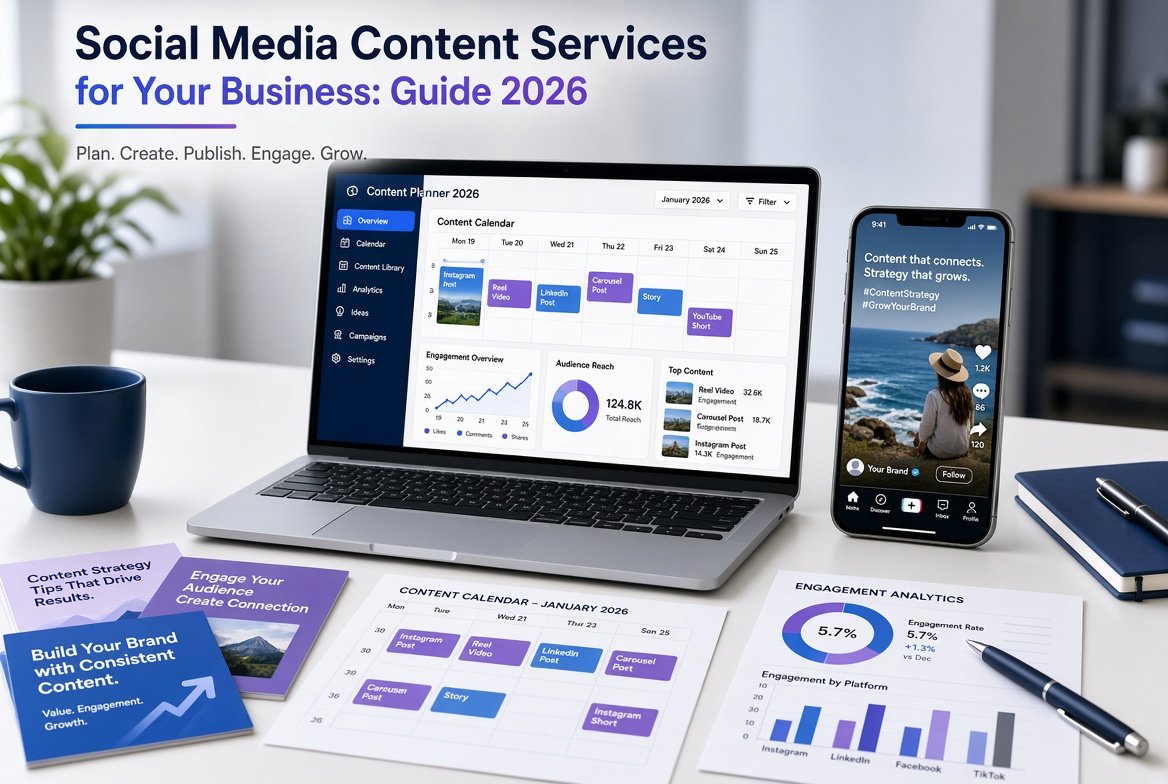
Social media content services help businesses create engaging posts, videos, graphics, captions, and campaigns that attract the right audience, strengthen brand awareness, and support business growth. In 2026, an effective social media strategy requires more than publishing attractive images. Businesses need relevant content, consistent messaging, platform specific formats, and a clear understanding of what motivates their audience to interact, follow, enquire, and purchase.
Professional social media content services bring content planning, creative production, copywriting, design, and performance analysis together. Whether your business wants to generate leads, promote products, build a recognizable brand, or improve audience engagement, a structured content strategy can help you communicate more effectively across social platforms.
This guide explains what social media content services include, how they benefit businesses, which content formats work for different platforms, and how to choose the right content strategy for your marketing goals.
Social media content services involve planning, creating, designing, and optimizing content for platforms such as Facebook, Instagram, TikTok, YouTube, Snapchat, WhatsApp, and X. These services help businesses communicate their value through relevant content that fits each platform and the expectations of its audience.
Content can include promotional graphics, educational posts, short videos, product demonstrations, customer stories, carousels, captions, infographics, and interactive posts. Depending on the provider and project requirements, services may also include content calendars, creative direction, platform optimization, publishing support, and performance reporting.
The main purpose is to ensure that every post has a reason to exist. Content may educate potential customers, introduce a product, answer common questions, encourage conversations, generate enquiries, or support a campaign.
Professional social media content services commonly include:
Businesses that want a coordinated approach can explore social media marketing services to understand how content creation fits into a broader marketing strategy.
Social media gives businesses opportunities to reach audiences, explain products, build relationships, and maintain communication with existing customers. However, publishing content without a defined purpose can waste time and marketing resources.
A well planned content strategy connects audience needs with business objectives. It helps determine what to publish, where to publish it, how to communicate the message, and how to evaluate the results.
Consistent social media content helps people recognize your business and understand what it offers. Repeated exposure to recognizable colors, visual elements, messaging, and useful information can strengthen brand familiarity over time.
For example, a home improvement company might publish project transformations, practical maintenance tips, customer testimonials, and explanations of its services. These content formats communicate the company’s expertise while giving potential customers useful information.
Brand awareness is not simply about reaching the largest possible audience. It is about becoming recognizable to the people most likely to need your products or services.
Engagement includes meaningful interactions such as comments, shares, saves, replies, and other actions available on each platform.
Useful content gives audiences a reason to participate. A tutorial can help someone solve a problem, a comparison post can simplify a decision, and a question can encourage people to share their experiences.
Engagement should be evaluated in context. A large number of reactions does not automatically mean a post is generating business value. The objective is to attract relevant interactions that support your wider marketing goals.
Social media content can introduce potential customers to your services and encourage them to take the next step. Educational posts, service explanations, customer success stories, and short demonstrations can help people understand how your business solves a problem.
A clear call to action can direct interested users to a service page, enquiry form, booking process, or messaging channel.
Businesses that need a more direct approach can combine content creation with Facebook advertising services to promote selected offers and reach relevant audiences through paid campaigns.
People often want to understand a business before contacting it or making a purchase. Social media content can answer common questions, explain how products work, demonstrate expertise, and show what customers can expect.
Behind the scenes content, staff introductions, project demonstrations, product walkthroughs, and genuine customer feedback can make a business more approachable.
Trust depends on authenticity and accuracy. Avoid fabricated testimonials, exaggerated claims, or misleading product demonstrations.
Social media content can help customers understand product features, compare options, learn how to use a purchase, and discover complementary products or services.
Existing customers may also benefit from troubleshooting tips, updates, announcements, and educational resources. This makes social media useful beyond initial customer acquisition.
A balanced strategy supports both new customer discovery and long term relationships.
Different content formats serve different purposes. The right combination depends on your industry, audience, resources, and marketing objectives.
Graphic design helps businesses present information in a visually consistent and easy to understand format. Designed posts can communicate product benefits, promotions, announcements, statistics, and educational messages.
Effective social media graphics typically include a clear visual hierarchy, readable typography, appropriate spacing, brand elements, and one main message.
The design should fit the platform and the device on which the audience is likely to view it. Text that appears readable on a desktop screen may be too small on a mobile phone.
Businesses can explore professional social media post design for creative assets that align with their brand identity and communication goals.
Short videos are useful for product demonstrations, quick tutorials, behind the scenes footage, frequently asked questions, and concise educational explanations.
The opening seconds should give viewers a clear reason to continue watching. Captions can improve accessibility and help viewers understand the message when audio is unavailable.
Video content should prioritize clarity over unnecessary effects. A simple demonstration that answers a customer question may provide more value than an elaborate video without a clear message.
Professional video editing services can help businesses turn raw footage into polished content suitable for different platforms.
Carousel posts present multiple slides within a single social media publication. They can explain a process, compare options, summarize a guide, or break a complex topic into manageable steps.
An effective carousel starts with a clear topic, develops one idea per slide, and ends with a useful conclusion or next step.
For example, a software company might create a carousel explaining five ways to improve workflow efficiency. Each slide presents one recommendation, supported by a short explanation and a consistent visual style.
Educational content answers questions and helps audiences understand a topic related to your business.
Examples include tutorials, checklists, practical tips, common mistakes, product comparisons, and explanations of industry terminology.
This format can position a business as a useful resource rather than a brand that only publishes advertisements. It can also provide source material for longer articles, email newsletters, and video content.
Promotional content communicates an offer, product launch, seasonal campaign, discount, event, or service announcement.
Effective promotions explain what is being offered, who may benefit, and what the audience should do next. Important conditions should be clear, including relevant dates or eligibility requirements.
Promotional posts work best as part of a balanced content plan rather than the only type of content a business publishes.
User generated content is created by customers or other people rather than produced entirely by the brand. Examples may include customer photos, product demonstrations, reviews, and personal experiences.
With appropriate permission, businesses can share genuine customer content to provide social proof and show how their products or services are used in real situations.
Brands should respect privacy, follow platform rules, and disclose relevant commercial relationships when required.
Stories and interactive features can help businesses share timely updates, ask questions, conduct polls, announce offers, and encourage direct conversations.
Their availability and functionality differ across platforms. A good strategy selects interactive features based on audience habits and campaign objectives rather than using every available format.
Each social media platform has its own audience behaviors, content formats, and discovery mechanisms. Repurposing an idea across platforms can save time, but the content should be adapted to the destination.
Facebook content can support local businesses, community engagement, product promotion, event announcements, customer education, and lead generation.
Useful formats include branded graphics, short videos, customer stories, community updates, product demonstrations, and links to relevant website resources.
Businesses should consider their audience demographics, the type of content that receives meaningful responses, and the purpose of each publication.
For brands using Facebook as a core marketing channel, Facebook advertising campaigns can complement organic content when paid distribution is appropriate.
Instagram is a visual platform suited to product showcases, lifestyle content, educational carousels, Reels, Stories, and behind the scenes posts.
Businesses can use consistent visual design to reinforce their identity while adapting individual posts to different goals. A carousel might explain a product feature, while a Reel demonstrates the product in use.
Content should be created for mobile viewing and should communicate its main message quickly.
Businesses looking to develop their presence can explore Instagram advertising services as part of a broader strategy for reaching relevant audiences.
TikTok content often benefits from a natural, direct, and entertaining presentation. Product demonstrations, short tutorials, relatable situations, educational videos, and responses to common questions can help businesses communicate in a format that feels appropriate to the platform.
Trends may offer creative opportunities, but a business should not participate in every trend. Content should remain relevant to its audience and brand identity.
A useful TikTok video communicates one main idea, uses an engaging opening, and provides a clear payoff for the viewer.
YouTube supports both short form and longer educational content. Businesses can publish product tutorials, demonstrations, expert discussions, customer stories, explainers, and detailed guides.
Short videos can introduce a topic, while longer videos can address more complex questions. Titles, thumbnails, descriptions, and video structure should accurately represent the content and help viewers understand what they will learn.
Businesses can review YouTube advertising options when they want to support selected videos or campaigns with paid promotion.
Snapchat content can be useful for brands targeting audiences who actively use its visual messaging and short form content features.
Creative options may include quick product previews, limited time announcements, behind the scenes moments, event coverage, and vertical video.
The content should suit the platform and the intended audience. Businesses considering paid campaigns can explore Snapchat advertising services to understand how advertising can complement their content plan.
WhatsApp can support customer communication, service updates, product announcements, appointment reminders, and relevant promotional messages.
Businesses should use appropriate consent based communication practices and avoid sending excessive or unsolicited messages. Messages should provide clear value and make it easy for recipients to understand the sender and purpose.
For businesses that rely on direct customer conversations, WhatsApp marketing services may support a more structured approach to customer communication.
X can be useful for timely commentary, short updates, industry discussions, announcements, customer support, and sharing useful resources.
Brands should focus on clarity, relevance, and participation in conversations related to their expertise. The tone and format should match the audience and the subject rather than relying on generic promotional messages.
Businesses can explore X advertising services if paid distribution is part of their marketing objectives.
A social media content strategy defines what your business publishes, who the content is for, which platforms it supports, and how results will be measured.
Without a strategy, content production can become inconsistent and disconnected from business priorities.
Start by deciding what you want social media to achieve. Common objectives include increasing brand awareness, generating qualified leads, driving website traffic, promoting products, improving customer retention, or supporting customer service.
Each objective may require a different content approach.
For example, a brand awareness campaign may prioritize memorable creative assets and audience reach. A lead generation strategy may emphasize service explanations, customer proof, and clear enquiry options.
Identify the people you want to reach, including their needs, challenges, interests, and common questions.
Customer interviews, sales conversations, support requests, website analytics, and existing social media interactions can provide useful insights.
Create audience profiles based on meaningful differences in needs and behavior. Avoid making assumptions based only on broad demographic categories.
Your business does not need to publish on every social media platform.
Choose channels based on where your audience spends time, which formats suit your message, and what your team can maintain consistently.
A business selling visually distinctive products may prioritize Instagram and TikTok, while a company providing detailed product education may invest in YouTube and LinkedIn depending on its audience.
Start with the platforms that best support your goals, then expand when resources and performance justify it.
Content pillars are recurring themes that organize your publications. They help maintain variety while ensuring that posts remain relevant to the business.
Common content pillars include:
The proportion assigned to each pillar depends on the business. A service provider may need more educational and trust building content, while an online store may use more product demonstrations and buying guidance.
A content calendar records planned topics, publication dates, formats, platforms, responsible team members, and campaign objectives.
It helps teams prepare assets in advance, coordinate campaigns, and avoid last minute publishing.
The calendar should remain flexible enough to accommodate important updates and relevant opportunities. Planning should support consistency without making content feel repetitive or disconnected from current audience needs.
Develop captions, graphics, videos, and other assets according to the content brief. Check that the message is accurate, the design follows brand guidelines, and the content suits the intended platform.
Before publication, review spelling, readability, links, calls to action, accessibility, and any claims about products or services.
A consistent approval process helps reduce errors and ensures that content meets business standards.
After publication, monitor audience responses and answer relevant questions. Engagement can provide valuable feedback about customer concerns and future content opportunities.
Review performance regularly to understand which topics and formats are helping achieve your goals. Use those insights to refine future content rather than relying on assumptions.
Engaging content is relevant to its audience and communicates a useful message in an appropriate format. There is no single creative formula that works for every business, but several principles can improve content quality.
Every post should have one main purpose. Avoid combining unrelated offers, explanations, and announcements in a single graphic or caption.
A clear message helps people understand the content quickly and decide whether it is relevant to them.
Images and videos should support the message rather than distract from it. Choose readable text, suitable contrast, consistent branding, and compositions that work on mobile screens.
Visual quality matters, but the creative idea and usefulness of the message matter too.
Good captions explain why the content matters to the reader. They can introduce a problem, provide a recommendation, clarify a benefit, or invite a relevant response.
Use natural language and avoid excessive hashtags, repetitive keywords, and exaggerated promises.
A call to action tells the audience what to do next. Depending on the post, this may mean saving a guide, visiting a website, asking a question, exploring a service, or contacting the business.
Not every post needs to request a sale. Educational content may be more effective when it encourages a useful interaction rather than an immediate purchase.
A vertical video, a detailed carousel, and a text based update have different strengths. Adapt the format, opening, caption, and call to action to match the platform.
Repurposing content is useful when the core idea remains relevant, but simply copying the same asset everywhere may reduce its effectiveness.
Organic content and paid advertising serve related but different purposes.
Organic content is published without paying for distribution. It helps businesses maintain an active presence, share information, engage existing followers, and develop their brand identity.
Paid advertising uses a budget to distribute selected creative assets to targeted audiences. It can support specific objectives such as awareness, website visits, enquiries, or sales.
A coordinated strategy can use organic content to explore audience interests and paid campaigns to distribute suitable messages more widely.
For example, a business might publish several educational posts about a common customer problem, identify which messages generate meaningful interest, and then test selected creative assets in an advertising campaign.
Paid performance depends on many factors, including the offer, audience, creative quality, landing page, budget, and campaign setup. Strong organic engagement alone does not guarantee advertising success.
The cost of social media content services depends on the number of platforms, content volume, creative complexity, video requirements, approval process, and level of strategic support.
Common pricing structures include the following.
Per post or creative asset: Suitable for businesses that need occasional graphics, captions, or individual videos.
Monthly content packages: Designed for businesses that need a recurring content calendar and a defined volume of posts or creative assets.
Video production packages: Suitable for companies that need regular short videos, editing, subtitles, or platform specific variations.
Strategy and content retainers: These may include audience research, content planning, creative production, reporting, and ongoing optimization.
Campaign based projects: Useful for product launches, seasonal promotions, events, and specific marketing initiatives.
When comparing providers, confirm exactly what the package includes. Graphic design, caption writing, video editing, publishing, community management, paid advertising, and reporting are different services and may be priced separately.
Businesses should also consider how many revision rounds are included, who supplies the source material, and whether additional platform formats require extra work.
The most appropriate package is one that fits your goals and resources while allowing enough time to produce quality content consistently.
Social media content should be measured according to its intended purpose. A post designed to build awareness should not be evaluated using exactly the same criteria as a post designed to generate enquiries.
Reach indicates how many unique accounts saw content, while impressions generally represent the number of times it was displayed. Definitions and availability can vary by platform.
These metrics help businesses understand content distribution, but they do not reveal whether the audience took meaningful action.
Engagement rate compares selected interactions with a defined measure, such as reach or followers. Always document the formula used when comparing results across platforms or reporting periods.
Comments, saves, shares, and meaningful replies can provide useful insight into how audiences respond to different topics.
For video content, review relevant metrics such as views, average watch time, completion rate, and audience retention where available.
These measures can help identify whether the opening is effective and whether the video maintains audience interest.
Use website analytics and appropriate campaign tracking to understand whether social content sends visitors to important pages.
Evaluate not only the number of visits but also which pages people explore and whether they take relevant actions.
For lead generation and sales objectives, measure form submissions, calls, purchases, qualified enquiries, or other meaningful outcomes.
Tracking should be configured correctly so that reported conversions can be interpreted with confidence.
When paid campaigns are involved, monitor spending and the outcomes associated with it. Return on advertising spend can be useful for campaigns with trackable revenue, but it does not account for every business cost or establish overall profitability by itself.
Use metrics that connect social media activity with real business objectives rather than focusing exclusively on likes or follower counts.
Businesses can improve their results by identifying and correcting common content problems.
Random publishing often leads to inconsistent messaging and repetitive promotions. A content calendar based on defined goals helps keep the strategy focused.
Different platforms have different formats, expectations, and audience behavior. Adapt creative assets rather than assuming that one version will perform equally well across every channel.
Audiences may lose interest when every publication asks them to buy something. Balance promotional content with education, useful advice, customer stories, and relevant entertainment.
Social media is a communication channel, not simply a publishing platform. Responding to relevant questions helps customers find information and can reveal concerns that future content should address.
A trend may attract attention but still be unsuitable for your brand. Use trends only when they fit your audience, message, and business identity.
Crowded graphics, unreadable text, inconsistent branding, and poor video editing can make content harder to understand. Establish creative guidelines and review assets before publishing.
A growing follower count can be encouraging, but it does not automatically generate leads or sales. Evaluate metrics in relation to the intended business outcome.
The right provider should understand your business, audience, brand identity, and marketing objectives. They should be able to explain how content decisions connect to measurable goals.
Before selecting a provider, consider these factors.
Strategy and research: Look for a clear process for understanding your audience, reviewing competitors, and planning content themes.
Creative quality: Review examples of graphics, videos, captions, and platform specific adaptations.
Industry relevance: Experience in a similar industry may help the provider understand customer concerns and communicate complex products or services accurately.
Brand consistency: The provider should follow your brand guidelines while developing creative ideas that suit each platform.
Communication and approvals: Confirm how briefs, revisions, deadlines, and content approvals will be managed.
Reporting and analysis: Ask how the provider measures performance and uses the results to improve future content.
Transparent deliverables: Clarify the number of posts, videos, platforms, revisions, and reporting activities included in the agreement.
Realistic expectations: No provider can guarantee viral reach, a fixed follower increase, or a specific number of sales from every content package.
A suitable partner should prioritize useful content, clear communication, and a repeatable process rather than relying on unsupported performance promises.
PulseDigitall helps businesses develop their digital presence through coordinated marketing, content, and creative services. Effective social media content should reflect a company’s brand identity, address audience needs, and support its wider business objectives.
Businesses can explore social media marketing solutions to learn how content planning and platform specific marketing can work together.
Depending on the project’s requirements, a content strategy may include social media post design, caption development, video creative, campaign planning, and content performance analysis. The right mix depends on the audience, available resources, and goals the business wants to achieve.
For businesses that also need a stronger visual identity, branding and design services can help establish a consistent presentation across marketing materials.
The objective is to create content that communicates clearly, provides genuine value, and gives potential customers a reason to engage with your business.
Social media content services cover the planning and creation of content for social platforms. They can include graphic design, captions, videos, carousels, content calendars, creative strategy, publishing support, and performance analysis.
Businesses use these services to maintain a consistent presence, communicate product benefits, educate audiences, strengthen brand recognition, and support marketing campaigns. The exact benefits depend on content quality, audience relevance, and the business strategy.
The right platforms depend on your target audience, industry, content formats, and objectives. Facebook and Instagram may suit many consumer and local businesses, TikTok can support short form video, YouTube can support detailed video education, and WhatsApp can support direct customer communication.
There is no universal posting frequency that works for every business. Choose a schedule that your team can maintain while producing useful, high quality content. Review performance and adjust the frequency based on audience response and available resources.
Pricing varies according to content volume, platform coverage, graphic design, video production, strategy, and reporting. Request a clear breakdown of deliverables so you can compare providers fairly.
Yes. Content can introduce services, answer customer questions, build trust, and direct interested users toward enquiry forms, websites, calls, or messaging channels. Results depend on audience relevance, the offer, the content, and the next step provided.
Content creation focuses on producing assets such as graphics, videos, and captions. Social media management may also include scheduling, publishing, community engagement, account monitoring, and reporting. The exact scope varies by provider.
No. Video can be valuable, but it is not essential for every objective or every business. Graphics, carousels, written updates, and customer stories can also communicate effectively. Select formats based on your audience and resources.
Businesses can measure reach, impressions, engagement, video retention, website traffic, leads, and conversions. The most useful metrics depend on the objective of each post or campaign.
Yes, provided it is adapted to the destination. A video may need a different aspect ratio, opening, caption, or length, while an educational idea may work better as a carousel on one platform and a short video on another.
Social media content services help businesses turn ideas into a consistent, purposeful, and recognizable digital presence. From branded graphics and educational posts to short videos and platform specific campaigns, each piece of content should support a clear audience need or business objective.
The strongest strategies combine useful content, recognizable branding, appropriate platform selection, consistent publishing, and performance analysis. Instead of chasing every trend or publishing for the sake of activity, focus on creating material that helps people understand your business and make informed decisions.
Ready to create a more effective social media content strategy for your business? Get Free Strategy Session with PulseDigitall to discuss your goals and identify content opportunities that fit your audience.