
 Social Media Marketing Campaigns: A Complete Strategy for Business Growth
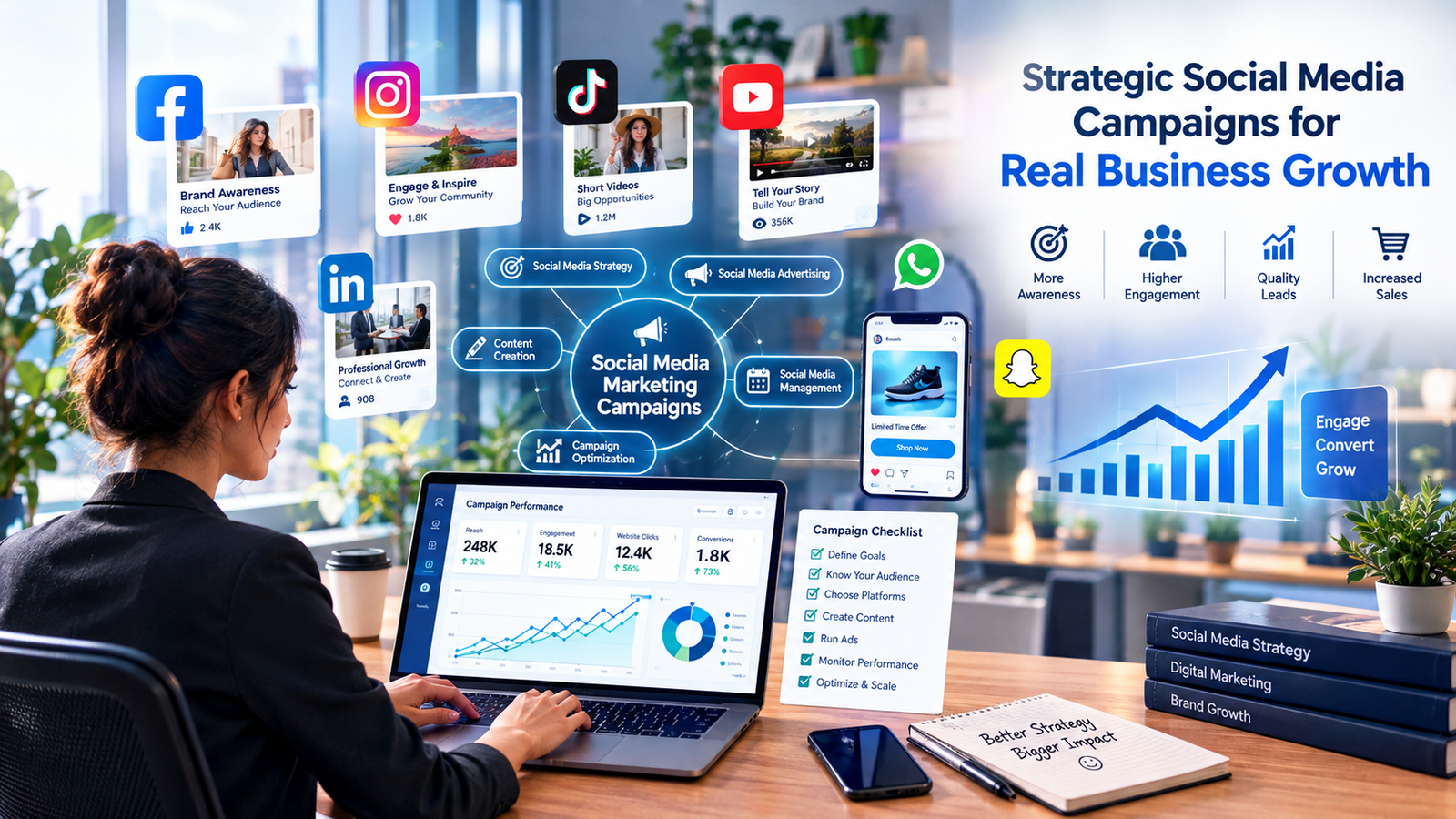
Social media marketing campaigns are planned, goal driven marketing efforts that use social platforms such as Facebook, Instagram, TikTok, YouTube, LinkedIn, and other social networks to reach specific audiences, build brand awareness, generate engagement, drive website traffic, generate leads, and increase sales. An effective campaign combines a clear social media strategy, audience research, compelling content, social media advertising, consistent social media management, performance tracking, and continuous optimization.
Social media is no longer simply a place where businesses publish occasional posts. Customers discover brands, compare products, watch demonstrations, read reviews, communicate with businesses, and make purchasing decisions through social platforms. This means businesses need a structured approach rather than random posting.
A successful social media campaign starts with one basic question: What business result should this campaign produce?
The answer could be brand awareness, website traffic, engagement, leads, sales, app downloads, bookings, customer retention, or a combination of several objectives. Once the goal is clear, the audience, platform, content, advertising budget, and measurement strategy become much easier to define.
This guide explains how to build social media campaigns from the ground up, how to develop a practical social media marketing strategy, how social media advertising fits into the customer journey, and how to measure whether campaigns are producing meaningful results.
Social media marketing campaigns are coordinated marketing activities created around a specific objective, audience, message, timeframe, or offer.
A campaign may focus on:
A campaign can include both organic content and paid advertising. For example, a business launching a new skincare product might create Instagram posts, short form videos, Stories, Facebook advertisements, influencer content, and retargeting campaigns around the same product.
These individual activities become more powerful when they work together under one campaign strategy.
The biggest advantage of social media is the ability to meet customers where they already spend time consuming information.
Traditional advertising often relies on interrupting the audience. Social media allows brands to participate in the content environment where customers are already discovering ideas, products, businesses, and communities.
A potential customer may see a short video demonstrating a product today, visit the company profile tomorrow, search for reviews later, and eventually click an advertisement. This means the customer journey is rarely linear.
A strong social media marketing strategy accounts for multiple interactions rather than expecting one post to immediately produce a sale.
Social media can help businesses:
For businesses looking to build a broader digital presence, social media marketing services can combine strategy, content, advertising, audience targeting, and ongoing campaign management.
One of the most common mistakes businesses make is starting with content instead of strategy. They ask, “What should we post today?” A better question is, “What do we need our social media activity to accomplish?”
A practical social media strategy should define:
Without these components, social media management can become a repetitive cycle of creating posts without knowing whether those posts contribute to business growth.
Every campaign should have a primary objective.
Awareness campaign: Introduce the brand to a new audience.
Engagement campaign: Increase interactions and audience participation.
Traffic campaign: Send qualified visitors to a website or landing page.
Lead generation campaign: Collect contact information from potential customers.
Sales campaign: Generate purchases or transactions.
Retention campaign: Encourage existing customers to return.
One campaign can support several objectives, but having a primary objective makes measurement much clearer.
A social media marketing campaign becomes stronger when it is built around a specific audience instead of “everyone.” Audience research should consider age, location, industry, occupation, interests, buying behavior, pain points, desired outcomes, common objections, preferred content formats, platforms used, and purchase journey.
Demographic information alone is not enough. You also need to understand what the audience is trying to accomplish.
For example, a business selling professional accounting software may target small business owners. A more useful insight could be that they want simpler financial reporting because they do not have time to manage complicated accounting systems.
That insight can influence the campaign message. Instead of simply saying “Powerful accounting software,” the campaign could focus on “Spend less time managing reports and more time running your business.”
Personas help transform broad demographic data into practical marketing decisions.
A simple persona might include:
This information can guide content, advertisements, landing pages, and calls to action.
Not every business needs to be active on every social platform. Platform selection should depend on audience behavior, content format, industry, and campaign objective.
Facebook can be useful for local businesses, ecommerce, service businesses, community building, retargeting, lead generation, and broad audience campaigns. Businesses can use Facebook advertising to reach specific audience segments with paid campaigns.
Instagram is particularly useful for visually driven brands. It can support product discovery, Reels, Stories, influencer collaborations, ecommerce, and brand building. Businesses can explore Instagram advertising when they need paid reach and audience targeting.
TikTok is heavily focused on short form video and discovery. It can be useful for consumer brands, entertainment, education, beauty, fashion, food, lifestyle products, and creator led campaigns. A strong TikTok advertising strategy should focus on native looking creative rather than simply adapting traditional advertisements.
YouTube can support both awareness and education. It is particularly valuable when a product or service benefits from demonstrations, explanations, tutorials, reviews, or longer form storytelling. Businesses can use YouTube advertising to reach audiences through video based campaigns.
Snapchat can be relevant for younger audiences and brands that use visual, mobile first content. Businesses targeting specific audience segments can explore Snapchat advertising as part of a broader social advertising strategy.
WhatsApp can play a different role because it is often more communication focused than discovery focused. Businesses may use it for customer communication, lead follow up, product inquiries, appointment communication, customer support, and promotional messaging where appropriate. A dedicated WhatsApp marketing strategy can connect social discovery with direct customer communication.
X can be useful for real time conversations, industry commentary, announcements, and community engagement depending on the target audience. Businesses can explore X advertising where the platform aligns with their audience and campaign objectives.
Once platforms are selected, define content pillars. Content pillars are recurring themes that organize what the brand talks about.
For a digital marketing agency, content pillars could include SEO education, PPC education, social media tips, website optimization, marketing trends, case studies, client success stories, and industry insights.
For a skincare brand, content pillars could include skincare education, ingredient education, product demonstrations, skincare routines, customer experiences, and common skincare mistakes.
Content pillars prevent the social feed from becoming repetitive while maintaining consistency.
Social media audiences consume information in different ways. A strong campaign can combine short form videos, Reels, Stories, carousels, static images, infographics, tutorials, testimonials, interviews, behind the scenes content, product demonstrations, educational posts, user generated content, and live sessions.
The objective is not to create every format every day. Instead, identify the formats that communicate the message effectively and align with audience behavior.
Short form video can communicate a product benefit, tutorial, customer problem, before and after process, common mistake, quick tip, product demonstration, behind the scenes moment, or customer story.
The opening seconds matter because users can scroll away immediately. Instead of starting with a long introduction, consider opening with the problem. For example: “Your Facebook ads are getting clicks but no sales?” That immediately creates relevance for the target audience.
Promotional content has a place in every social media marketing strategy, but businesses should not make every post a sales pitch.
Educational content can build trust before the customer is ready to purchase. A flooring company could publish content about choosing flooring for a commercial office, SPC flooring benefits, installation mistakes, waterproof flooring maintenance, and flooring ideas for modern villas.
A digital marketing company could publish content about SEO, Google Ads mistakes, social media campaign tips, landing page optimization, and local SEO basics.
Organic content and paid advertising serve different functions. Organic content helps maintain presence, community, and brand communication. Social media advertising allows businesses to deliberately place content in front of selected audiences.
A social media advertising campaign can target factors such as location, demographics, interests, behaviors, previous interactions, customer lists where platform policies permit, and similar audience systems where available.
The exact targeting options vary by platform and change over time. The important principle is to connect targeting with campaign objectives.
Organic activity includes unpaid posts and interactions. It can support brand credibility, community, customer communication, education, long term visibility, and social proof.
Paid advertising can support audience expansion, product promotion, lead generation, website traffic, retargeting, and sales.
A business does not necessarily need to choose between them. A practical strategy can use organic content to establish the brand while paid advertising expands reach and targets selected audiences.
A social media campaign should not always send users to a generic homepage. If an advertisement promotes a specific service, product, or offer, the landing page should continue that message.
For example:
This creates a consistent customer journey. If your campaigns require dedicated conversion focused pages, landing page development can help connect advertising messages with conversion experiences.
A campaign should tell the audience what to do next.
The CTA should match the customer’s stage in the buying journey. A person seeing a brand for the first time may not be ready to buy immediately. An educational CTA such as “Learn more” may be more appropriate.
The customer does not know the brand yet. Content should focus on problems, education, trends, helpful information, and brand introduction.
The customer knows the problem and is exploring solutions. Content can include product comparisons, demonstrations, case studies, reviews, testimonials, and detailed educational content.
The customer is ready to act. Campaign messaging can emphasize product benefits, offers, pricing information, consultation, demonstrations, and a strong CTA.
The customer has already purchased. Content can include product education, support, new products, loyalty offers, customer appreciation, and community content.
Many users interact with a campaign without converting immediately. They may watch a video, visit a website, view a product, add something to a cart, read a service page, start a form, or follow a social profile.
Remarketing can help reconnect with eligible audiences who previously interacted with a business. For ecommerce, someone may view a product but leave without purchasing. A later campaign can remind that user about the product or introduce additional information.
Remarketing should remain relevant and should respect platform rules, privacy requirements, and audience eligibility.
Social media management involves much more than publishing content. A complete process can include content planning, calendar management, caption writing, creative coordination, publishing, community management, comment monitoring, message management, audience research, campaign monitoring, performance reporting, and competitor analysis.
Consistent management helps businesses maintain a recognizable presence while responding to audience behavior.
A content calendar makes campaign execution easier. A simple weekly structure could include an educational post on Monday, short form video on Tuesday, customer focused content on Wednesday, an industry insight on Thursday, a product or service promotion on Friday, behind the scenes content on Saturday, and community content on Sunday.
This is only an example. The ideal schedule depends on the audience, platform, industry, available resources, and campaign objectives. Consistency is more important than forcing a particular posting frequency.
People often want evidence before choosing a business. Social proof can include customer reviews, testimonials, case studies, user generated content, product demonstrations, before and after examples where appropriate, client results, media mentions, and industry credentials.
Instead of simply saying that a business provides excellent service, show evidence that helps customers understand why they should trust it.
User generated content can make campaigns feel more authentic because the content comes from customers or community members rather than solely from the brand.
Examples include customer reviews, unboxing videos, product demonstrations, customer photographs, and customer stories. Brands should obtain appropriate permission before using customer content in marketing.
Influencers and creators can introduce products to audiences that already trust their content. However, follower count alone should not determine whether a creator is suitable.
Consider audience relevance, engagement quality, content style, geographic audience, brand alignment, previous partnerships, audience demographics, and campaign objective.
One piece of content can be repurposed, but it should not always be copied identically across every platform.
For example, a long YouTube video could become an Instagram Reel, TikTok video, Facebook short video, LinkedIn educational post, blog article, and email newsletter. The central idea stays consistent while the format changes according to platform behavior.
Social media and SEO are different channels, but they can support the same content ecosystem. A social campaign can distribute a blog article that targets valuable search queries. The article can then attract organic search traffic over time.
Pulse Digitall provides SEO services in the USA covering keyword research, on page SEO, off page SEO, and local SEO.
This creates an opportunity to reuse research across channels. One customer question can become an SEO article, Instagram carousel, TikTok video, YouTube Short, Facebook post, email, and lead magnet.
Social media can create awareness while paid search captures users who later search for the brand, product, or service.
For example, a user discovers a company through Instagram. Later, the user searches for the company name on Google. The user clicks a Google advertisement and visits the website. The customer journey involved both social media and paid search.
Businesses running multiple paid channels should therefore consider the full customer journey rather than evaluating every platform completely in isolation.
Pulse Digitall also provides PPC and Google Ads services, including search advertising, display advertising, and lead generation.
Paid reach can introduce thousands of people to a business. That means the brand experience matters. If someone discovers a business through an advertisement and visits its social profile, the profile should communicate who the business serves, what it offers, why it exists, what makes it different, and how customers can contact it.
Brand consistency should extend across logo, colors, typography, photography, video style, tone, and messaging.
Businesses developing a stronger visual identity can explore branding and design services. Specific services include logo design, social media post design, video editing, and company branding.
Follower count is easy to see, but it is not always the most useful business metric. Campaign measurement should reflect the objective.
The important principle is simple: measure the metric that represents the campaign objective.
Engagement rate helps show how actively audiences interact with content.
Cost per lead can be calculated by dividing advertising spend by the number of leads generated.
Conversion rate measures the percentage of relevant visitors or users who complete a desired action.
Customer acquisition cost considers the amount spent to acquire a customer.
ROAS compares advertising revenue with advertising expenditure. The appropriate metric depends on the business model and campaign objective.
Testing allows marketers to understand what resonates with audiences. You can test different hooks, headlines, video openings, images, offers, CTAs, audience segments, landing pages, ad formats, and content themes.
For example, two advertisements might promote the same product. Version A focuses on price while Version B focuses on convenience. If both are tested under comparable conditions, the resulting data can help identify which message generates stronger results.
Testing should be systematic rather than based on assumptions.
If you change the audience, creative, offer, landing page, budget, and CTA at the same time, it becomes difficult to determine what caused the performance change.
A more controlled approach is to identify a specific variable or hypothesis. For example: “Does a problem focused video introduction generate more qualified traffic than a product focused introduction?”
Publishing frequently does not automatically create business growth.
Managing too many platforms can reduce quality and consistency.
Audiences need useful content, education, entertainment, and community interaction as well as promotional messages.
Social media is a communication channel. Ignoring customers can undermine the value of the platform.
Likes and followers can provide context, but they do not always demonstrate revenue or lead generation.
Different platforms have different formats and audience expectations.
Most social media consumption happens through mobile devices, so landing pages and websites need to work well on smaller screens.
Businesses that need a mobile friendly website can explore responsive website development.
Choose one primary objective.
Understand who you are trying to reach and what problem they are trying to solve.
Select platforms based on audience behavior and campaign requirements.
Determine what the audience receives or what action you want them to take.
Develop a clear message based on customer needs rather than company features alone.
Create videos, graphics, carousels, images, or other appropriate formats.
Make sure the destination page matches the campaign.
Publish organic content and activate paid campaigns where appropriate.
Track performance against the original objective.
Improve targeting, creative, messaging, budget allocation, and landing pages based on evidence.
Reconnect with eligible audiences who have already interacted with the business.
Increase investment in campaigns that demonstrate sustainable performance and align with business economics.
Campaigns have start and end dates, but social media management is continuous. A business may run a product launch campaign for four weeks while maintaining its social media presence throughout the year.
Long term social media management can support brand recognition, community development, customer support, content distribution, audience research, reputation management, campaign learning, and customer retention.
Service businesses often need a different approach from ecommerce brands. A service company may not be able to sell directly through a social post. Instead, the campaign may generate consultation requests, phone calls, quote requests, contact forms, demo requests, or appointment bookings.
The social advertisement creates interest. The landing page explains the offer. The form captures the lead. The sales team then qualifies the prospect.
This makes the entire funnel important. If a campaign generates many leads but the leads are poorly qualified, the advertising may appear successful while producing limited business value.
Ecommerce campaigns can focus more directly on product discovery and purchase. Useful campaign components can include product videos, customer reviews, demonstrations, collection advertisements, retargeting, promotional offers, user generated content, and creator partnerships.
The website experience also matters. If customers struggle to navigate the store, find products, understand shipping information, or complete checkout, advertising performance can suffer.
Businesses requiring ecommerce infrastructure can explore ecommerce development services or Shopify website development.
Your social media campaign does not exist separately from your website. The advertisement creates the first impression. The landing page creates the second. The website determines whether the visitor can easily find information and complete the desired action.
Important website factors include mobile responsiveness, loading speed, navigation, clear messaging, trust signals, strong calls to action, simple forms, secure checkout, and relevant content.
For businesses using WordPress, WordPress development services can support website improvements and campaign landing experiences.
Social media marketing continues to evolve as platforms introduce new formats, recommendation systems, advertising technologies, shopping features, creator tools, and AI powered capabilities.
Several principles remain important: understanding the audience, creating useful content, building trust, testing messages, measuring business outcomes, maintaining consistent branding, and improving customer experience.
Technology can change rapidly, but customers still respond to relevant messages, useful information, compelling stories, and credible brands.
Effective social media marketing campaigns are not built around posting more content. They are built around understanding people.
A strong social media strategy starts with a business objective, identifies the right audience, chooses appropriate platforms, develops relevant content, creates a clear customer journey, and uses data to improve performance.
Social media advertising can extend reach and target specific audiences, while organic content can build credibility and community. Social media management keeps the brand active, responsive, and consistent. Together, these activities form a complete social media marketing strategy.
The most important shift is to stop thinking of social media as a collection of individual posts. Think of it as a connected marketing system:
Audience → Message → Content → Engagement → Website → Conversion → Customer → Retention
When each stage supports the next, social media becomes more than a visibility channel. It becomes an important part of the broader customer acquisition and retention process.
For businesses looking to build a complete digital marketing ecosystem, Pulse Digitall combines social media with PPC, SEO, branding, web development, and lead generation. Explore the complete digital marketing services offered by Pulse Digitall to build a strategy around specific business goals.
Social media marketing campaigns are planned marketing activities designed to achieve a specific objective through social platforms. Objectives can include awareness, engagement, website traffic, lead generation, sales, product promotion, or customer retention.
Social media marketing focuses on using social platforms to achieve marketing objectives, while social media management covers the ongoing operational activities involved in maintaining social profiles, publishing content, responding to audiences, monitoring activity, and managing campaigns.
A social media strategy is a structured plan that defines business goals, target audiences, platforms, content themes, messaging, advertising activities, conversion pathways, and performance measurement.
Start by defining the campaign objective, identifying the target audience, selecting the appropriate platform, creating the offer and message, producing the creative, establishing a conversion pathway, launching the campaign, measuring performance, and optimizing based on results.
There is no universal platform that is appropriate for every business. The right platform depends on the target audience, industry, content format, geographic market, campaign objective, and available resources.
Social media advertising is paid promotion on social platforms. Advertisers can use paid campaigns to reach selected audiences and achieve objectives such as awareness, engagement, website traffic, leads, app activity, or sales.
There is no universal posting frequency. The appropriate schedule depends on the platform, audience, content resources, industry, and campaign objectives. Consistent high quality content is generally more useful than publishing large quantities of low value content.
Yes. Small businesses can use social campaigns to build local awareness, promote services, generate leads, communicate with customers, and reach specific audiences. Campaign scope and budget should be aligned with business capacity.
There is no single price that applies to every campaign. Costs depend on factors such as platform, audience, competition, campaign objective, geographic targeting, creative, industry, and budget.
The appropriate metrics depend on the campaign goal. Common metrics include reach, impressions, engagement, video views, website traffic, leads, cost per lead, conversions, sales, revenue, and return on advertising spend.
No. Followers can provide an indication of audience size, but they do not necessarily represent business performance. A campaign should be evaluated against its actual objective.
Short form video can communicate educational information, product benefits, demonstrations, stories, and entertainment quickly. It is particularly useful on platforms that emphasize video discovery.
They can complement each other. Organic content can support community and brand communication, while paid advertising can expand reach and target specific audiences.
Social media remarketing involves showing relevant advertising to eligible audiences who have previously interacted with a business, its website, or its content. Availability and targeting options depend on the platform and applicable policies.
Businesses can use advertisements, lead forms, landing pages, direct messages, calls, consultations, webinars, downloads, and other conversion mechanisms to turn social media interest into potential customers.
Review the campaign objective, audience, creative, message, targeting, landing page, conversion process, and performance data. Test specific changes rather than changing everything simultaneously.
A successful campaign aligns the right audience with a relevant message and a clear action while producing measurable results against its intended business objective.
Social media and SEO operate differently, but social activity can help distribute content, increase visibility, generate referral traffic, build brand awareness, and attract attention to content that supports broader digital marketing goals.
Influencer marketing can be useful when the creator’s audience, content style, location, and credibility align with the campaign. Follower count alone should not be the only selection factor.
Brand consistency helps audiences recognize and understand a business across different channels. Visual identity, messaging, tone, and content style should support the same overall brand positioning.
A business can use social platforms without a traditional website, but a website can provide additional space for detailed information, lead generation, ecommerce, booking, content, and conversion tracking.
Yes. Social media can introduce audiences to a business while Google Ads can capture users who later search for relevant products, services, or brands. Combining insights from multiple channels can provide a broader view of the customer journey.
A campaign is usually a focused initiative built around a particular objective, offer, audience, or timeframe. A social media marketing strategy is the broader framework that determines how social media supports the business over time.
Campaign duration depends on the objective, budget, audience, sales cycle, platform, and amount of data required for evaluation. Short promotional campaigns may run for a limited period, while awareness or lead generation campaigns may require longer testing periods.
Social media can contribute to sales by generating awareness, educating audiences, driving website traffic, generating leads, promoting products, and supporting remarketing. Actual results depend on the business model, offer, audience, campaign execution, and conversion experience.