
Walk into two coffee shops. One has a handwritten sign, mismatched mugs, and a logo that looks different on the door than it does on the receipt. The other feels like every single detail, the color of the napkins, the font on the menu, the tone of the barista’s small talk, was decided on purpose. You’ll trust the second one more, even if you can’t quite explain why.
That’s brand identity at work. It’s not just a logo or a color palette, it’s the sum of everything that makes your business recognizable and trustworthy at a glance. And for most businesses, the difference between the two coffee shops above comes down to one thing: whether there’s a unified strategy behind the identity, or just a collection of disconnected choices.
This guide breaks down what brand identity actually means, why corporate brand identity matters more than most business owners realize, and how a proper branding strategy paired with clear brand guidelines can transform a scattered business into a recognizable one.
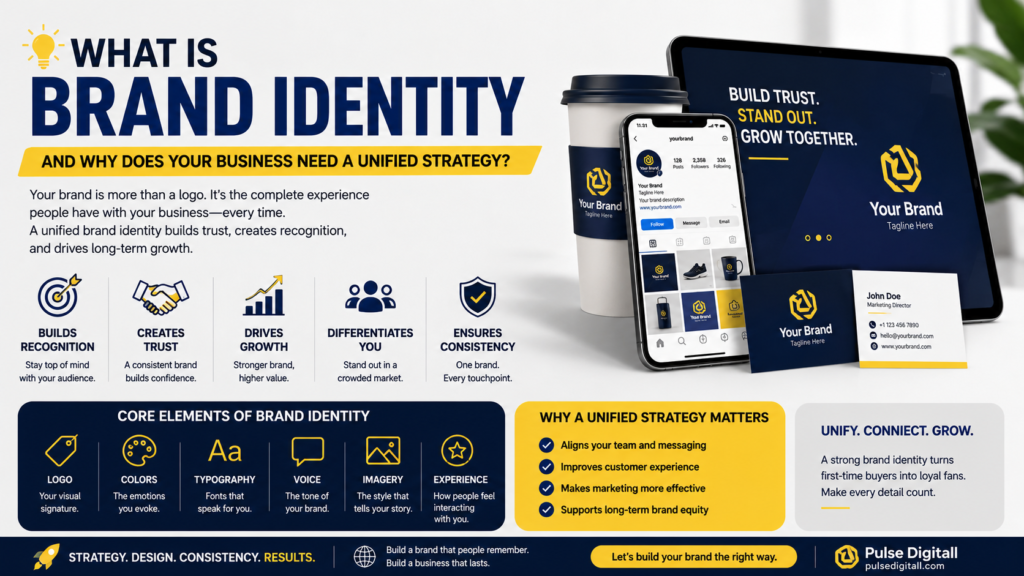
Brand identity is the collection of visual, verbal, and experiential elements that represent your business to the outside world. It’s how people recognize you before they even read your name.
It includes things like:
It’s easy to confuse brand identity with branding itself, but they aren’t quite the same thing.
These three terms get thrown around interchangeably, but understanding the distinction actually matters.
A business can have a beautiful brand identity on paper and still suffer from a poor brand image if the actual customer experience doesn’t match what the identity promises.
Corporate brand identity isn’t just about looking professional, it directly affects how much people trust you, how much they’re willing to pay, and whether they choose you over a competitor offering something nearly identical.
Think about how quickly you can identify certain brands from just a color or a shape, no text required. That kind of recognition doesn’t happen by accident. It comes from consistent, repeated exposure to the same visual language across every touchpoint.
A polished, consistent identity tells potential customers that a business is established and serious. Inconsistent branding, mismatched fonts, colors that shift from platform to platform, does the opposite. It quietly signals that a business might be disorganized in other areas too, even if that’s not actually true.
Two nearly identical products can sell at wildly different price points based purely on how they’re branded. A strong identity allows businesses to charge more because customers associate that identity with quality, even before they’ve tried the product.
People don’t just buy products, they buy into stories and identities that reflect something about themselves. A well-crafted brand identity taps into that emotional layer, turning one-time buyers into loyal customers who feel a sense of belonging.
Every ad, every social post, every email campaign works harder when it’s backed by a recognizable identity. Without that foundation, marketing efforts feel disconnected and forgettable, no matter how much money gets spent on them.
Building an identity from scratch, or fixing one that’s grown inconsistent over time, means paying attention to several interconnected pieces.
When all three of these layers, visual, verbal, and experiential, are aligned, the result feels intentional rather than accidental.
A branding strategy is the long-term plan that guides how a brand identity gets built, communicated, and maintained over time. It’s not a one-time project, it’s an ongoing framework that shapes every decision related to how the business presents itself.
Plenty of businesses hire a designer, get a nice logo, and call it done. But without a strategy behind it, that identity has nothing holding it together long term. New team members make inconsistent choices, new marketing channels get handled differently, and within a year or two, the once-clean identity starts fragmenting again.
A strategy answers the deeper questions design alone can’t:
Even the best branding strategy falls apart without documentation. That’s where brand guidelines come in, a reference document that translates strategy and identity into practical rules everyone can follow.
A guidelines document isn’t just for designers. It gets referenced by:
Without this reference point, every one of these groups ends up interpreting the brand differently, which is exactly how inconsistency creeps in over time.
Not sure whether your business actually needs to invest time into this? Here are common warning signs.
If even a couple of these sound familiar, it’s usually a signal that identity decisions have been made reactively rather than strategically.
Bringing everything together doesn’t have to be overwhelming. Here’s a practical approach most businesses follow.
Before creating anything new, gather every piece of existing branding, logos, colors, old marketing materials, website screenshots, and identify where inconsistencies are showing up.
Nail down brand purpose, audience, and positioning before touching visual design. Design decisions made without this foundation tend to look nice but communicate nothing meaningful.
With strategy in place, build out the logo, color system, typography, and voice guidelines as a cohesive package rather than isolated pieces.
Turn every decision into a clear, accessible reference document that anyone touching the brand can consult.
Update the website, social profiles, packaging, email templates, and physical materials so nothing gets left behind using the old, inconsistent version.
A guidelines document only works if people actually know it exists and understand how to use it. A short onboarding session or internal walkthrough goes a long way.
Brand identity isn’t static. Reviewing it every year or two ensures it still reflects where the business actually is, without requiring a full rebrand from scratch.
Not every business needs the exact same approach to identity, though the underlying principles stay the same. Understanding how this plays out across different industries makes the concept feel less abstract.
For product-based businesses, packaging and in-store or on-shelf presence carry enormous weight. A unified identity here means the product looks recognizable whether it’s sitting on a shelf, showing up in a social ad, or being unboxed on camera by a customer.
Law firms, consultancies, and agencies rely heavily on trust signals since customers often can’t evaluate quality until after they’ve already committed. Here, a polished, consistent identity across the website, proposals, and even email signatures does a lot of the trust-building work before a single conversation happens.
Software companies often live or die by how intuitive and trustworthy their brand feels digitally, since there’s rarely a physical touchpoint at all. Consistency across the product interface, marketing site, and support documentation becomes the entire brand experience.
For restaurants, cafes, and hotels, brand identity extends into physical space design, staff uniforms, and even the music playing in the background. Every sensory detail contributes to whether the experience feels cohesive or thrown together.
Regardless of industry, the same underlying question applies: does every touchpoint reinforce the same identity, or does each one feel like it belongs to a slightly different business?
Most conversations about brand identity focus entirely on external perception, but there’s an internal side that gets overlooked just as often.
When a brand’s purpose and personality are clearly documented, employees have language to describe what makes the company different, whether they’re chatting with a customer or explaining their job at a dinner party. Without that clarity, messaging tends to feel generic and forgettable even from people who work there every day.
A well-defined brand identity acts almost like a filter for business decisions. Should the company sponsor this event? Does this new product fit the brand? Should customer support respond this way to a complaint? Having a clear identity and set of values makes these calls faster and more consistent, rather than relying on whoever happens to be in the room that day.
People increasingly want to work for companies whose identity and values feel authentic and well-defined. A strong, consistent brand identity, one that shows up the same way in job postings as it does in customer-facing marketing, helps attract candidates who genuinely align with the company culture rather than just the paycheck.
With so much business happening online now, a handful of digital touchpoints tend to reveal inconsistency faster than anywhere else.
Auditing these five areas specifically tends to reveal inconsistency faster than almost anywhere else in a business.
Avoiding these pitfalls usually comes down to treating brand identity as a strategic business asset rather than a purely creative exercise.
Businesses that invest in this work early tend to see compounding benefits. Recognition builds faster, marketing campaigns perform better because they’re reinforcing the same identity rather than starting from scratch each time, and customer trust develops more naturally because everything feels consistent and intentional.
It also makes scaling significantly easier. Whether it’s launching a new product line, expanding into a new market, or bringing on new team members, a documented brand strategy means growth doesn’t come at the cost of consistency.
What’s the difference between brand identity and a logo?
A logo is just one visual element within a much larger system. Brand identity includes color, typography, voice, imagery, and overall experience, the logo is simply the most visible piece of that puzzle.
How long does it take to build a brand identity?
It varies depending on business size and complexity, but a thorough process, including strategy, design, and documentation, typically takes anywhere from a few weeks to a couple of months.
Do small businesses really need brand guidelines?
Yes. Even a simple one or two-page document helps maintain consistency as the business grows, brings on new team members, or works with outside contractors and agencies.
How often should a brand identity be updated?
There’s no fixed rule, but most businesses revisit their identity every few years to ensure it still aligns with their audience and market position, without needing a complete overhaul each time.
Can a strong brand identity really increase sales?
Yes, consistent branding builds trust and recognition, both of which directly influence purchasing decisions, especially when customers are choosing between similar options.
What’s the difference between brand strategy and marketing strategy?
Brand strategy defines who you are and how you’re perceived long term, while marketing strategy focuses on specific campaigns and tactics used to reach business goals. Marketing strategy should always be built on top of a clear brand strategy.
Is rebranding the same as refreshing a brand identity?
Not quite. A rebrand usually involves significant changes to positioning and visual identity, often due to a major business shift. A refresh is a lighter update that modernizes existing elements without abandoning brand recognition already built.
Who should be involved in building brand guidelines?
Ideally, leadership, marketing, and design teams all contribute, since guidelines need to reflect both strategic direction and practical, everyday usage across departments.
Brand identity isn’t a nice-to-have extra reserved for large corporations with big budgets. It’s a foundational business asset that shapes how customers perceive value, decide who to trust, and remember who you are among countless competitors. Without a unified strategy behind it, even the best individual design choices end up feeling disconnected.
Building that consistency takes intentional work, auditing what exists, clarifying strategy, documenting guidelines, and training everyone who touches the brand. But the payoff, stronger recognition, easier scaling, and deeper customer trust, makes it one of the smartest long-term investments a business can make.
If you’re not sure where to start, or you’ve realized your current identity has grown inconsistent over time, working with a team that specializes in brand strategy can help turn scattered pieces into something cohesive. The experts at Pulse Digitall help businesses build unified brand identities backed by real strategy, not just a new logo.