
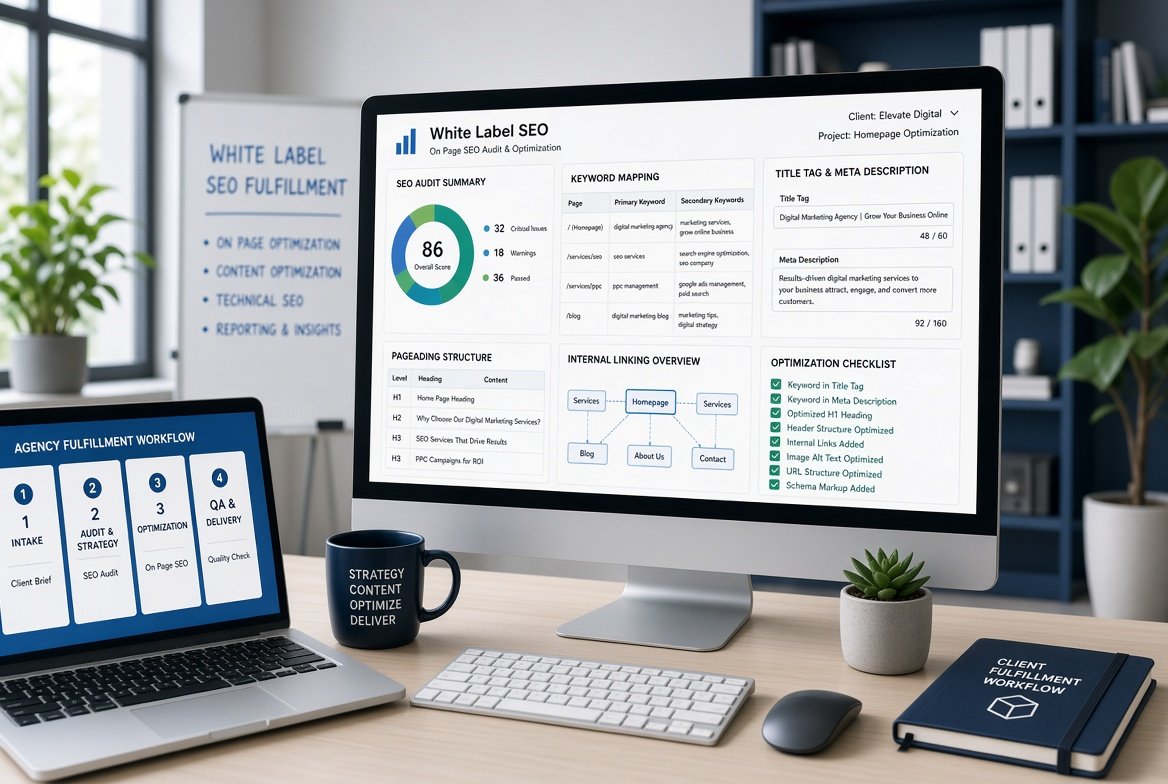
 White Label On Page SEO for Agencies: Improve Rankings
White label on page SEO helps digital marketing agencies deliver professional website optimization services under their own brand without building a dedicated in house SEO team. By partnering with an experienced SEO provider, agencies can outsource tasks such as title tag optimization, meta descriptions, heading structure, internal linking, keyword placement, image optimization, and content improvements while maintaining their client relationships.
For agencies managing multiple websites, white label on page SEO provides a practical way to expand service offerings, manage workloads, and deliver consistent optimization across client projects. Instead of spending additional resources recruiting and training specialists, agencies can work with a fulfillment partner to support their existing SEO campaigns and meet growing client demands.
This guide explains how white label on page SEO works, which services agencies can outsource, how to choose the right fulfillment partner, and how to build a scalable SEO delivery process.
White label on page SEO is a service in which an SEO provider performs on page optimization for an agency’s clients while the agency presents the work under its own brand. The fulfillment provider works behind the scenes, allowing the agency to manage communication, reporting, pricing, and the overall client relationship.
On page SEO focuses on improving elements within a website so that search engines and visitors can better understand its content, structure, and purpose.
Depending on the agreement, white label on page SEO may include:
Agencies can combine these services with broader search engine optimization services to offer clients a more complete SEO solution.
The exact scope varies by provider. Some partners deliver recommendations and optimized copy, while others can implement approved changes directly when they have the necessary website access.
Agencies often face pressure to increase client capacity without compromising the quality of their work. As the number of projects grows, managing every optimization task internally can become difficult.
White label fulfillment provides an alternative to hiring for every new requirement.
An agency that primarily focuses on paid advertising, web design, social media, or content marketing may receive requests for SEO services from existing clients.
White label on page SEO allows the agency to introduce website optimization without creating a complete internal SEO department.
For example, an agency that builds WordPress websites can offer page optimization after launch. A PPC agency can help clients improve landing page clarity and organic search readiness alongside paid campaigns.
This approach creates opportunities to serve more client needs through a coordinated service portfolio.
On page optimization involves research, page reviews, metadata writing, content recommendations, internal linking, quality assurance, and reporting.
When an agency handles every task internally, these activities can compete with account management, strategy, sales, and other core responsibilities.
A white label provider can handle agreed fulfillment tasks while the agency retains oversight and communicates directly with its clients.
The benefit depends on the quality of the workflow, the clarity of the scope, and how efficiently both teams collaborate.
An agency may be able to manage a few optimization projects internally but struggle when several clients require simultaneous updates.
A white label partner can provide additional delivery capacity based on an agreed workflow and available resources.
Before expanding, agencies should confirm the provider’s capacity, turnaround times, review process, and ability to handle different website platforms.
Scaling should not mean sacrificing quality. Every deliverable still needs appropriate review before it reaches a client.
Hiring SEO specialists involves more than salary costs. Agencies may also need recruitment, training, software subscriptions, management time, and ongoing professional development.
White label fulfillment converts some of these fixed commitments into service costs associated with actual client requirements.
However, outsourcing is not automatically cheaper in every situation. Agencies should compare provider fees with internal delivery costs, the level of oversight required, and the expected project volume.
A white label arrangement allows the agency to remain the primary point of contact for its clients.
The agency can present approved deliverables through its own reporting templates, proposals, client portal, or project management system, subject to the provider’s agreement.
Branding arrangements should be transparent within the agency’s internal processes, and all representations made to clients should be accurate.
The right service package depends on client needs, website condition, and the agency’s existing capabilities. Some projects require only metadata improvements, while others need detailed content and structural recommendations across many pages.
Keyword mapping connects relevant search terms to the pages best suited to target them. It helps prevent unnecessary overlap and clarifies the purpose of each page.
A white label provider may research primary keywords, supporting terms, related questions, and search intent before recommending page level changes.
For example, an informational article should generally answer a question, while a commercial service page should explain the service and support a potential customer’s decision.
Agencies can complement this work with dedicated keyword research services when clients need broader keyword discovery and content planning.
Title tags help communicate a page’s topic to search engines and users. A well written title should be descriptive, relevant, and distinct from titles used on other pages.
White label title optimization may include reviewing existing titles, identifying duplication, improving keyword relevance, and making titles more useful to searchers.
There is no universal title length that guarantees a specific display in search results. Search engines may truncate or rewrite titles depending on the device and query.
The objective is to communicate the page’s subject clearly rather than forcing keywords into an arbitrary character count.
Meta descriptions summarize a page and may influence whether users click through from search results. They should describe the page accurately and explain the value of visiting it.
A white label SEO provider can create unique descriptions for priority pages, improve unclear copy, and identify missing or duplicated descriptions.
Meta descriptions are not a direct ranking factor in Google’s ranking systems, and Google may generate a different search snippet. Their primary purpose is to provide a useful summary for potential visitors.
Headings help organize page content into meaningful sections. A clear structure allows visitors to scan the page and locate the information they need.
On page optimization may involve improving the main heading, organizing subheadings, removing redundant headings, and ensuring that section titles reflect the information that follows.
Headings should serve the reader first. Repeating the same keyword in every heading can make content unnatural and does not guarantee improved rankings.
Content optimization improves the relevance, completeness, clarity, and usability of existing page copy.
A white label provider may review introductions, service descriptions, supporting sections, FAQs, terminology, and calls to action. Recommendations should address the page’s intended audience and search intent rather than simply increasing word count.
Agencies can combine this work with professional content writing services when a client needs new copy, substantial rewrites, or additional supporting content.
Internal links connect related pages within the same website. They help users navigate relevant information and provide search engines with crawlable paths to other pages.
White label internal linking work may include identifying relevant link opportunities, recommending descriptive anchor text, improving links to important service pages, and identifying isolated pages.
A good internal linking plan reflects the website’s structure and the relationships between topics. Links should be useful and relevant rather than added solely to increase link counts.
Images can support page relevance and improve the visitor experience when they are useful and appropriately implemented.
Image optimization may include reviewing descriptive filenames, alternative text, image dimensions, file size, and placement within the content.
Alternative text should describe the meaningful information conveyed by an image. Decorative images may require empty alt attributes, and keywords should not be inserted unnaturally.
Image compression and appropriate formats can also support performance, although the actual impact depends on the website’s implementation.
Clear URLs help users and website administrators understand the purpose of a page.
A white label provider may identify unnecessarily complex URLs, inconsistent naming patterns, or potential duplication issues.
Changing URLs requires caution. If a URL must change, the agency should plan appropriate redirects, update internal links, and check relevant canonical and sitemap references. Unnecessary URL changes can create avoidable technical problems.
Structured data can help search engines interpret certain information about a page or business and may make a page eligible for supported search features.
White label on page SEO may include identifying relevant schema types, checking existing structured data, and recommending corrections.
Structured data must accurately represent visible page content and follow the relevant search engine guidelines. Adding schema does not guarantee rich results or higher rankings.
A page level audit reviews important optimization elements and prioritizes issues that may affect search visibility or usability.
An audit can identify missing metadata, unclear headings, weak content, internal linking gaps, image optimization opportunities, and potential indexing or canonical concerns.
Some technical issues extend beyond on page content. Crawlability, indexing, performance, and website architecture may require collaboration with technical SEO specialists or developers.
Agencies should confirm whether these tasks are included in the white label package or treated as separate services.
A repeatable workflow helps agencies maintain quality, communicate clearly, and deliver optimization recommendations consistently.
The agency provides the website URL, target locations, business objectives, service details, target audience, priority pages, and relevant SEO data.
Where available, Google Search Console, analytics data, and existing keyword research can help the provider understand current performance.
Agencies should share only the access and information necessary for the project and follow appropriate client data security practices.
The fulfillment team reviews the agreed pages and identifies optimization opportunities.
The review may cover metadata, content, heading structure, internal links, images, URLs, and relevant page elements.
The scope should be defined before work begins so both parties understand which pages and deliverables are included.
The provider maps keywords and search intent to the appropriate pages. This helps establish the role of each page and reduces unnecessary overlap.
Existing rankings, content quality, competition, and business priorities should inform the recommendations.
The provider prepares updated titles, descriptions, headings, copy recommendations, internal link suggestions, and other agreed deliverables.
Recommendations should explain the proposed changes clearly enough for the agency or its client to review them.
Before delivery, the provider checks the work for accuracy, consistency, relevance, formatting, and compliance with the agreed scope.
Quality assurance should also check for accidental keyword stuffing, incorrect claims, irrelevant links, duplicate metadata, and changes that conflict with the client’s brand voice.
The provider supplies the agreed files, documentation, or reports. The agency reviews the deliverables and presents them to the client using its normal communication process.
If implementation is included, the parties should agree on access, approvals, backups, and a process for validating changes after publication.
After implementation, the agency can monitor search impressions, clicks, landing page performance, relevant rankings, and conversions.
Performance should be assessed over an appropriate period and interpreted alongside other factors, including seasonality, competition, and technical changes.
No provider can guarantee that every optimization will improve rankings or generate a specific amount of traffic.
Both in house SEO and white label fulfillment can work well. The right choice depends on the agency’s size, service mix, workload, budget, and need for direct control.
| Factor | White Label On Page SEO | In House SEO |
|---|---|---|
| Staffing | Uses an external fulfillment partner | Requires internal staff |
| Capacity | Can add capacity according to provider availability | Depends on team size and workload |
| Control | Shared through an agreed scope and review process | Direct day to day oversight |
| Expertise | Depends on the partner’s capabilities | Depends on recruitment and training |
| Cost structure | Usually service or project based | Includes employment and operating costs |
| Client relationship | Managed by the agency | Managed by the agency |
| Scalability | Can support expansion without hiring for every role | May require additional recruitment |
| Workflow | Requires clear communication and coordination | Can be more integrated internally |
White label fulfillment can be especially useful when demand fluctuates or an agency needs specialist support. In house teams may be preferable when SEO delivery is central to the business and the agency has enough ongoing work to justify dedicated staff.
Some agencies use a hybrid model, keeping strategy and account management in house while outsourcing repeatable production tasks.
The provider you choose can directly affect your delivery quality, client experience, and agency reputation. Evaluate potential partners carefully before committing to ongoing projects.
Ask how the provider approaches keyword mapping, content optimization, internal linking, metadata, and page level audits.
Request sample deliverables or anonymized examples that demonstrate the depth and clarity of the work. A polished report is useful, but the underlying recommendations must also be practical and accurate.
A reliable provider should have a defined review process and clear criteria for approving deliverables.
Ask how they check metadata, anchor text, content accuracy, duplicate recommendations, and adherence to client instructions.
Clarify who is responsible for correcting errors and how revisions are handled.
Discuss whether reports, spreadsheets, documents, and communications can use your agency’s branding.
Confirm whether the provider contacts clients directly, whether its identity appears in deliverables, and how confidentiality is managed.
The arrangement should match your agency’s client service model and contractual obligations.
Ask about typical delivery times, maximum workload, rush requests, and what happens when several projects arrive at once.
Realistic service levels are more valuable than promises that cannot be maintained during busy periods.
Determine whether pricing is based on individual URLs, project size, monthly retainers, or specific deliverables.
Confirm whether keyword research, copywriting, implementation, reporting, revisions, and technical recommendations are included.
A clear scope reduces unexpected costs and makes it easier to calculate project profitability.
Your fulfillment partner should be able to understand briefs, ask useful questions, communicate delays, and explain recommendations.
Agree on a primary contact, preferred communication channel, project management process, and escalation procedure before work begins.
Search engine results depend on many factors outside the provider’s control. Be cautious of claims that a specific position or traffic increase is guaranteed.
Look for a partner that explains its methodology, identifies limitations, and focuses on measurable improvements rather than unrealistic promises.
Agencies need a pricing model that covers fulfillment costs, account management, quality assurance, revisions, software, and other business expenses.
The right model depends on the service scope and how predictable the work is.
Charging per URL can work well when each page requires a relatively consistent set of tasks.
For example, an agency may price metadata optimization separately from a full page review that includes content recommendations, internal links, and image optimization.
The scope must be clearly defined because the effort required for a short service page can differ significantly from that required for a long, complex page.
Project pricing suits website audits, optimization of a defined group of pages, or a one time content improvement project.
It allows the agency to set clear deliverables, deadlines, and review milestones.
Accurate scoping is essential to avoid including an unlimited number of pages or revisions within a fixed fee.
Monthly retainers can suit agencies that need recurring optimization support for several clients.
The agreement may include a defined number of pages, content updates, audits, or support hours. The agency should ensure the workload remains realistic for the available fulfillment capacity.
Before setting a price, estimate the full cost of delivery. Include provider fees, internal review time, client communication, project management, tools, and a reasonable allowance for revisions.
The difference between the client price and direct fulfillment cost is not automatically net profit because the agency still has operating expenses.
Review margins periodically and adjust pricing when the scope, complexity, or delivery costs change.
Outsourcing optimization can save time, but poor planning may create new problems. Agencies should avoid these common mistakes.
A vague brief can result in generic content, irrelevant keyword recommendations, and unnecessary revisions.
Provide clear information about the business, audience, target pages, search intent, brand voice, and required deliverables.
Keyword placement is one part of on page SEO, not the entire process.
Content must answer the intended question, provide useful information, and support a good user experience. Repeating target phrases without improving relevance can make a page less effective.
Optimization should consider the page’s current visibility, search queries, clicks, conversions, and historical performance where data is available.
A page that already performs well may need careful improvements rather than a complete rewrite.
Different industries, website types, and business models require different optimization approaches.
Templates can improve efficiency, but the analysis and recommendations should still reflect each website’s needs.
Even if the fulfillment provider has strong quality controls, the agency should review important deliverables before presenting them to clients.
This ensures that recommendations align with business objectives, brand guidelines, and contractual commitments.
Recommendations do not improve a website until appropriate changes are implemented and made available to users and search engines.
Confirm which tasks were completed, validate important changes, and monitor relevant performance data after publication.
On page SEO is most effective when it supports a broader optimization plan. Improving titles, headings, and content may help a page communicate its purpose more clearly, but other factors can also affect performance.
Technical SEO addresses issues related to crawling, indexing, site architecture, performance, and other website infrastructure concerns.
Agencies may need a separate technical review when on page audits uncover issues that cannot be resolved through content or metadata changes alone.
Off page SEO includes activities that help build a website’s reputation and authority beyond its own pages. Depending on the strategy, this may involve earning relevant backlinks, digital PR, and brand mentions.
Agencies can explore off page SEO services when clients need support beyond page level optimization.
A website may need additional pages, updated articles, or improved topic coverage to address the needs of its audience.
A structured content strategy helps identify gaps and determine which pages should be created, improved, consolidated, or maintained.
Businesses serving specific geographic areas may need location relevant content, business profile optimization, and local search improvements.
Agencies working with local businesses can integrate local SEO solutions when location based visibility is a priority.
Combining these disciplines helps agencies develop a more complete SEO offering instead of treating individual page changes as an isolated solution.
White label on page SEO is a service in which an external SEO provider performs website optimization for an agency’s clients under an agreed white label arrangement. The agency maintains the client relationship and presents the work as part of its own service offering.
Agencies can outsource keyword mapping, title tag optimization, meta descriptions, heading improvements, content recommendations, internal linking, image SEO, URL reviews, schema recommendations, and page level audits. The exact scope depends on the fulfillment partner’s services.
Yes. Small agencies can use white label fulfillment to add SEO capabilities without immediately hiring a full internal team. It can also help established agencies manage workload fluctuations and specialist requirements.
Not always. Some providers supply recommendations and optimized copy, while others can implement changes directly. Agencies should confirm whether website access, implementation, testing, and post implementation validation are included.
Pricing varies according to the number of pages, depth of optimization, research requirements, content complexity, implementation needs, and reporting scope. Agencies should request a detailed quote based on their actual project requirements.
Many white label arrangements support agency branded reports and documents. Confirm the provider’s branding, confidentiality, and communication policies before starting the engagement.
Results vary depending on the website, competition, existing visibility, scope of changes, and search engine processing. Some pages may respond sooner than others, and ranking improvements are not guaranteed within a fixed timeline.
Neither approach is universally better. White label fulfillment can provide flexibility and access to external expertise, while an internal specialist offers direct oversight and closer integration with the agency’s operations. Some agencies benefit from combining both models.
Use detailed briefs, agreed deliverable standards, quality assurance checklists, clear communication, and a consistent agency review process. Monitor implementation and performance to determine whether recommendations are useful and appropriate.
Yes. Agencies can combine it with technical SEO, content writing, off page SEO, local SEO, web development, and paid marketing where those services support the client’s goals.
White label on page SEO gives agencies a flexible way to expand their optimization capabilities, manage fulfillment demands, and serve clients without handling every task internally. When supported by clear processes, experienced specialists, and effective quality control, it can become a useful part of a scalable service model.
The key is to select a partner that understands search intent, delivers practical recommendations, communicates reliably, and respects your agency’s standards. Define the scope, review the work, and monitor outcomes so your clients receive consistent and useful optimization.
If your agency wants to strengthen its SEO offering, explore PulseDigitall’s SEO services to discuss your requirements and identify the optimization support that fits your clients’ needs.
Get Free Strategy Session and plan an SEO fulfillment approach that supports your agency’s growth.