
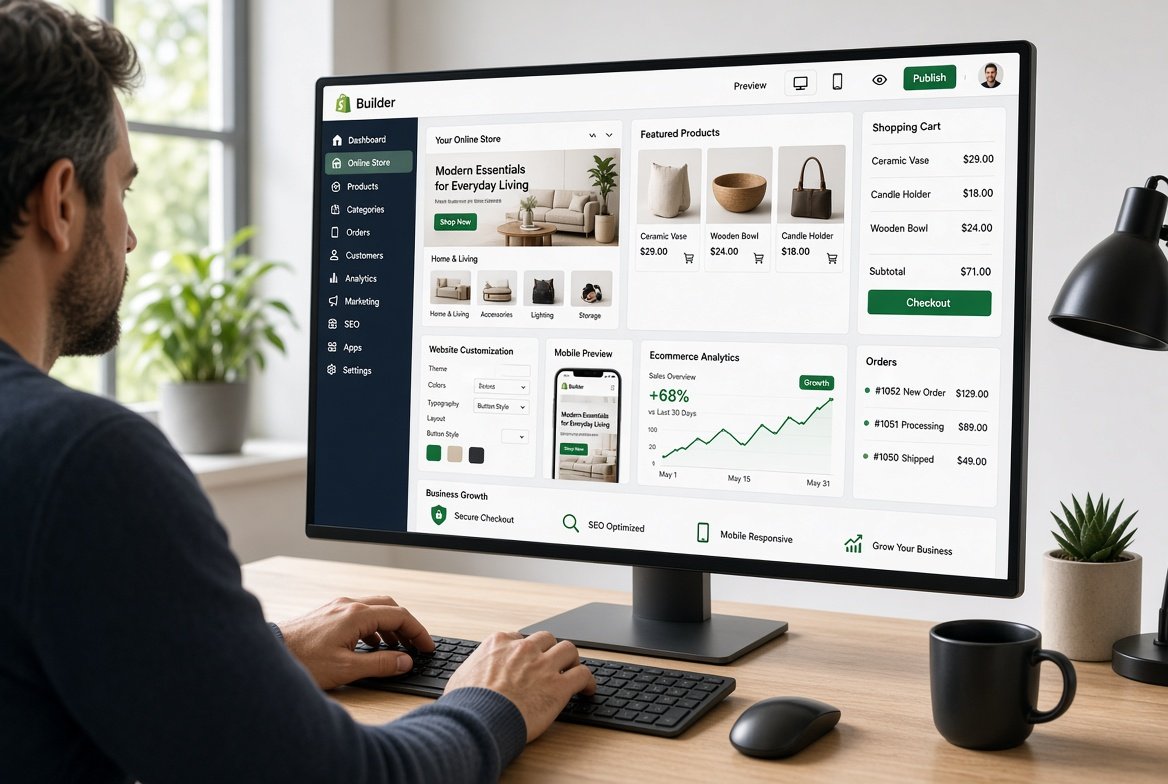
 Shopify Website Builder for Online Businesses
A Shopify Website Builder makes it easier for businesses to create, customize, and manage a professional online store without building every ecommerce feature from scratch. Shopify provides tools for product management, online payments, checkout, inventory, mobile responsive design, marketing, and store customization, making it a practical platform for businesses that want to start selling online or expand an existing ecommerce operation.
For a new business, the right website builder can reduce technical complexity and help launch an online store faster. For an established company, Shopify can provide a flexible ecommerce foundation that supports product growth, marketing campaigns, customer management, and online sales.
A Shopify Website Builder is a platform that allows businesses to create ecommerce websites using Shopify’s built in tools, themes, sections, applications, and customization options.
Instead of developing an ecommerce website entirely from the beginning, business owners can select a suitable Shopify theme, add products, create collections, customize pages, configure payments, and prepare the store for customers.
The platform can support many types of online businesses, including fashion stores, beauty brands, electronics retailers, home improvement businesses, food brands, accessories stores, and other product based companies.
A Shopify website builder can help with:
Businesses that need more advanced functionality can also combine Shopify with applications, custom sections, integrations, and professional development services.
Creating an ecommerce website requires more than adding products to a few web pages. A successful online store needs navigation, product organization, checkout functionality, payment processing, mobile usability, search visibility, and a smooth customer experience.
Shopify brings many of these requirements together in one ecommerce platform.
One of the biggest advantages of using Shopify is the ability to create an online store without developing every ecommerce component manually.
A business can select a theme, add branding, create product pages, organize collections, configure navigation, and prepare checkout settings.
This can significantly reduce the time required to move from an idea to a functioning ecommerce website.
Businesses can also use professional Shopify website development services when they need a more customized store.
Customers often judge an online business by its website. A professional ecommerce design can make products easier to understand and help customers move from browsing to purchasing.
Shopify provides themes and customization options that allow businesses to create branded storefronts.
Important design elements include:
For businesses that need a highly customized visual experience, Shopify website design can help create a store around specific branding and customer requirements.
A large percentage of ecommerce visitors use smartphones. Therefore, an online store must work properly across mobile devices as well as desktop computers.
A Shopify Website Builder can help businesses create responsive storefronts where pages, product images, navigation, buttons, and shopping functionality adapt to different screen sizes.
Mobile usability should be considered across the entire customer journey.
For example, a customer should be able to:
A responsive website can make this process easier and reduce friction for mobile shoppers.
Shopify provides a range of features that can help businesses manage an online store.
Product management is one of the core functions of an ecommerce website.
Businesses can create product pages with information such as:
Well structured product pages are important because customers need enough information to make purchasing decisions.
They are also important for search visibility. Product titles, descriptions, headings, URLs, images, and structured information can contribute to ecommerce search performance.
As a store grows, product organization becomes increasingly important.
Collections allow businesses to group related products into logical categories.
For example, a fashion store might create collections for:
An electronics store might use categories such as:
Clear collections make navigation easier and can also create additional opportunities for search engine optimization.
The shopping cart allows customers to review products before completing their purchases.
A good cart experience should clearly display:
Reducing unnecessary steps can make the buying process more convenient.
Checkout is one of the most important parts of an ecommerce website.
Customers need a clear and trustworthy process for entering delivery details, selecting payment options, reviewing orders, and completing purchases.
Shopify provides ecommerce checkout functionality that helps businesses manage this critical stage of the customer journey.
Small businesses often need an ecommerce solution that is practical, manageable, and capable of supporting growth.
A Shopify Website Builder can be useful for small businesses because owners can manage products, orders, collections, and store content without needing to build an entire ecommerce platform from the ground up.
For example, a small clothing brand can launch with a limited product range and gradually add more products as demand increases.
Similarly, a local business can create an online store to reach customers beyond its physical location.
Small businesses should also consider search visibility from the beginning. A strong SEO strategy for small businesses can help attract customers through organic search rather than relying entirely on paid advertising.
Shopify is not limited to new businesses.
Growing ecommerce companies can use the platform to manage larger product catalogs, marketing campaigns, customer activity, and sales operations.
As the business grows, the website may require:
A growing business may eventually require professional Shopify ecommerce development to implement more advanced requirements.
A major advantage of Shopify is that businesses do not have to keep their store looking exactly like a standard theme.
Store owners can customize various elements to match their brand.
Customization may include:
Custom functionality may require additional development, particularly when the business has requirements that are not available through standard theme settings.
Building a Shopify website is only the first step.
Customers still need to find the website through search engines.
Search engine optimization can help ecommerce businesses improve their organic visibility for relevant searches.
Important areas include:
Keyword research identifies the words and phrases potential customers use when searching for products.
For example, an online furniture business might target phrases related to:
The keyword strategy should reflect actual customer intent rather than simply targeting terms with high search volume.
Businesses can use professional keyword research services to identify relevant opportunities.
On page SEO includes optimizing important elements of ecommerce pages.
These may include:
Effective on page SEO helps search engines understand what individual pages are about.
Technical SEO focuses on the technical foundation of the website.
For a Shopify store, important considerations can include:
Technical issues can affect both search engine visibility and user experience.
Internal links connect relevant pages across the website.
For example, a product category page can link to related collections, buying guides, product pages, and useful informational content.
Strong internal linking can help search engines discover pages and can also guide visitors toward relevant products and information.
Businesses can use content writing services to develop useful ecommerce content that supports both customers and search visibility.
Ecommerce websites should not rely only on product pages.
Informational content can help attract people who are researching products before making a purchase.
For example, a furniture store could publish articles about:
This type of content can target informational searches and introduce potential customers to the brand.
Content can then internally link to relevant collections and products.
Businesses can also combine ecommerce content with broader SEO services to build organic visibility across commercial and informational searches.
Organic search is not the only way to attract visitors.
Paid advertising can help ecommerce businesses reach potential customers more quickly.
Google Ads can be used to promote products through search campaigns, Shopping campaigns, display advertising, and other campaign formats.
For example, a business selling running shoes could target users searching for specific product categories and purchase related terms.
A well structured Google Shopping Ads campaign can display product information to people actively searching for products.
Search campaigns can also target users with strong commercial intent.
Businesses that want to combine paid and organic traffic can consider Google Ads versus SEO to understand where each marketing channel fits within their strategy.
Getting visitors to a website is not enough.
The store also needs to encourage visitors to take meaningful actions.
Conversion optimization focuses on improving the percentage of visitors who complete desired actions, such as:
Several elements can affect ecommerce conversions.
High quality images help customers understand what they are buying.
Whenever possible, businesses should provide multiple product views, close up details, lifestyle images, and images showing scale or use.
Product descriptions should answer the questions customers are likely to have.
A strong description can explain:
Calls to action should be easy to identify.
Examples include:
The wording should match the action the customer is expected to take.
Not every visitor should be sent to the homepage.
Businesses running advertising campaigns can create dedicated landing pages that match specific campaigns, products, or audiences.
For example, a business promoting a seasonal product can create a dedicated page focused on that offer.
A landing page can contain:
Dedicated landing page development can be particularly useful for paid advertising campaigns.
Website performance can influence both customer experience and ecommerce performance.
Visitors generally expect pages to load quickly, especially when browsing on mobile devices.
Businesses should pay attention to:
A store should provide a balance between visual design and performance.
Adding too many unnecessary elements can make a website harder to use and potentially slower.
Shopify can support different ecommerce business models.
Direct to consumer businesses can use Shopify to sell products directly to customers through their own online stores.
The website can become the central point for product discovery, purchasing, customer communication, and brand building.
A physical retail business can add ecommerce functionality and reach customers outside its local area.
This can create an additional revenue channel without requiring a completely separate ecommerce system.
Manufacturers can create online catalogs and ecommerce stores for selected products.
Depending on the business model, they may also use the website to generate wholesale inquiries.
Some businesses sell products through recurring purchase models.
Shopify applications and integrations can support subscription based ecommerce requirements.
Entrepreneurs can also use Shopify for certain dropshipping business models.
However, product quality, supplier reliability, delivery times, customer service, and profit margins should be evaluated carefully before launching.
Product pages are among the most important pages on an ecommerce website.
A strong product page should provide enough information for customers to make a confident decision.
A typical product page may include:
The title should clearly identify the product and, where appropriate, include relevant search terminology.
Use clear, high quality images that show the product from useful angles.
Explain the product features and benefits in a natural way.
Display pricing clearly and make discounts understandable.
Options such as size, color, material, or quantity should be easy to select.
Customers should be able to understand whether the product is available.
Important delivery information should be easy to find.
Customer reviews can provide additional confidence and help shoppers understand the product from other customers’ perspectives.
Social media can help ecommerce businesses build awareness and drive traffic to their stores.
Businesses can promote products through platforms such as Facebook, Instagram, TikTok, YouTube, and other relevant channels.
A Shopify store can be connected with marketing platforms to create a smoother path from product discovery to purchase.
For businesses focused on Facebook, Facebook advertising can help reach selected audiences with product promotions, lead campaigns, and retargeting campaigns.
Instagram can also be useful for visually driven ecommerce businesses. A dedicated Instagram advertising strategy can help brands reach users through visual product promotions.
Your ecommerce website should look like your business rather than a generic online store.
Branding can include:
Consistent branding can help customers recognize the business across the website, social media, advertising, and other marketing channels.
Businesses that need stronger visual identity can explore branding and design services.
Analytics help businesses understand what is happening on their ecommerce website.
Important metrics may include:
These insights can help identify where customers are entering the website and where they may be leaving.
For example, if many users view a product but very few add it to their cart, the business may need to review the product page, pricing, images, descriptions, reviews, or calls to action.
Even though Shopify makes ecommerce website creation easier, businesses can still make strategic mistakes.
A basic theme can be a useful starting point, but businesses should customize the experience to reflect their brand and customers.
A website that looks good on desktop but performs poorly on mobile can lose potential customers.
Short or copied descriptions may not provide enough information to customers or search engines.
Large image files can affect page performance.
Applications can add useful functionality, but unnecessary applications can increase complexity and potentially affect performance.
Launching a store without an SEO strategy can make it difficult to generate consistent organic traffic.
Traffic numbers are useful, but revenue and conversions are often more important for ecommerce businesses.
Customers should be able to complete purchases with as little unnecessary friction as possible.
Businesses often ask whether they should use Shopify or build an ecommerce website from scratch.
The right choice depends on the business requirements.
Shopify may be a strong option when a company wants:
Custom ecommerce development may be more appropriate when a business needs highly specific functionality that cannot be efficiently achieved through standard Shopify features.
The decision should be based on business requirements, budget, technical needs, scalability, and long term plans.
A successful Shopify website project should follow a structured process.
First, determine what the website needs to achieve.
Possible goals include:
Understand who the customers are, what they need, what they search for, and what influences their buying decisions.
Identify relevant commercial and informational keywords before creating the website structure.
Create categories, collections, product pages, informational pages, and navigation based on customer needs.
Choose a design that supports the brand and provides a strong user experience.
Upload products with optimized titles, descriptions, images, prices, variants, and relevant information.
Set up payments, shipping, taxes, inventory, checkout, notifications, and other required settings.
Improve titles, descriptions, headings, URLs, images, internal links, structured data, and other relevant SEO elements.
Before launch, test:
After launch, begin marketing through organic search, Google Ads, social media, content marketing, email, and other suitable channels.
The cost of creating a Shopify website depends on the size and complexity of the store.
A basic store may require only a theme, product setup, content, and standard configuration.
A larger store may require:
Therefore, businesses should define their requirements before estimating the total project cost.
The cheapest option is not always the best option. A well structured ecommerce website can provide better long term value when it is designed around customer experience, search visibility, and business goals.
A business can create a basic Shopify store independently. However, professional help can become valuable when the project involves complex requirements or when the website is expected to generate significant revenue.
A Shopify professional can help with:
A professional approach can also reduce mistakes that may become expensive to fix after launch.
An ecommerce website should not be treated as a one time project.
After launch, businesses should continue improving the store based on customer behavior, search performance, sales data, and market changes.
Ongoing improvements may include:
Businesses can also combine SEO with paid advertising. PPC advertising strategy can help businesses plan paid campaigns while organic SEO works toward sustainable search visibility.
Yes. Shopify is an ecommerce website builder and commerce platform that allows businesses to create and manage online stores, products, collections, checkout, payments, orders, and other ecommerce functions.
Yes. Shopify can be suitable for small businesses that want to sell products online without building an ecommerce platform entirely from scratch.
Yes. Shopify websites can be customized through themes, sections, applications, settings, and custom development.
Yes. Shopify websites can rank in search engines when their technical structure, content, product pages, internal linking, website experience, and overall SEO strategy are properly optimized.
Shopify is designed specifically for ecommerce and provides features for product management, checkout, payments, inventory, orders, marketing integrations, and store management.
Yes. Shopify can support growing ecommerce businesses, although the appropriate Shopify setup depends on product volume, traffic, integrations, operational requirements, and other business needs.
Basic Shopify store creation does not require advanced coding knowledge. However, coding and professional development skills can be useful for advanced customization and custom functionality.
Yes. Shopify stores can be promoted through Google Ads, including search and Shopping campaigns. Proper conversion tracking is important so businesses can measure the performance of their advertising campaigns.
A Shopify Website Builder provides businesses with a practical foundation for creating an online store, managing products, accepting orders, and building an ecommerce presence. However, simply launching a Shopify store does not guarantee sales.
The strongest ecommerce websites combine professional design, clear product information, mobile usability, search engine optimization, fast performance, conversion focused pages, and a consistent marketing strategy.
Whether you are launching your first online store or improving an existing ecommerce business, Shopify can provide the foundation needed to build, manage, and grow your online presence. With the right structure and ongoing optimization, your Shopify website can become an important part of your long term digital marketing and sales strategy.