
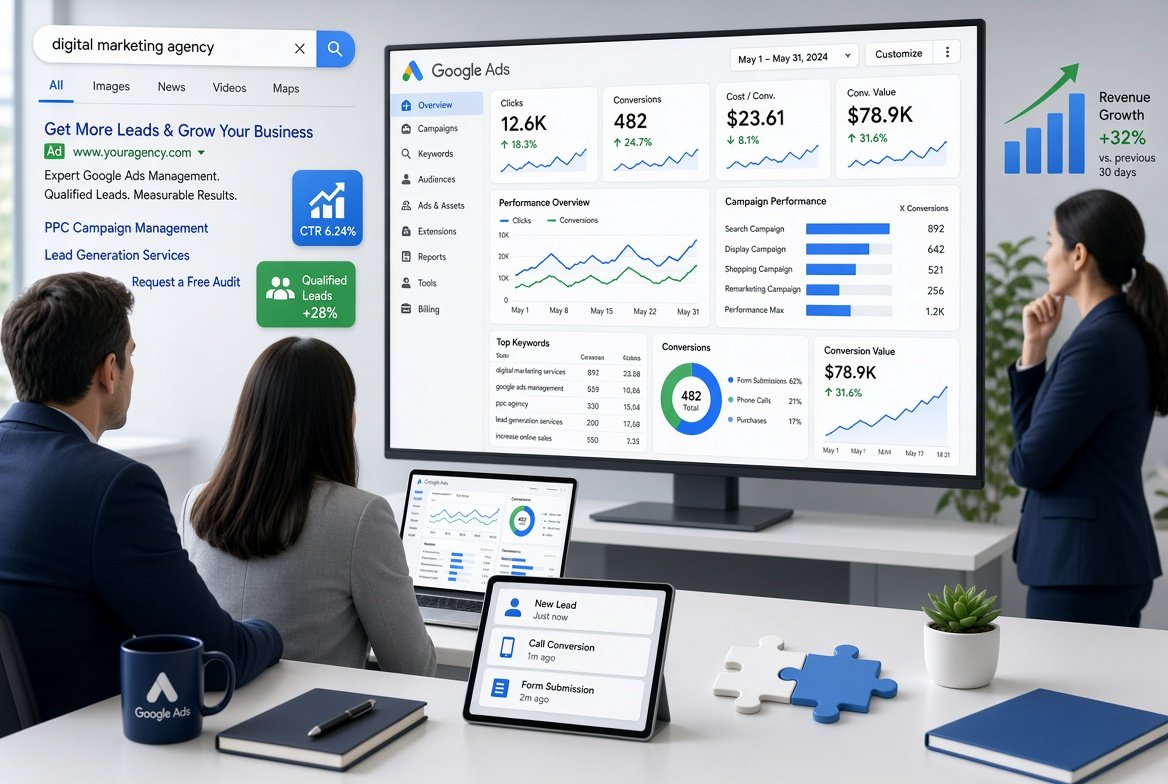
A Google Ads Agency helps businesses generate qualified leads and sales through professionally managed paid advertising campaigns on Google. Instead of simply increasing advertising spend, a professional agency focuses on keyword targeting, campaign structure, advertisement copy, bidding, conversion tracking, landing pages, and continuous optimization. As a result, businesses can make better use of their advertising budgets and focus on customers who are more likely to take action.
Google Ads gives businesses the opportunity to appear when potential customers are actively searching for products and services. For example, someone searching for a dentist, roofing company, software platform, marketing agency, or online product may already have a strong reason to buy.
However, visibility alone does not guarantee profitable results. Poor keyword selection, irrelevant traffic, weak advertisements, inaccurate conversion tracking, and ineffective landing pages can quickly waste an advertising budget.
That is where professional campaign management becomes valuable. A Google Ads Agency combines strategy, data analysis, campaign management, and conversion optimization to help businesses turn paid traffic into measurable business results.
A Google Ads Agency is a digital marketing company that manages paid advertising campaigns through Google’s advertising platforms. Depending on the business, the agency may manage search campaigns, display campaigns, shopping campaigns, remarketing, and lead generation campaigns.
Typical Google Ads services include:
First, the agency learns about the business, its products, services, customers, competitors, and goals. Then, the campaign structure is developed around those objectives.
The purpose is not simply to generate clicks. Instead, the focus should be on valuable actions such as phone calls, purchases, bookings, quote requests, form submissions, and qualified leads.
Businesses looking for professional support can use PPC advertising services to build campaigns around measurable business goals.
Managing Google Ads may look simple at first. However, profitable PPC advertising involves many moving parts.
An account can contain multiple campaigns, ad groups, keywords, audiences, advertisements, locations, conversion actions, bidding strategies, and landing pages. Therefore, even small mistakes can become expensive when campaigns receive significant traffic.
A professional Google Ads Agency can help businesses:
Moreover, an experienced agency can recognize patterns that may be difficult for a business owner to identify without regular PPC experience.
For example, a campaign may generate many clicks while producing very few qualified leads. In that situation, increasing the budget would not solve the underlying problem. Instead, the agency needs to investigate keywords, search terms, advertisements, landing pages, audience targeting, and conversion tracking.
Google Ads can be powerful because it allows businesses to reach people based on their active searches.
Consider searches such as:
emergency plumber near me
buy office furniture online
best accounting software
roof replacement company
digital marketing agency
These searches indicate that users have specific needs. Consequently, businesses offering relevant products or services have an opportunity to appear in front of potential customers at an important stage of the buying journey.
Nevertheless, the advertisement must be relevant. The landing page should also match the user’s expectations, while the conversion process needs to be simple.
For this reason, effective Google Ads management involves much more than choosing keywords and setting a daily budget.
A Google Ads Agency may provide several advertising services depending on the business model, target audience, and marketing objectives.
Search advertisements appear when people search for relevant products or services on Google.
These campaigns are especially useful for high intent searches. For instance, someone searching for “emergency electrician” may need a service immediately. Therefore, a relevant advertisement can put a business directly in front of that potential customer.
Businesses can use Google Search advertising to target valuable searches and direct users toward relevant landing pages.
Display campaigns use visual advertisements across websites and digital properties within Google’s advertising network.
These campaigns can support:
Unlike search campaigns, display advertising can reach people while they are browsing other online content. Therefore, it can be useful when the goal extends beyond immediate search demand.
Businesses can use Google Display advertising to reach relevant audiences beyond traditional search results.
Google Shopping Ads are particularly useful for ecommerce businesses.
These advertisements can show product images, prices, store information, and other product details when users search for products. As a result, potential customers can compare products before visiting an online store.
Businesses can use Google Shopping Ads as part of a broader ecommerce advertising strategy.
Lead generation campaigns focus on acquiring potential customers rather than immediate product purchases.
They can be useful for:
The campaign should connect with a clear follow up process. Otherwise, generating leads without contacting them quickly can reduce the overall value of the campaign.
Professional lead generation advertising can help businesses build campaigns around customer inquiries and measurable actions.
Keyword research is one of the most important parts of Google Ads management.
Not every keyword with high search volume deserves advertising budget. Instead, the focus should be on relevance, intent, competition, and potential business value.
For example:
how to repair a leaking roof
is mainly informational.
On the other hand:
roof repair company near me
shows stronger commercial intent.
Both searches relate to roofing, yet the second search may be more valuable for a roofing company because the user may already be looking for a service provider.
A Google Ads Agency evaluates keywords based on:
Furthermore, PPC keyword research can provide useful information for organic search campaigns. Businesses can strengthen their wider strategy through keyword research services.
Search intent describes what a person wants to accomplish when searching online.
Understanding this intent helps advertisers choose better keywords and create more relevant advertisements.
The user wants to learn something.
Examples include:
These searches may be useful for content campaigns, although they do not always indicate immediate buying intent.
The user is researching products, services, or providers.
Examples include:
These searches can indicate that a user is moving closer to a purchase decision.
The user is ready to take action.
Examples include:
Therefore, transactional keywords can be especially valuable when the business has a strong conversion process.
The user is looking for a specific company, website, or brand.
A Google Ads Agency should consider search intent throughout campaign planning because the same keyword category can produce very different business outcomes.
Campaign structure affects how easily an account can be managed, analyzed, and optimized.
A basic structure may look like this:
Campaign
↓
Ad Group
↓
Keywords
↓
Advertisements
↓
Landing Page
For example, a home improvement company may create separate campaigns for:
Each service can then have closely related keywords and advertisements.
Consequently, users are more likely to see advertisements that match their searches. At the same time, advertisers can review performance at a more detailed level.
Advertisement copy needs to communicate value quickly because users often scan search results before deciding where to click.
A strong advertisement should answer several questions:
For example, a generic advertisement might say:
Professional Digital Marketing Services
A stronger version could mention a specific service, location, benefit, and action.
Furthermore, advertisements should be tested regularly. One message may generate more clicks, while another may produce fewer clicks but significantly better leads.
Therefore, campaign optimization should consider conversion quality rather than click volume alone.
A successful advertisement can still fail if the landing page does not convert visitors.
Imagine someone clicks an advertisement for emergency plumbing and lands on a generic homepage. The visitor may struggle to find the advertised service and leave.
A strong landing page should provide:
Most importantly, the landing page should match the advertisement.
If the advertisement promotes emergency plumbing, the landing page should immediately explain the emergency plumbing service instead of forcing the visitor to search through the website.
Businesses can support this process through landing page development.
Conversion tracking shows what happens after someone interacts with an advertisement.
Without accurate tracking, a business may know how many clicks it received but not how many customers those clicks generated.
Important conversion actions can include:
Accurate tracking also helps Google Ads campaigns make better optimization decisions when automated bidding is being used.
For that reason, a Google Ads Agency should verify that important conversion actions are configured correctly before making major campaign decisions.
Professional Google Ads management can involve many different activities.
First, the agency reviews the existing account to identify structural and performance issues.
The audit may cover:
Next, the agency evaluates keywords according to relevance, search intent, competition, and performance.
Actual search queries are reviewed to discover useful keywords and irrelevant searches.
As a result, businesses can identify new opportunities while reducing unnecessary spending.
Negative keywords help prevent advertisements from appearing for searches that are unlikely to produce useful results.
For example, a premium software company may not want to pay for users searching specifically for free alternatives.
Different messages, benefits, offers, and calls to action can be tested.
Over time, the data can reveal which messages attract the most valuable users.
Bidding strategies are reviewed according to campaign objectives and available conversion data.
Budgets can be adjusted toward campaigns, locations, products, or keywords that produce stronger results.
Tracking systems are checked to ensure important customer actions are being measured correctly.
Regular reporting gives businesses a clearer understanding of what happened, why it happened, and what should be improved next.
Small businesses often need to be particularly careful with advertising budgets.
A local company may not have enough resources to compete for every high volume keyword. Instead, the campaign should focus on valuable searches closely connected to its services.
For example, a local roofing company may focus on:
The exact keyword selection should depend on the business, location, competition, and customer demand.
Additionally, small businesses can combine paid advertising with SEO for small businesses to develop both immediate and long term search visibility.
Local businesses can use Google Ads to reach customers within specific geographic areas.
A company serving only selected cities does not necessarily need to advertise across an entire country. Instead, location targeting can help focus the budget where services are actually available.
For example, a local plumber may target selected cities or service areas rather than spending money on searches from locations it cannot serve.
However, paid advertising should not be the only local marketing channel.
Combining Google Ads with local SEO services can help businesses reach customers through both paid and organic search.
In addition, maintaining accurate business information through Google Business Profile services can support broader local visibility.
Google Ads and SEO serve different purposes, but they can work together effectively.
Google Ads provides paid visibility, while SEO focuses on organic search visibility.
Paid advertising can generate traffic soon after a campaign launches. SEO, on the other hand, usually takes longer to build but can create sustainable organic traffic.
Therefore, businesses do not always need to choose one channel over the other.
For example, a company could use Google Ads for high intent commercial keywords while developing organic content for informational searches.
Businesses can strengthen their organic visibility through search engine optimization services.
Moreover, paid campaigns can reveal valuable search terms that may later become targets for organic content.
Many visitors do not become customers during their first website visit.
They may compare several companies, review prices, speak with someone else, or simply postpone their decision.
Remarketing can help businesses reconnect with previous website visitors and engaged audiences.
For example, a visitor may view a product page and leave without purchasing. Later, the business can show that user a relevant advertisement.
As a result, the brand remains visible while the customer continues through the buying process.
Remarketing can be particularly useful for products or services that require consideration before purchase.
A professional agency should follow a structured optimization process.
The first step is understanding what is already happening.
The agency may review:
Next, the agency identifies areas where advertising budget is producing little or no business value.
This may include irrelevant searches, weak keywords, poorly performing audiences, or campaigns with low conversion quality.
Campaigns are then refined around relevant searches, audiences, locations, and customer intent.
Advertisement copy can be tested to improve relevance and encourage qualified users to click.
Landing pages are reviewed to ensure they match both the advertisement and the customer’s expectations.
Tracking is checked so that important customer actions are measured correctly.
Campaign data is reviewed regularly rather than waiting until the end of a month to identify problems.
Once profitable campaigns, keywords, products, or locations are identified, budgets can be increased carefully.
This gradual approach helps businesses scale while maintaining better control over advertising costs.
A Google Ads Agency should focus on metrics that connect advertising activity with business outcomes.
Impressions show how many times an advertisement was displayed.
Clicks show how many times users interacted with an advertisement.
Click through rate shows the percentage of impressions that resulted in clicks.
A low rate may indicate problems with targeting, keywords, or advertisement messaging.
Cost per click shows the average amount paid for each click.
However, a low cost per click is not automatically a sign of success.
A more expensive click may be valuable if it generates a high quality customer.
Conversion rate measures how frequently users complete a desired action.
Cost per lead shows the average advertising cost required to generate a lead.
Cost per acquisition measures the average cost required to acquire a customer or another defined conversion.
Return on advertising spend compares advertising revenue with advertising expenditure.
No single metric tells the entire story. Instead, these metrics should be reviewed together with lead quality, customer value, and revenue.
Businesses often make avoidable mistakes when managing campaigns internally.
High search volume does not automatically mean high business value.
A keyword may receive thousands of searches but generate very few customers.
Without negative keywords, irrelevant searches can consume budget.
Regular search term reviews can reveal opportunities to exclude unsuitable queries.
The homepage may not be the best destination for every advertisement.
A relevant service or product page can provide a stronger experience.
Without conversion tracking, businesses cannot accurately determine which campaigns generate valuable actions.
Clicks show engagement, but they do not necessarily represent revenue.
The real question is whether those clicks produce leads, customers, and sales.
Frequent changes can make performance patterns difficult to understand.
Optimization should be based on meaningful data rather than short term fluctuations.
Increasing the budget on a poorly performing campaign can increase losses.
Instead, businesses should identify what works first and then scale carefully.
Many searches happen on mobile devices. Therefore, landing pages and conversion processes must work properly across smaller screens.
Google Ads agency pricing varies according to the scope of work.
Several factors can affect the cost, including:
Some agencies charge a fixed monthly management fee. Others charge a percentage of advertising spend. Some use a combination of management fees and performance based structures.
However, price should not be the only consideration.
Businesses should evaluate the quality of strategy, reporting, communication, tracking, optimization, and results.
Choosing an agency is an important decision because advertising budgets can become significant over time.
Before hiring a Google Ads Agency, ask:
A reliable agency should explain its strategy clearly.
Furthermore, businesses should be cautious about agencies promising guaranteed revenue, guaranteed leads, or guaranteed results without first understanding the market, competition, offer, budget, and customer journey.
A strong Google Ads strategy connects every stage of the customer journey.
The process can look like this:
Keyword
↓
Search Intent
↓
Advertisement
↓
Landing Page
↓
Conversion
↓
Lead or Sale
↓
Customer
↓
Revenue
Every stage affects the next.
A relevant keyword can attract the right searcher. Next, a strong advertisement can encourage that person to click. Afterward, a relevant landing page can turn the visitor into a lead or customer.
Finally, accurate tracking can show whether the conversion has real business value.
That data can then be used to improve future campaigns.
Businesses can strengthen their wider paid marketing approach through a dedicated PPC advertising strategy.
Paid advertising does not always need to send users directly to a sales page.
Content can also play an important role in the customer journey.
Businesses can promote useful resources such as:
For users who are not ready to buy, helpful content can build trust and keep the business visible.
Later, those users may return when they are ready to make a purchase.
Professional content writing services can help businesses create useful content that supports both paid and organic marketing.
Getting more traffic is only one part of successful advertising.
Businesses also need to improve what happens after the click.
Conversion optimization may involve:
For example, increasing the conversion rate from two percent to three percent can create a meaningful improvement without increasing advertising traffic.
Therefore, Google Ads management and website conversion optimization should often be considered together.
Google advertising continues to evolve as automation, machine learning, search behavior, and audience signals change.
Automation can assist with:
Nevertheless, automation does not replace business strategy.
A business still needs to understand:
Human oversight remains important because platform recommendations do not always align perfectly with a company’s commercial priorities.
Businesses can also review Google Ads techniques to identify practical ways to improve campaign performance.
Some businesses choose to manage advertising internally.
This approach can work when a company has experienced PPC staff, sufficient time, reliable tracking systems, and a consistent optimization process.
On the other hand, hiring an agency can make more sense when:
Ultimately, the right choice depends on the business’s resources, objectives, and campaign complexity.
A Google Ads Agency plans, creates, manages, tracks, and optimizes paid advertising campaigns on Google. Services can include keyword research, campaign structure, advertisement creation, bidding, conversion tracking, landing page optimization, and reporting.
An agency can be valuable when it improves campaign efficiency, generates better quality leads, increases sales, or saves internal time. The value should be measured through meaningful business outcomes rather than clicks alone.
Pricing varies according to advertising budget, campaign complexity, number of services, locations, tracking requirements, and management scope. Agencies may charge fixed fees, percentage based fees, or a combination.
Yes. Google Ads can generate phone calls, form submissions, quote requests, bookings, and other customer inquiries. However, lead quality and follow up are also important parts of the process.
Google Ads can start generating traffic soon after campaigns launch. However, reliable optimization usually requires enough data to identify meaningful performance patterns. Results vary according to industry, budget, competition, targeting, offer, and conversion rate.
Yes. Google Ads can generate sales when advertisements reach relevant users and the landing page and conversion process are effective. Ecommerce businesses can also use Shopping campaigns to promote products.
Small businesses can benefit from Google Ads when campaigns focus on relevant searches, specific service areas, and valuable customer actions. Budget control and accurate tracking are particularly important.
Google Ads provides paid visibility, while SEO focuses on organic search visibility. Businesses can use both channels to reach customers at different stages of the search journey.
An agency can reduce wasted spend through keyword research, negative keywords, search term analysis, audience targeting, advertisement testing, bid management, landing page improvements, and accurate conversion tracking.
A good agency understands the business, creates a clear campaign strategy, tracks meaningful conversions, communicates performance clearly, regularly optimizes campaigns, and focuses on profitable business outcomes rather than vanity metrics.
A Google Ads Agency can help businesses turn paid search traffic into measurable leads, sales, and revenue through strategic campaign management.
The strongest campaigns are built around relevant keywords, clear search intent, persuasive advertisements, focused landing pages, accurate conversion tracking, and ongoing optimization.
Simply spending more money does not guarantee better PPC results.
Instead, successful advertising requires intelligent budget allocation, strong targeting, relevant messaging, and continuous performance analysis.
Businesses should also remember that paid advertising works best when it is connected to the wider digital marketing strategy. Combining Google Ads with SEO, content marketing, local search, and conversion optimization can create multiple opportunities to reach potential customers.
For businesses that want to improve their paid search performance, professional Google Ads management can provide the strategy, analysis, and ongoing optimization needed to build a stronger advertising channel.
Get Free Strategy Session or Request Proposal.