
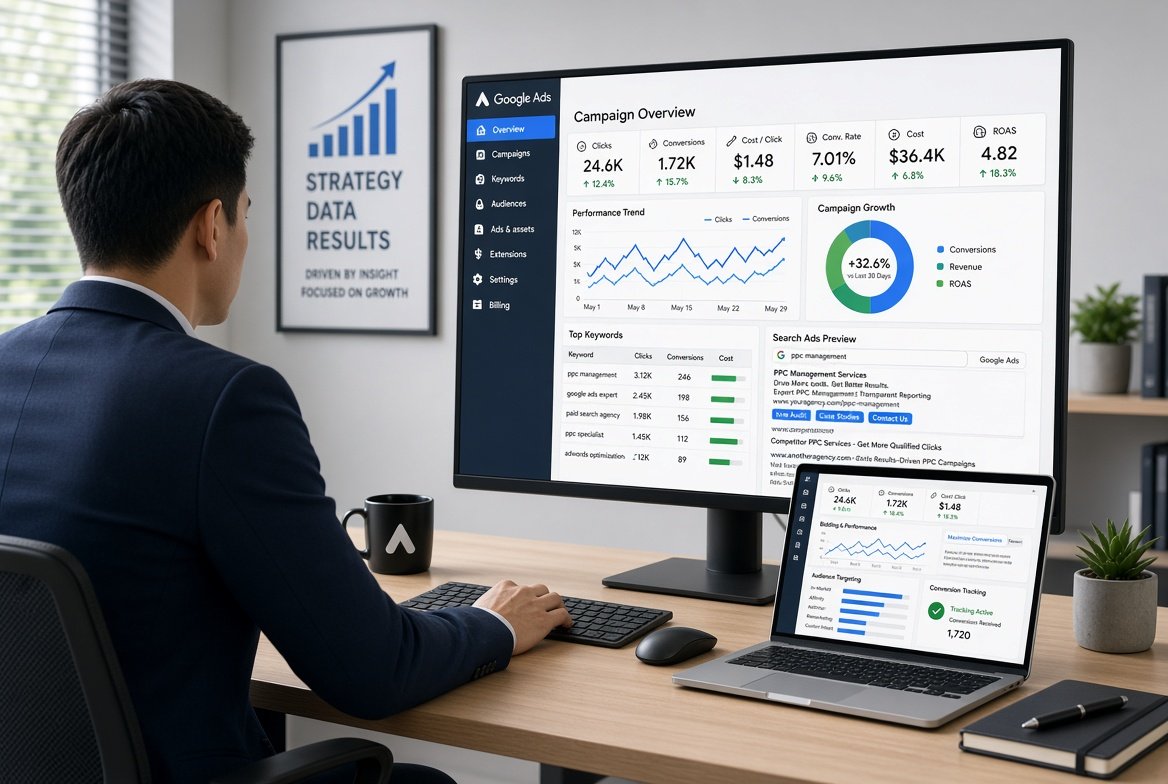
A Google Ads Specialist helps businesses create, manage, optimize, and scale paid search campaigns to generate better leads, sales, and measurable returns from advertising spend. Instead of simply launching advertisements and increasing budgets, a specialist analyzes search intent, keywords, audiences, bids, ad copy, landing pages, conversion tracking, and campaign performance to improve results.
Google Ads can put a business in front of potential customers at the exact moment they are searching for a product or service. However, getting visibility is not the same as getting profitable results. Poor keyword selection, irrelevant traffic, weak advertisements, inaccurate conversion tracking, and poorly optimized landing pages can quickly waste an advertising budget.
A professional Google Ads strategy focuses on connecting the right searcher with the right offer at the right stage of the buying journey.
A Google Ads Specialist manages paid advertising campaigns across the Google advertising ecosystem. Their work can include campaign planning, keyword research, account structure, advertisement creation, audience targeting, bidding, conversion tracking, performance analysis, and ongoing optimization.
The goal is not simply to generate clicks.
The goal is to generate valuable actions such as:
A specialist uses campaign data to identify what is working and what is wasting budget.
For businesses that need professional support, PPC advertising services can provide a structured approach to campaign planning, management, and optimization.
Google Ads looks simple from the outside. An advertiser chooses keywords, writes advertisements, sets a budget, and launches a campaign.
In practice, profitable PPC advertising requires much more.
Google Ads accounts can contain hundreds or thousands of keywords, multiple campaigns, different audiences, several advertisement variations, conversion actions, and complex bidding strategies.
Small mistakes can become expensive when campaigns receive significant traffic.
A Google Ads Specialist can help businesses:
The specialist also looks beyond individual clicks and evaluates how paid traffic contributes to actual business revenue.
Google Ads allows businesses to compete for visibility when users search for relevant products and services.
For example, imagine someone searches:
emergency plumber near me
A plumbing company running a relevant Google Search Ads campaign may have an opportunity to appear prominently for that search.
The advertiser may pay when the user clicks the advertisement, depending on the campaign and bidding setup.
The actual cost and position depend on several factors, including competition, bid strategy, advertisement relevance, landing page experience, and auction dynamics.
This means that simply increasing the budget does not guarantee better results.
Campaign quality and strategy matter.
A Google Ads Specialist may use different campaign types depending on the business objective.
Search advertisements appear when users search for relevant terms on Google.
They are particularly useful for businesses that want to reach people who already have a specific need.
For example:
Businesses can use Google Search advertising to target relevant searches and connect users with appropriate landing pages.
Display advertising can help businesses reach users across websites, applications, and other digital properties within the Google Display Network.
Display campaigns can support:
Businesses can explore Google Display advertising when visual advertising is part of their marketing strategy.
Google Shopping Ads are particularly useful for ecommerce businesses.
They can display product images, prices, store information, and other product details when users search for products.
A well optimized Shopping campaign can help ecommerce businesses reach customers with strong purchase intent.
Businesses can use Google Shopping Ads to promote products directly within Google’s shopping experience.
Lead generation campaigns focus on acquiring potential customers rather than immediate product purchases.
They can be useful for:
The campaign should be connected to a clear conversion process so the business can measure the value of generated leads.
Professional lead generation advertising can help businesses build campaigns around customer inquiries and measurable actions.
Keyword research is one of the most important responsibilities of a Google Ads Specialist.
Not every keyword that receives searches is valuable for a business.
The specialist needs to understand search intent.
For example:
buy office chair online
shows stronger commercial intent than:
how to choose an office chair
Both searches may be relevant to the furniture industry, but they represent different stages of the customer journey.
A strong Google Ads campaign separates keywords based on intent and creates advertisements that match what the user is looking for.
Businesses can also strengthen their keyword planning through keyword research services.
Search intent describes what a person is trying to accomplish when searching.
Common categories include:
The user wants information.
Examples include:
The user is researching options before making a decision.
Examples include:
The user is ready to take action.
Examples include:
The user is looking for a particular company, website, or brand.
Understanding intent helps a Google Ads Specialist decide which keywords should receive advertising budget.
A well structured account makes campaign management easier.
A typical structure may include:
Campaign
↓
Ad Group
↓
Keywords
↓
Advertisements
↓
Landing Page
For example, a roofing company might create separate campaigns for:
Each campaign can then contain tightly related ad groups.
This makes it easier to create relevant advertisements and analyze performance.
Advertisement copy plays an important role in attracting qualified clicks.
A good advertisement should clearly communicate:
For example, a generic advertisement might say:
Professional Roofing Services Available
A stronger advertisement could communicate the service, location, benefit, and action more clearly.
The exact message depends on the business and target audience.
A Google Ads Specialist should continually test different messages rather than assuming the first advertisement will always perform best.
Getting a click is only the beginning.
The landing page needs to persuade the visitor to take the desired action.
A poor landing page can waste money even when the advertisement is performing well.
A strong landing page should generally have:
The page should closely match the advertisement.
If someone clicks an advertisement for emergency plumbing but lands on a generic homepage, they may leave immediately.
Businesses can improve paid campaign performance through dedicated landing page development.
Conversion tracking tells advertisers what happens after someone interacts with an advertisement.
Without accurate conversion tracking, a business may know that it received clicks but not know whether those clicks generated customers.
Important conversion actions can include:
A Google Ads Specialist should make sure that important conversions are tracked correctly.
This allows campaign decisions to be based on business outcomes rather than assumptions.
Google Ads optimization is an ongoing process.
Campaign performance can change because of:
A specialist regularly reviews campaign data and makes adjustments.
The search terms report can reveal what people are actually searching before clicking an advertisement.
This information can identify:
Negative keywords prevent advertisements from appearing for irrelevant searches.
For example, a company selling premium accounting software may not want to pay for clicks from users searching for free software.
Adding appropriate negative keywords can reduce wasted spend.
Bidding strategies should match the campaign objective and available conversion data.
A specialist may evaluate:
The correct bidding approach depends on the campaign and business model.
A Google Ads Specialist needs to understand which metrics matter.
Impressions show how often advertisements were displayed.
Clicks show how many times users interacted with the advertisement.
Click through rate measures how frequently users click after seeing an advertisement.
A low click through rate can indicate problems with targeting, keywords, or advertisement messaging.
Cost per click shows the average amount paid for each click.
Lower cost is not always better.
A more expensive click can be valuable if it generates high quality customers.
Conversion rate measures how frequently users complete a desired action.
Cost per conversion helps businesses understand how much advertising spend is required to generate a conversion.
Return on advertising spend compares advertising revenue with advertising costs.
For ecommerce businesses, this can be particularly useful when measuring sales campaigns.
Small businesses often have limited advertising budgets, so efficient targeting is extremely important.
A small business should avoid trying to compete for every possible keyword.
Instead, it should focus on high value searches connected to its products or services.
For example, a local electrician may prioritize:
rather than spending heavily on broad informational searches.
Small businesses can also combine paid advertising with SEO for small businesses to develop both immediate and long term visibility.
Local businesses can use Google Ads to target specific service areas.
Location targeting can help businesses focus their advertising budget on areas where they actually operate.
For example, a home service business serving specific cities does not necessarily need to advertise across an entire country.
Local businesses can also combine Google Ads with local SEO services to improve their visibility in both paid and organic search results.
Maintaining an optimized Google Business Profile can further strengthen local visibility.
Businesses can use Google Business Profile services to support their broader local search strategy.
Google Ads and SEO are different marketing channels, but they can complement each other.
Google Ads provides paid visibility, while SEO focuses on earning organic visibility.
Paid campaigns can produce traffic quickly, while SEO generally requires more time to build authority and rankings.
Businesses can use both channels to cover different parts of the customer journey.
For example, a company may use Google Ads for high intent commercial keywords while building organic content for informational searches.
A broader search engine optimization strategy can help create long term organic visibility alongside paid advertising.
Not every visitor converts during their first visit.
Remarketing allows businesses to reconnect with users who previously interacted with their website or advertisements.
For example:
A user visits a service page.
They read the information but do not submit a form.
Later, the business can show a relevant advertisement to that user.
Remarketing can help maintain brand visibility and encourage users to return when they are ready to make a decision.
Many businesses waste advertising budget because of avoidable mistakes.
Broad targeting without proper monitoring can attract irrelevant traffic.
Search term data can reveal opportunities and wasted spend.
Ignoring it means missing useful optimization opportunities.
Without negative keywords, advertisements may appear for searches that have little commercial value.
A homepage is not always the best destination for a paid advertisement.
Users should ideally land on a page directly related to their search and advertisement.
If conversions are not tracked accurately, campaign optimization becomes difficult.
Clicks do not necessarily equal customers.
Businesses should measure leads, sales, revenue, and other meaningful outcomes.
Constant changes can make performance difficult to evaluate.
Optimization should be based on meaningful data.
A specialist typically works through several stages.
The first step is understanding the current setup.
The audit may review:
The specialist looks for areas where budget is being spent without producing valuable results.
Campaigns can be reorganized around stronger keywords, audiences, locations, and search intent.
Ad copy can be tested and refined to improve relevance and click through rate.
The landing experience should match the user’s search and advertisement.
Important business actions should be measured correctly.
Campaigns should be reviewed based on actual performance data.
Once profitable campaigns, keywords, audiences, and advertisements are identified, budgets can be increased carefully.
Google Ads management costs vary depending on the scope of work.
Factors can include:
Some agencies charge a flat monthly management fee, while others use a percentage of advertising spend.
The cheapest management option is not necessarily the best option.
Businesses should evaluate the quality of strategy, reporting, communication, tracking, and results.
Before hiring a specialist, ask about their experience and approach.
Useful questions include:
A good specialist should be able to explain their strategy clearly rather than promising guaranteed results.
A strong Google Ads strategy should connect advertising with the entire customer journey.
The process can look like this:
Keyword research
↓
Search intent
↓
Campaign structure
↓
Advertisement
↓
Landing page
↓
Conversion
↓
Lead or customer
↓
Performance analysis
↓
Optimization
Every stage affects the next.
If the keyword is wrong, the advertisement may attract the wrong person.
If the advertisement is weak, users may not click.
If the landing page is poor, visitors may not convert.
If tracking is inaccurate, the business cannot properly evaluate the campaign.
A Google Ads Specialist looks at this entire process rather than optimizing individual metrics in isolation.
PPC advertising continues to evolve as user behavior, automation, search technology, and artificial intelligence change.
Businesses should monitor developments in:
Businesses can also review the latest Google Ads techniques to identify practical ways to improve campaign performance.
At the same time, PPC should remain connected to the wider digital marketing strategy rather than operating as an isolated channel.
Artificial intelligence is increasingly influencing digital advertising.
Automation can help with areas such as bidding, audience signals, advertisement variations, recommendations, and campaign optimization.
However, automation does not eliminate the need for strategic decision making.
A business still needs to determine:
A specialist can use automation while maintaining human oversight of business objectives.
A Google Ads Specialist is a professional who plans, creates, manages, tracks, and optimizes Google advertising campaigns to improve leads, sales, and advertising efficiency.
Daily work can include monitoring campaign performance, reviewing search terms, adjusting bids, analyzing conversions, testing advertisements, managing budgets, adding negative keywords, and identifying optimization opportunities.
It can be valuable for businesses that want professional campaign management and do not have the internal expertise or time to manage PPC effectively. The value depends on campaign performance and business outcomes.
A specialist can reduce wasted spend by improving keyword targeting, adding negative keywords, adjusting bids, reviewing search terms, improving campaign structure, and focusing budgets on high value traffic.
The terms are often used interchangeably. A Google Ads Specialist specifically focuses on Google’s advertising platforms, while a PPC Specialist may work across multiple paid advertising platforms.
Yes. Google Ads can be highly useful for local businesses because advertisements can target relevant searches and geographic areas. Lead tracking and fast follow up are important for maximizing results.
Some campaigns can generate traffic and conversions soon after launch, but reliable optimization usually requires enough data to identify patterns. The timeframe varies based on budget, industry, competition, audience, and conversion volume.
Both can be useful. Google Ads can provide paid visibility while SEO focuses on organic search visibility. The right combination depends on business goals, budget, competition, and customer behavior.
Track meaningful conversions, revenue, customer acquisition cost, conversion value, and return on advertising spend. Looking only at clicks or impressions does not show whether the campaign is profitable.
Yes. A specialist can manage Google Shopping campaigns, product feeds, product targeting, budgets, bidding, and performance analysis depending on the business setup.
Google Ads can become a powerful customer acquisition channel when campaigns are built around search intent, relevant keywords, strong advertisements, effective landing pages, accurate conversion tracking, and continuous optimization.
A Google Ads Specialist does more than manage advertisements. The role involves understanding customer behavior, analyzing campaign data, identifying opportunities, controlling wasted spend, and improving the path from search to conversion.
For businesses that want better PPC performance, the focus should always remain on meaningful outcomes such as qualified leads, sales, revenue, and profitable customer acquisition.
If your campaigns are generating clicks but not enough business, or if you are preparing to launch Google Ads for the first time, professional campaign planning and management can help create a stronger foundation.
Get Free Strategy Session or Request Proposal.