
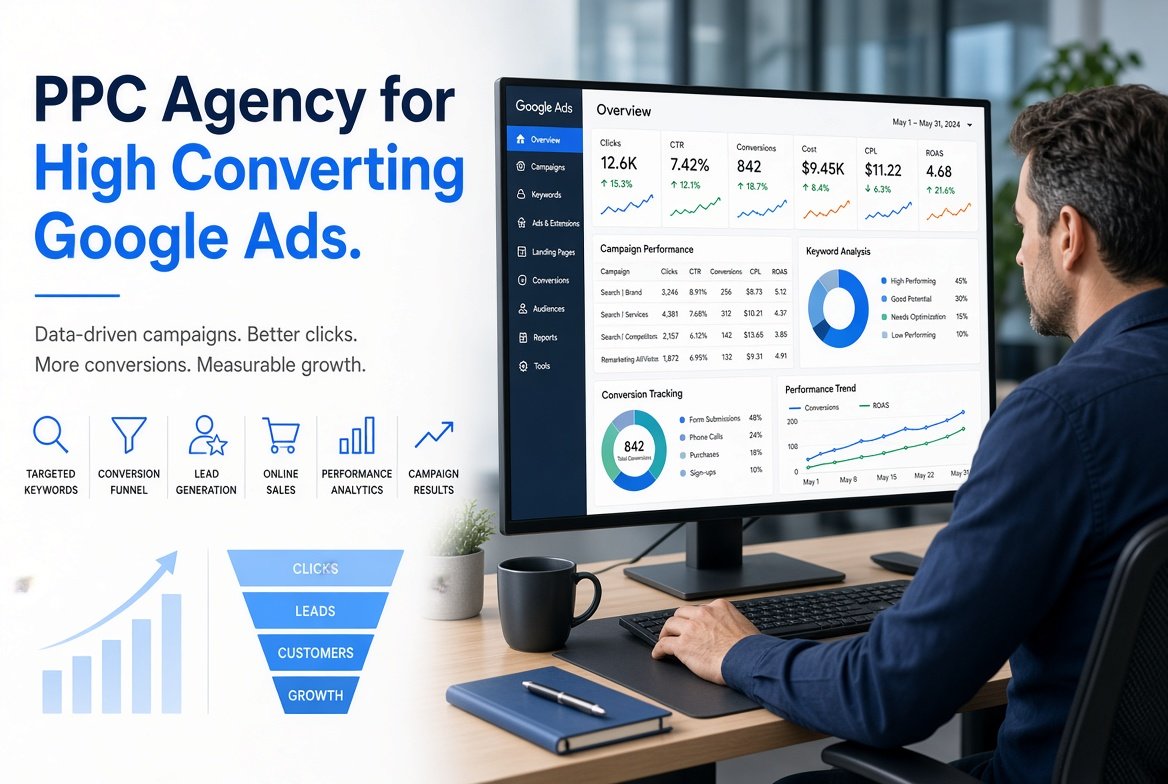
 PPC Agency for High Converting Google Ads
A professional PPC agency helps businesses attract qualified leads, increase online sales, and improve returns from Google Ads. Through targeted keyword research, compelling advertisements, accurate conversion tracking, and landing page optimization, businesses can reach potential customers who are actively searching for their products or services. PulseDigitall helps businesses develop data driven PPC strategies focused on reaching relevant audiences, reducing wasted advertising spend, and improving measurable campaign performance.
Running Google Ads successfully requires more than launching advertisements and waiting for clicks. Businesses need a clear strategy, appropriate targeting, relevant ad copy, effective landing pages, and reliable performance tracking. Without these elements, campaigns can consume advertising budgets without generating enough sales or qualified inquiries.
Choosing the right pay per click advertising agency helps businesses manage these factors through a structured process. Whether a company wants more phone calls, service inquiries, online purchases, or appointment bookings, effective PPC management connects advertising decisions with business objectives.
A PPC agency is a digital marketing company that plans, creates, manages, and optimizes paid advertising campaigns. PPC stands for pay per click, a model in which advertisers generally pay when someone clicks their advertisement.
Google Ads is a major PPC advertising platform that allows businesses to promote products and services through search results, Shopping listings, display advertising, YouTube, and other eligible placements.
A PPC agency handles tasks such as keyword research, campaign setup, audience targeting, ad creation, budget management, conversion tracking, and performance reporting. Its objective is to help businesses attract relevant visitors and turn advertising opportunities into meaningful results.
For example, a local plumbing company may want more emergency service calls. A PPC specialist can identify relevant search terms, create advertisements targeting the company’s service area, direct visitors to a relevant landing page, and track incoming calls. This allows the business to assess whether its advertising is generating genuine opportunities.
Businesses looking for professional campaign support can explore Google Ads management services from PulseDigitall.
A professional PPC agency provides several services to help businesses improve paid advertising performance.
These activities work together. Relevant keywords bring the right audience, clear advertisements set accurate expectations, and useful landing pages make it easier for visitors to take action.
Google Ads can help businesses reach people who are actively searching for their products or services. However, poor targeting, irrelevant searches, weak advertisements, and inaccurate tracking can reduce campaign effectiveness.
An experienced PPC agency helps businesses identify these problems and establish a more organized approach to paid advertising.
Search advertising can connect businesses with customers who already need a product or service. Someone searching for an emergency electrician or a professional flooring installer may be ready to contact a provider.
A PPC agency researches relevant keywords and groups them according to customer intent. This helps businesses create advertisements that address specific needs instead of attracting broad, unrelated traffic.
For example, a commercial flooring company may prioritize searches for commercial flooring installation rather than spending its entire budget on general flooring terms that attract people looking for DIY advice.
The objective is to attract visitors who have a realistic chance of becoming customers.
Not every click generates business value. Some users may be searching for jobs, free resources, unrelated services, or providers outside the company’s service area.
PPC management services help identify these issues by reviewing search terms, location performance, device data, and conversion patterns.
Negative keywords can exclude selected irrelevant searches. Geographic targeting can focus spending on areas the business serves. Campaign reports can also reveal which products or services deserve greater investment.
However, the cheapest click is not always the most valuable. A more expensive keyword may produce high quality customers, while inexpensive traffic may generate no sales. Decisions should reflect conversion quality and business economics.
Lead generation campaigns should attract people who genuinely need the advertised service. A high converting campaign aligns the search term, advertisement, landing page, and call to action.
For example, an advertisement promoting Google Ads management should lead to a page explaining the agency’s PPC services, process, and benefits. A clear inquiry form or consultation option can help interested visitors take the next step.
Businesses can explore PPC lead generation services from PulseDigitall to learn how paid advertising can support customer acquisition.
A professional PPC agency measures results against defined objectives. Reports should help business owners understand which campaigns generate leads or sales, which keywords perform best, and how much each conversion costs.
For ecommerce businesses, revenue and return on ad spend may be important. For service companies, qualified leads, phone calls, and booked appointments may be more relevant.
Using meaningful metrics helps businesses make informed decisions instead of judging campaigns by impressions and clicks alone.
The right combination of PPC services depends on the company’s industry, audience, budget, and business objectives.
Google Search advertising displays sponsored results when users search for relevant terms. It can be useful for businesses offering products or services that customers actively seek.
A PPC agency researches keywords, creates relevant ad groups, configures targeting, and reviews search term quality. Campaigns may be organized around different services, locations, or product categories.
Search advertising can support phone calls, purchases, appointment bookings, and service inquiries.
Learn more about Google Search advertising from PulseDigitall.
Google Display advertising uses visual ads across eligible websites, applications, and placements within the Google Display Network. It can help businesses introduce products, increase brand awareness, and reconnect with eligible audiences.
Successful display campaigns require suitable audience targeting, relevant creative assets, and regular performance reviews. High impression volume does not automatically indicate that a campaign is generating valuable customers.
Explore Google Display advertising to understand how visual advertising can complement search campaigns.
Google Shopping campaigns promote eligible products with information such as product images, prices, and store details. They can help ecommerce businesses reach shoppers who are comparing products before making a purchase.
Campaign performance depends on accurate product information, a well maintained product feed, competitive offers, relevant product pages, and reliable purchase tracking.
A PPC agency may review product titles, descriptions, images, categories, and feed errors to improve product data quality and campaign management.
Businesses can explore Google Shopping advertising for their ecommerce marketing strategy.
Performance Max is a Google Ads campaign type that uses automation to help advertisers reach eligible audiences across Google’s advertising channels.
It can support advertisers with clear conversion objectives, suitable creative assets, and reliable tracking. However, automation does not eliminate the need for strategic management.
Businesses still need to monitor conversion quality, evaluate campaign insights, provide relevant assets, and ensure that tracked actions represent meaningful business outcomes.
YouTube advertising allows businesses to promote products and services through video. It can help explain complex services, demonstrate product features, introduce a brand, or reach audiences who may not be actively searching.
Campaign performance depends on the creative, audience, offer, and advertising objective. Video views should not automatically be treated as sales or qualified leads.
PulseDigitall also provides YouTube advertising services for businesses exploring video promotion.
Remarketing helps advertisers reconnect with eligible people who previously interacted with their website or business.
For example, an online store may show relevant advertisements to eligible visitors who viewed a product but did not complete a purchase. A service provider may reconnect with previous visitors who explored its services.
Remarketing should follow applicable privacy requirements, consent settings, and advertising policies. Campaigns should provide useful information rather than repeatedly displaying the same message without a clear purpose.
High converting campaigns require research, relevant messaging, reliable measurement, and continuous improvement. No agency can guarantee a particular conversion rate, but a structured process can help businesses improve their decisions.
Before launching campaigns, the agency should understand the company’s services, target customers, geographic coverage, competitive advantages, and sales process.
The initial assessment should establish the advertising objective, available budget, historical performance, and actions that qualify as conversions.
An ecommerce business may prioritize completed purchases and revenue. A local service provider may focus on qualified inquiries and phone calls. A B2B company may measure booked meetings and sales opportunities.
Keyword research identifies the terms potential customers use when searching for products or services. A PPC agency evaluates relevance, commercial intent, competition, and likely business value.
For example, searches for bathroom renovation contractors reflect a different need from searches for bathroom design ideas. Businesses focused on immediate inquiries may prioritize keywords that closely match their services.
Negative keywords can help exclude searches that are unlikely to generate valuable customers.
Businesses can also strengthen their wider search strategy through keyword research services.
Campaign structure affects budget control, targeting, reporting, and optimization. A PPC agency should organize campaigns around meaningful differences in services, products, locations, or advertising objectives.
A business serving multiple cities may benefit from separate geographic campaigns when budgets or performance differ significantly. An ecommerce company may organize campaigns around major product categories.
The structure should remain manageable. Creating too many small campaigns can divide limited data and make optimization more difficult.
Effective Google Ads copy explains the offer clearly and gives users a reason to take the next step. Headlines and descriptions should match the search intent and landing page.
Advertisements may highlight a specific service, customer benefit, relevant location, or genuine offer. All claims should be accurate and supported by what the business can deliver.
Relevant ad assets can provide additional information, such as service categories, contact details, and useful page links.
A relevant advertisement can still perform poorly if its landing page does not meet the visitor’s expectations.
An effective landing page should include a clear headline, useful information, credible proof, easy navigation, and a visible call to action. It should also load properly and work well on mobile devices.
Common problems include slow loading, unclear service details, lengthy forms, weak trust signals, and content that does not match the advertisement.
Businesses needing dedicated campaign pages can explore landing page development from PulseDigitall.
Conversion tracking measures the actions that matter to the business. These may include completed purchases, calls, lead forms, and appointment bookings.
Google Ads conversion tracking, Google Analytics 4, and Google Tag Manager can support measurement when implemented correctly. Tracking should be tested to confirm that events fire as expected and duplicate conversions are minimized.
A page view or button click may indicate interest, but it should not automatically be treated as a valuable lead or completed sale.
Reliable measurement helps businesses understand which campaigns are generating meaningful outcomes.
Google Ads offers bidding strategies for different advertising objectives. The appropriate choice depends on campaign goals, available conversion data, budget, and measurement quality.
Conversion focused automated bidding may be suitable when tracking is reliable. However, an unrealistic target cost per acquisition can restrict traffic or reduce conversion volume.
A PPC agency should consider historical performance, customer value, and business margins before making bidding decisions.
After launch, campaigns require regular reviews. An agency may evaluate search terms, locations, devices, advertisement performance, landing pages, and conversion patterns.
Search term analysis can reveal irrelevant traffic and new opportunities. Geographic reporting can identify locations that produce stronger leads. Device analysis can expose mobile usability problems.
Quality Score can help diagnose ad relevance and landing page experience, but it is not a direct measure of profitability.
Testing helps businesses compare advertisements, offers, landing page messages, and campaign approaches.
For example, a service company may compare a headline focused on expertise with one focused on convenience. The agency should define the success measure before the test begins.
Tests need enough reliable data to support useful conclusions. Short term fluctuations should not automatically trigger major campaign changes.
Low cost leads do not always become customers. A campaign with a higher cost per lead may generate more valuable sales opportunities.
Businesses should connect advertising data with qualified leads, booked appointments, closed sales, revenue, and profit contribution whenever possible.
This approach helps businesses evaluate whether their advertising is supporting actual commercial results rather than generating activity without measurable value.
A PPC agency should report metrics that help businesses understand what their advertising investment produces.
Click through rate measures the percentage of impressions that result in clicks. It can indicate whether an advertisement is relevant to its audience, but it does not prove that the campaign is profitable.
Cost per click measures the average amount paid for each click. It varies by industry, keyword competition, location, and campaign settings. Cheaper clicks are not automatically better if they fail to generate valuable outcomes.
Conversion rate measures the proportion of relevant interactions that result in a defined conversion. The calculation depends on the tracking setup, so reporting definitions should remain consistent.
Cost per lead measures advertising cost relative to the number of leads generated.
For example, if a campaign spends $1,000 and generates 20 tracked leads, the average advertising cost per lead is $50. This figure does not establish profitability because the business must also evaluate lead quality and how many leads become customers.
Return on ad spend, or ROAS, compares attributed advertising revenue with advertising expenditure.
If a campaign generates $5,000 in attributed revenue from $1,000 in advertising spend, its reported ROAS is 5:1. This does not mean the business earned $4,000 in profit because product costs, fulfillment, salaries, management fees, and other expenses still apply.
Lead quality is essential for businesses that rely on inquiries rather than immediate purchases. Tracking qualified leads, booked meetings, and closed sales provides a clearer picture of performance.
Connecting these outcomes with advertising data helps businesses make more informed decisions about budgets and targeting.
PPC agency pricing varies according to advertising spend, account complexity, campaign types, reporting requirements, and the level of support included.
Common pricing models include fixed monthly management fees, a percentage of advertising spend, project based fees, or a combination of setup and ongoing management charges.
Businesses should distinguish between the agency’s management fee and the advertising budget paid to Google. These are separate expenses and should be clearly explained.
Before hiring an agency, ask whether the fee includes campaign setup, keyword research, conversion tracking, reporting, landing page recommendations, and ongoing optimization. Creative production or website development may involve additional costs.
The right choice depends on the business’s requirements and the value it expects from professional management. Businesses can learn more about budgeting through PulseDigitall’s guide to Google Ads advertising costs.
Businesses can manage Google Ads internally or hire an external PPC agency.
An in house team may understand the company’s products, customers, margins, and sales process in greater detail. It can also coordinate advertising with other internal departments.
An external agency may provide specialist experience in campaign strategy, keyword research, conversion tracking, and performance analysis. This can be useful when the company lacks the time or expertise to manage advertising consistently.
However, an agency still needs accurate business information and feedback about lead quality and sales. A hybrid approach can work well when internal staff provide business knowledge while an agency manages campaign implementation and optimization.
PPC and SEO both help businesses reach customers through search engines, but they operate differently.
PPC provides paid visibility when campaigns are eligible to appear and advertising budgets are available. It can support lead generation, product promotion, and offer testing. Traffic generally depends on continued advertising investment.
SEO focuses on improving organic visibility through technical improvements, relevant content, useful landing pages, and authority building. Organic growth can take time and does not guarantee specific rankings.
Businesses with immediate lead generation needs may prioritize PPC while building their organic search presence. Others may invest more heavily in SEO based on their budget, competition, and customer journey.
Read PulseDigitall’s guide to Google Ads versus SEO to understand the differences. Businesses can also explore SEO services for small businesses to support long term organic visibility.
Choosing a PPC agency requires more than comparing prices. Businesses should assess the agency’s experience, reporting process, communication, and approach to campaign improvement.
Ask whether the agency has worked with businesses similar to yours. Ecommerce campaigns, local lead generation, and B2B advertising involve different challenges.
Past results can demonstrate experience, but they should not be treated as guarantees of future performance.
Find out how the agency measures purchases, calls, lead forms, and qualified inquiries. The tracking setup should reflect the business’s actual objectives and should be tested before results are used to make important decisions.
Ask how the agency reviews search terms, manages budgets, tests advertisements, and identifies landing page problems.
The agency should explain how decisions are made and how performance improvements will be evaluated.
Reports should clearly explain spending, conversions, cost per conversion, lead quality, and revenue where available. The agency should identify what changed, what it means, and which actions it recommends.
Businesses should retain appropriate access to their Google Ads accounts and understand who owns campaign data, conversion settings, and creative assets.
Clear ownership arrangements make it easier to review performance and maintain continuity if the agency relationship ends.
Be cautious of agencies that guarantee specific rankings, fixed lead volumes, or a particular return without understanding the business, market, budget, and offer.
A reliable PPC agency establishes measurable objectives, explains potential limitations, and uses campaign data to guide improvements.
Broad or poorly controlled targeting can attract searches that do not match the business. Keyword selection, negative keywords, location settings, and search term reviews help maintain relevance.
A homepage may not answer a visitor’s specific question. Relevant landing pages help match the advertisement with the visitor’s needs and provide a clearer next step.
Counting every button click or page view as a valuable conversion can distort campaign reporting. Tracking should prioritize meaningful actions and avoid duplicate events.
Frequent changes based on small samples can produce misleading conclusions. Campaign adjustments should reflect conversion volume, sales cycles, and reliable performance evidence.
Slow pages, difficult forms, and unclear contact options can reduce conversions from mobile visitors. Testing the full customer journey on smartphones can reveal problems that affect campaign results.
Clicks and impressions are useful diagnostic metrics, but they do not necessarily indicate business success. Campaigns should be evaluated against qualified leads, sales, revenue, and other relevant outcomes.
PPC can complement other marketing activities by helping businesses capture existing demand, test offers, and reach relevant audiences.
SEO can support organic visibility. Content marketing can answer customer questions. Social media advertising can introduce offers to audiences who may not be actively searching.
For example, a business may use Google Search campaigns to reach customers with immediate needs, remarketing to reconnect with eligible website visitors, and SEO to build long term organic visibility.
PulseDigitall provides additional services that can support this strategy, including on page SEO services, off page SEO services, and content writing services.
Businesses interested in social campaigns can explore social media marketing services and Facebook advertising services.
Each channel should have a clear purpose, and its performance should be evaluated using appropriate metrics.
A PPC agency can be useful for a small business when advertising has a clear commercial purpose and the company can support both management costs and media spending.
Small businesses often have limited budgets, making targeting, conversion tracking, and lead quality especially important. A PPC agency can help prioritize relevant services, identify suitable locations, and monitor whether advertising generates genuine opportunities.
Before investing, businesses should understand how much they can reasonably afford to spend to acquire a customer. This depends on average sale value, gross margin, conversion rates, customer lifetime value, and the proportion of leads that become paying customers.
A company with strong customer margins may be able to support a higher acquisition cost than one with narrow margins. Cash flow and the time needed to convert leads into sales also matter.
The best approach is to begin with clear goals, reliable tracking, and realistic expectations, then adjust spending based on evidence.
A PPC agency manages paid advertising campaigns, including keyword research, campaign setup, ad creation, targeting, budget management, conversion tracking, and optimization. Its goal is to help businesses reach relevant audiences and achieve measurable advertising objectives.
Pricing depends on campaign complexity, advertising spend, service scope, and reporting requirements. Agencies may charge a fixed monthly fee, a percentage of advertising spend, a project fee, or a combination. The advertising budget is generally separate from the management fee.
Campaigns may begin receiving impressions and clicks after approval and eligibility checks. However, meaningful performance evaluation requires enough reliable data to assess conversions, lead quality, and costs. The timeframe depends on competition, budget, conversion volume, and the sales cycle.
No agency can responsibly guarantee a specific number of conversions without accounting for factors such as competition, budget, offer quality, website performance, and customer demand. A professional agency can establish goals, improve campaign management, and measure progress, but actual results vary.
Google Ads can suit small businesses when campaigns target relevant customers and the budget aligns with the company’s acquisition economics. Clear goals, focused targeting, accurate tracking, and regular performance reviews are important.
PPC is an advertising payment model in which advertisers generally pay for clicks. Google Ads is an advertising platform that supports several campaign types, including search, display, and Shopping campaigns. Not every Google Ads campaign uses a strictly pay per click charging model.
Evaluate advertising costs alongside sales, revenue, gross margins, and customer acquisition costs. ROAS can help compare attributed revenue with advertising spend, but it does not account for all business expenses. Lead generation businesses should also evaluate lead quality and the proportion of leads that become customers.
Managing campaigns internally may suit businesses with sufficient time and expertise. Hiring an agency can provide specialist support with strategy, tracking, and optimization. The decision depends on account complexity, available resources, and the expected value of professional management.
Google Ads can help businesses connect with potential customers at the moment they search for relevant products and services. However, strong campaign performance requires a clear strategy, relevant advertisements, accurate conversion tracking, useful landing pages, and consistent optimization.
A professional PPC agency brings these elements together to help businesses make informed advertising decisions. By measuring qualified leads, purchases, customer acquisition costs, and revenue where available, businesses can evaluate performance against their actual goals.
PulseDigitall helps businesses approach paid advertising with a focus on campaign relevance, measurement, and continuous improvement. Whether you want to generate more service inquiries, improve ecommerce sales, or make better use of your advertising budget, the first step is to identify your objectives and understand how success will be measured.
Visit PulseDigitall’s PPC advertising services to explore your options and request a proposal for your business.