
 Local SEO Services to Grow Your Local Business
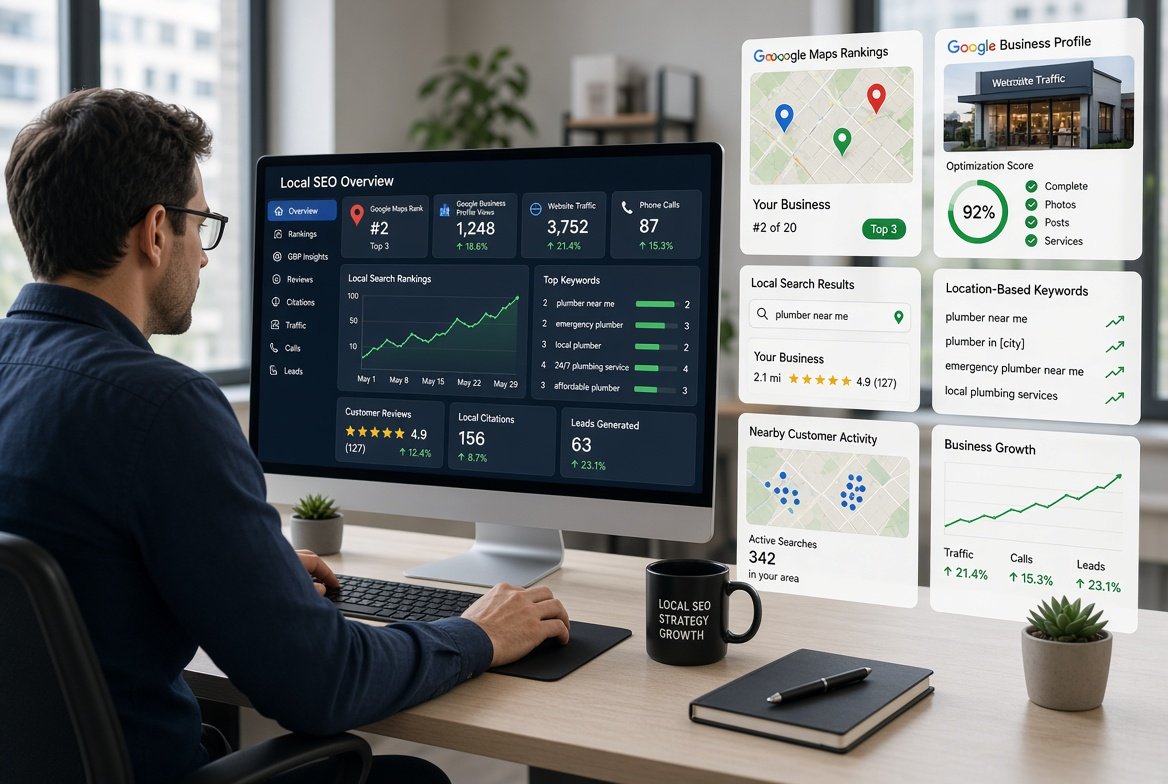
Local SEO Services help businesses improve their visibility in local search results, appear more prominently on Google Maps, attract nearby customers, and generate more calls, website visits, enquiries, and sales. A strong local SEO strategy focuses on Google Business Profile optimization, location based keywords, local content, citations, reviews, technical SEO, and other signals that help search engines understand where a business operates and which customers it serves.
For businesses that depend on customers from specific cities, suburbs, neighborhoods, or service areas, local search visibility can have a direct impact on growth. Someone searching for a plumber, dentist, restaurant, roofing company, flooring supplier, or marketing agency near them is often looking for a business they can contact quickly.
That makes local SEO more than a traffic strategy. It is a way to connect your business with people who are already searching for your products or services.
Local SEO Services are professional search engine optimization services designed to improve a business’s visibility for searches connected to a specific geographic location.
Traditional SEO can target customers across a country or even internationally. Local SEO focuses on searches where location and proximity influence the results.
Examples include:
Local SEO can help businesses appear in several areas of search, including:
A successful strategy connects all of these elements rather than focusing on only one ranking factor.
Local search behavior has changed the way customers discover businesses.
Instead of searching for a business name they already know, potential customers often search for a service and location.
For example, a person may search for “bathroom renovation near me” rather than looking for a specific renovation company.
This creates an opportunity for businesses that have strong local visibility.
Someone searching for a local service may already have a problem they want to solve.
Consider these searches:
“emergency plumber near me”
“tree stump removal Melbourne”
“local SEO company”
“flooring installation Dubai”
These are not simply informational searches. Many of them have commercial or transactional intent.
When your business appears at the right moment, the chance of generating a lead can be much higher.
Even when someone does not contact your business immediately, appearing repeatedly in local search can increase brand recognition.
A customer may see your business in:
Repeated visibility can make the business more familiar when the customer is eventually ready to buy.
Google Business Profile is one of the most important parts of local search optimization.
A properly optimized profile can provide customers with useful information about your business directly in Google Search and Maps.
Important profile information can include:
Businesses should keep this information accurate and consistent.
Professional Google Business Profile optimization can help businesses improve the quality and completeness of their profile while building a stronger local search presence.
Google Maps is particularly important for businesses that depend on local customers.
When someone searches for a nearby business, Google may display a map with several local businesses.
For example, a customer searching for “coffee shop near me” may see:
The goal of local SEO strategy is to strengthen the signals that help your business compete in these local results.
Google Maps visibility can be especially valuable for service businesses, restaurants, retailers, healthcare providers, home service companies, and professional services.
Keyword research is the foundation of an effective local SEO campaign.
Businesses need to understand what their potential customers search for and how location is included in those searches.
For example, a flooring business may target:
A Melbourne tiling company may target:
Keyword research should consider:
Businesses can use professional keyword research services to identify relevant local search opportunities.
Location based keywords help search engines understand the geographic relevance of a page.
Instead of creating a generic page targeting “plumbing services,” a local business might create a page targeting “plumbing services in Melbourne.”
However, simply adding a city name repeatedly is not enough.
The content should genuinely provide useful information about the location.
A strong location page can discuss:
This creates a better experience for both search engines and customers.
Location landing pages can be highly effective for businesses serving multiple areas.
For example, a business serving Melbourne may create dedicated pages for:
Each page should provide genuinely useful information about that location.
Creating hundreds of nearly identical pages with only the suburb name changed can create low quality content.
Instead, each location page should have its own:
This approach creates stronger topical and geographic relevance.
On page SEO ensures that important website pages clearly communicate their topic and geographic relevance.
Key elements include:
For example, a page targeting “local SEO services” should clearly explain what those services include, who they are for, and how they help businesses improve local visibility.
Professional on page SEO services can help businesses optimize these elements strategically.
Technical SEO creates the foundation that allows search engines to crawl, understand, and index a website.
Local businesses should pay attention to:
A technically strong website gives local SEO efforts a better foundation.
Technical SEO becomes even more important for businesses with many service and location pages.
For example, a company targeting twenty suburbs with several services could have hundreds of URLs.
Without proper technical organization, search engines may struggle to understand the site’s structure.
Internal linking helps search engines discover pages and understand how different sections of a website relate to each other.
A local service business can create a logical internal linking structure between:
For example, a blog about bathroom renovation can link to the main bathroom renovation service page.
A location page can link to relevant service pages.
A service page can link to related location pages where appropriate.
This creates a stronger website architecture.
Businesses can also use professional off page SEO services alongside internal optimization to build broader authority.
Local citations are online mentions of a business’s important information.
These may appear on:
Important citation information can include:
Consistency matters because conflicting business information can create confusion for customers and search engines.
However, businesses should prioritize quality and relevance instead of submitting to every directory available.
Customer reviews are an important part of a local business’s online presence.
Reviews can influence:
A business with many positive, genuine reviews may appear more attractive to potential customers than a competitor with very few reviews.
Businesses should encourage real customers to leave honest feedback after receiving a service or purchasing a product.
They should never create fake reviews or manipulate ratings.
Responding to reviews can also demonstrate that a business pays attention to customer feedback.
A good response should be:
Positive reviews can receive a simple thank you.
Negative reviews should be handled calmly, with an effort to resolve the underlying issue.
Local content can strengthen a business’s relevance within its target market.
Instead of publishing only generic articles, businesses can create content that answers questions from customers in specific locations.
Examples include:
This type of content can attract people earlier in the buying journey.
Businesses can also use content writing services to develop useful local content that supports their broader SEO strategy.
Small businesses can benefit significantly from local search visibility.
A large national brand may have a large advertising budget, but a local company can compete for highly specific searches.
For example, a small plumbing business may not compete nationally for the term “plumber.”
Instead, it can focus on searches such as:
“plumber in Richmond”
“emergency plumber Doncaster”
“blocked drain plumber near me”
These searches are narrower and can have strong commercial intent.
A focused SEO strategy for small businesses can help small companies compete more effectively in their target markets.
Not every local business has a storefront.
Service area businesses travel to customers instead.
Examples include:
These businesses can still build strong local search visibility by clearly defining their service areas and creating useful location focused content.
However, businesses should avoid creating misleading addresses or fake locations.
Accuracy and genuine service coverage should remain the priority.
Businesses with multiple physical locations have additional SEO requirements.
Each location should have accurate information and, where appropriate, its own dedicated page.
A multi location business may need to manage:
Each location page should provide unique and useful information rather than repeating the same text.
This makes the website more useful for customers searching in different areas.
Local search and mobile usage are closely connected.
Customers often search for local businesses while they are:
A mobile user may search for “restaurant near me” or “tyre fitting near me” and immediately call one of the displayed businesses.
Therefore, local businesses should ensure that their websites are:
A responsive website can make it easier for local customers to take action.
People increasingly use conversational queries when searching for local information.
Instead of typing a short phrase, someone may ask:
“Where can I find a plumber near me?”
“Which flooring company is open today?”
“Who provides bathroom renovation in my area?”
This makes natural language content increasingly useful.
Businesses should answer common customer questions clearly through service pages, FAQs, blog posts, and other useful content.
Search behavior is expanding beyond traditional search results.
Customers may also use artificial intelligence systems and answer engines to discover businesses and services.
This creates an opportunity for businesses to structure their content around clear questions and direct answers.
An AEO strategy can help businesses create content that is easier for answer focused systems to understand and potentially reference.
Local businesses should provide clear information about:
The more clearly a business explains what it does and where it operates, the easier it becomes for different search systems to understand its relevance.
Search experiences are also becoming more conversational and AI driven.
Businesses can prepare by creating useful, accurate, structured content rather than relying only on keyword repetition.
A GEO optimization strategy can help businesses think about how their content may be understood across generative search experiences.
This does not replace traditional SEO.
Instead, it adds another layer to the broader search visibility strategy.
SEO can generate organic visibility, while Google Ads can provide paid visibility.
Using both can be useful for businesses that want to capture demand from multiple parts of the search results.
For example, a local roofing company can use Google Ads to appear immediately for high intent searches while developing organic visibility through local SEO.
A business can also review Google Ads techniques to improve the performance of its paid search campaigns.
The key is to track results and understand which searches, locations, pages, and campaigns generate valuable leads.
Ranking is only one part of the process.
Once a visitor reaches your website, the page needs to make it easy for them to take action.
Important conversion elements can include:
For example, a local emergency plumber should make it immediately obvious how customers can contact the business.
A local SEO campaign that generates traffic but fails to generate enquiries may require conversion optimization rather than simply more traffic.
Businesses need to measure whether local SEO is producing meaningful results.
Important metrics can include:
The most useful metrics depend on the business model.
A restaurant may focus heavily on calls, directions, reservations, and website visits.
A service business may focus on calls and quote requests.
An ecommerce business may focus on local organic traffic and revenue.
Reporting should therefore connect SEO activity with actual business outcomes.
Many businesses make avoidable mistakes when trying to improve local rankings.
Repeating a location keyword unnaturally can make content difficult to read.
Keywords should be included where they genuinely help explain the page.
Creating identical pages for multiple suburbs can produce weak content.
Each important location page should provide unique value.
Different phone numbers, addresses, or business names across online platforms can create confusion.
Businesses that never monitor or respond to customer reviews can miss opportunities to build trust.
A website that is difficult to use on smartphones can lose local customers.
Fake reviews can damage trust and create serious reputation problems.
Businesses should not create locations where they do not genuinely operate.
Local content cannot perform effectively if important pages cannot be crawled, indexed, or accessed properly.
A ranking is useful, but leads, calls, sales, and customer enquiries are often more important business outcomes.
A professional local SEO campaign generally follows a structured process.
The first stage is understanding the current website, Google Business Profile, local visibility, citations, competitors, and technical issues.
Competitor analysis identifies businesses that already perform well in local search.
The analysis can examine:
Relevant service and location keywords are identified based on search intent and business goals.
Important pages are optimized for local search.
This may include service pages, location pages, homepage content, metadata, headings, internal links, and technical elements.
The business profile is reviewed and improved based on the available business information and local search strategy.
Useful local content is created to target relevant questions, services, locations, and customer needs.
Relevant business listings and authority signals are developed where appropriate.
Businesses can establish ethical processes for requesting reviews from genuine customers.
Results are monitored through analytics, search performance data, local visibility, and business conversions.
Local SEO is not a one time activity.
Search behavior, competitors, content, reviews, business services, and search engine systems continue to change.
Ongoing optimization helps maintain and improve visibility.
The timeline varies from one business to another.
Factors can include:
A business in a low competition area may see progress faster than a company competing in a major city with many established businesses.
Local SEO should therefore be viewed as a long term investment rather than a quick ranking shortcut.
Traditional SEO and local SEO share many principles, but their priorities can differ.
Traditional SEO may focus heavily on:
Local SEO places more emphasis on:
Many businesses benefit from combining both approaches.
A company can target national informational keywords while also optimizing for local commercial searches.
Managing local SEO can become complicated as a business grows.
A professional team can help coordinate:
Professional support can also help businesses avoid common shortcuts that may damage long term visibility.
For businesses that need a broader search strategy, SEO services can combine local optimization with technical, on page, off page, and content focused SEO.
Local SEO Services are search engine optimization services designed to improve a business’s visibility for searches connected to specific cities, neighborhoods, suburbs, or service areas.
Yes. Local SEO can help small businesses reach nearby customers who are actively searching for their products or services.
A properly managed Google Business Profile is an important part of local search visibility because it provides customers with key business information across Google Search and Maps.
Start by optimizing your Google Business Profile, researching local keywords, improving important website pages, creating useful location content, maintaining accurate business information, earning genuine reviews, and building a technically strong website.
Reviews can influence customer trust and how attractive a business appears in local search results. Genuine customer feedback is valuable for both reputation and conversions.
Yes. Local SEO can generate website visits, calls, direction requests, quote requests, enquiries, and other customer actions when the strategy targets relevant commercial searches.
Not necessarily. Location pages should be created when they provide genuine value and reflect areas the business actually serves. Creating large numbers of thin or duplicate pages can be counterproductive.
Yes. Service area businesses such as plumbers, electricians, roofers, cleaners, tilers, and tree removal companies can use local SEO to reach customers within their genuine service areas.
Pricing varies according to the business location, competition, number of service areas, website size, current authority, required work, and campaign goals. A proper audit is usually needed before determining the right scope.
Local SEO gives businesses an opportunity to reach customers at the exact moment they are searching for nearby products and services. A strong strategy combines Google Business Profile optimization, local keywords, useful location pages, technical SEO, customer reviews, local content, internal linking, citations, and conversion focused website improvements.
The goal should not simply be to rank for a few local keywords. The real objective is to build a local search presence that brings qualified people to your business and turns that visibility into meaningful actions.
For businesses that rely on customers from specific cities, suburbs, neighborhoods, or service areas, investing in Local SEO Services can become an important part of long term digital marketing growth.