
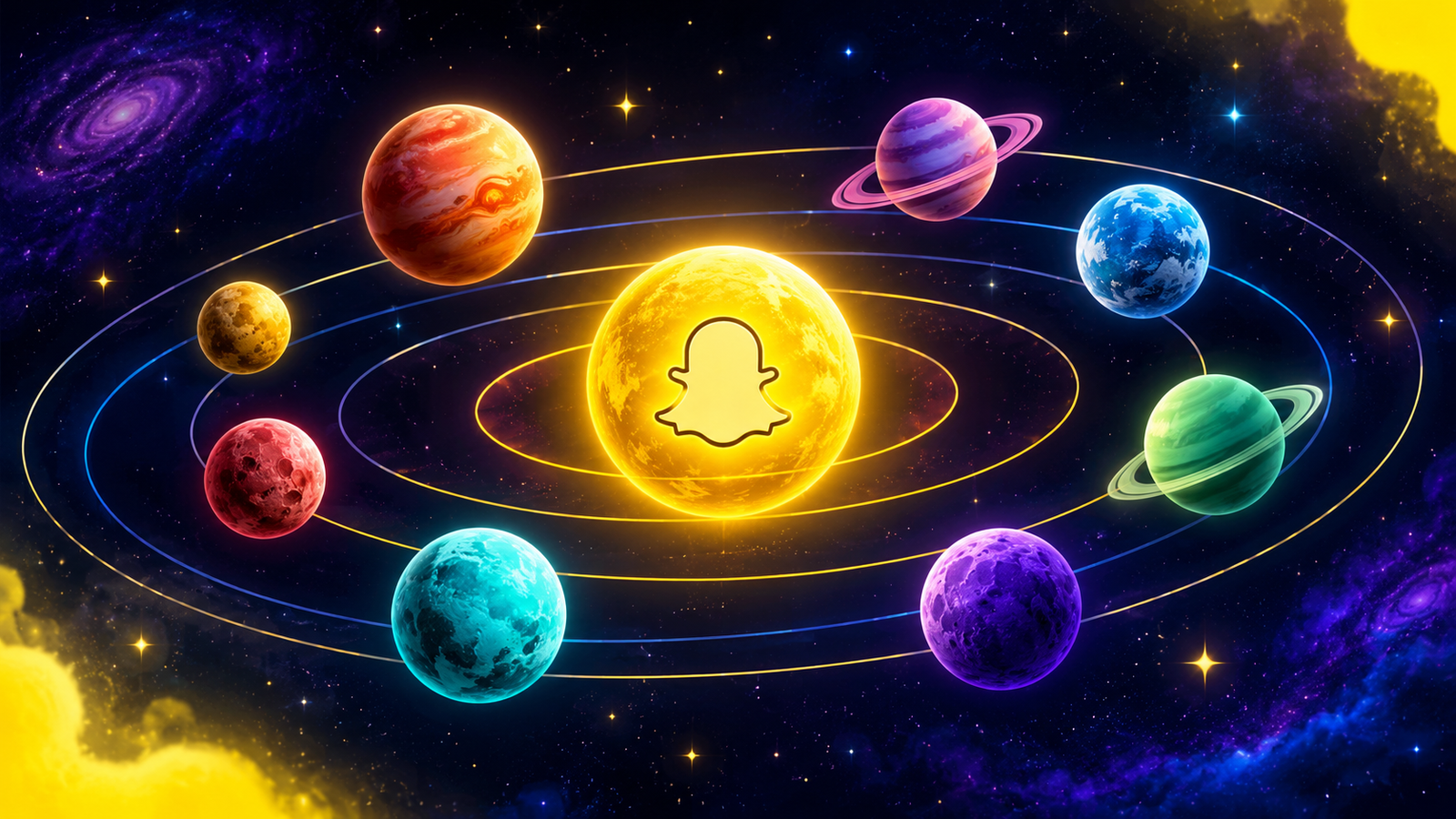
Snapchat Planets are part of Snapchat Plus’s Friend Solar System feature. It shows your closest friends as planets orbiting a central sun, and the planet you see depends on your position in someone’s Best Friends ranking. Mercury is the closest position (1st) and Neptune is the eighth.
Seen a planet badge on a friend’s profile and wondered what it means? This guide covers the Snapchat planets order, what each planet represents, how the Best Friends solar system works, Snapchat Plus requirements, and the questions beginners ask most.
Snapchat Planets are a visual feature linked to Snapchat Plus, the platform’s paid subscription. It’s commonly called the Friend Solar System because it uses a miniature solar system to represent your closest Snapchat friendships. You are the Sun, and your friends are planets orbiting around you, each matching a position in your Best Friends ranking. The feature makes rankings easier to picture, but remember they’re based on Snapchat interactions, not a formal measure of how close two people are in real life.
Availability and presentation can vary with Snapchat’s settings, subscription features and app version. New to Snapchat’s social features? Start with our guide on how to make a public profile on Snapchat and our explainer on what the green dot means on Snapchat.

The order follows the same sequence as the real solar system, starting with Mercury and ending with Neptune. The closer a planet is to the Sun, the higher the friendship position.
| Planet | Friendship position | General meaning |
|---|---|---|
| Mercury | 1st | Your closest-ranked Best Friend |
| Venus | 2nd | Your second-ranked Best Friend |
| Earth | 3rd | Your third-ranked Best Friend |
| Mars | 4th | Your fourth-ranked Best Friend |
| Jupiter | 5th | Your fifth-ranked Best Friend |
| Saturn | 6th | Your sixth-ranked Best Friend |
| Uranus | 7th | Your seventh-ranked Best Friend |
| Neptune | 8th | Your eighth-ranked Best Friend |
Your ranking and the ranking another person sees may differ, because Snapchat evaluates each friendship from the perspective of each individual account.
Every planet is a different position in the Friend Solar System, with its own colors and decorations so it’s easy to recognize.
Mercury is the first position. If a friend’s badge shows Mercury, you hold the top spot in their solar system. It’s generally shown as a reddish or pinkish planet with hearts or decorative elements.
It suggests a strong level of Snapchat interaction with that person compared to their other friends. It doesn’t automatically mean you’re their closest friend in real life. It reflects the platform’s ranking, not the full relationship.
Venus is the second position, usually drawn in pink, yellow and other warm colors with decorative hearts. Your ranking changes as your interactions change, so treat it as temporary.
Earth is the third position, shown in blue and green, often with hearts or a moon. It can point to frequent interactions on Snapchat, but it doesn’t show how much someone values you outside the app.
Mars is the fourth position, illustrated in red or reddish-orange tones. Your spot can move up or down as your interactions, and your friend’s other chats, change.
Jupiter is the fifth position, usually orange and brown. Fifth place doesn’t mean the friendship is less meaningful. It’s simply the position Snapchat assigned.
Saturn is the sixth position, easy to spot by its large rings and golden-orange look. Since rankings shift, Saturn can later become Jupiter, Uranus or another planet.
Uranus is the seventh position, typically blue-green or turquoise. The badge doesn’t mean the friendship is unimportant. It’s one position in a limited ranking.
Neptune is the eighth and final position, usually a deep blue planet. It doesn’t mean you’re the least important person in someone’s life. It’s just the last slot in this ranking.
The Friend Solar System turns a friendship ranking into a visual instead of a plain numbered list. Here’s how it works:
Snapchat uses activity such as messaging and Snapping to determine Best Friends. The exact formula isn’t public, so don’t assume one specific action guarantees a higher spot.
When the feature is available, a friend’s ranking maps to one of the eight planets, from Mercury (1st) through Neptune (8th).
The planet on the badge shows your relative position in that person’s solar system without showing a traditional numbered list.
Rankings aren’t permanent. Someone who is Jupiter today might become Venus later if the ranking shifts enough. Snapchat doesn’t give a public formula to predict exactly when.
To see your planet in a friend’s solar system, you generally need access to the relevant Snapchat Plus feature.
Wording and placement can change between app versions. If you can’t see a planet badge, don’t assume you aren’t a Best Friend. The feature may be unavailable, disabled, or not shown for that account.
Yes, the Friend Solar System is a Snapchat Plus feature. Snapchat Plus is a paid subscription that unlocks extra features and customization.
For current details, visit the official Snapchat Support website.
The Best Friends label refers to people you interact with frequently. The Friends label is broader and covers people you’ve added.
| Label | General meaning |
|---|---|
| Best Friends | A close position in Snapchat’s Best Friends ranking. |
| Friends | A Snapchat friendship, not necessarily a top-eight ranking. |
| Planet badge | A position in the Friend Solar System when the feature is available. |
Badge wording can vary with the interface, so always read the explanation shown in the app.
No. Your planet in someone’s solar system is your position in their ranking, and the planet they hold in yours is their position in your ranking. These can differ because each of you interacts with other friends differently.
For example, you might be Mercury in a friend’s solar system while they are Jupiter in yours. That doesn’t mean one person cares more. The feature represents Snapchat activity, not every part of a relationship.
Snapchat doesn’t publish the complete formula, so you can’t pinpoint the cause from the badge alone. If your planet changes, it doesn’t mean something bad happened in the friendship.
No, you can’t just pick any planet. Your planet reflects your position in the ranking. If Snapchat offers appearance customization, that’s separate from the underlying ranking. Be careful with websites or apps promising to change your ranking instantly. They can be misleading or ask for your account details.
The Friend Solar System has been linked to settings that let eligible users manage whether it’s enabled. Open Snapchat, check your Snapchat Plus or privacy-related settings, look for the Friend Solar System option, and follow the on-screen instructions. Labels may change over time. Also note that hiding a feature isn’t the same as changing your underlying friendship ranking.
No. Planets show a ranking based on in-app interactions, not the full quality of a real relationship. Your closest real-life friend may rank low because you don’t exchange many Snaps, while someone else may be Mercury just because of frequent chats. Use it as a fun way to see Snapchat activity, not a measure of loyalty or affection.
Snapchat borrows the names and general order of the planets, but the Friend Solar System is a social feature, not a scientific simulation. It doesn’t represent real distances, sizes or orbits. Wondering what other Snapchat icons mean? See our guide to the green dot on Snapchat.
If you run a business, knowing how Snapchat’s features work helps you connect with a younger audience. Read our guide on how to market to Gen Z on Snapchat to see what works.
Ready to go beyond organic posts? Our Snapchat advertising services help you run targeted campaigns, and our social media marketing services cover every major platform, including Instagram, TikTok, Facebook, WhatsApp, YouTube and Twitter (X) advertising. For Facebook specifically, see our tips on social ads on Facebook.
Great campaigns need great creative. Our social media content services, social media post design and video editing make your content stand out, backed by strong branding and design. You can also learn how TikTok Spark Ads turn organic content into ads or how conversational commerce on WhatsApp drives sales.
Mercury is the first position in the Friend Solar System. It means you hold the top spot in that person’s friendship ranking.
Venus is the second position. You’re ranked second in that person’s solar system.
Earth is the third position. It’s a visual indicator of your ranking, not a measure of overall friendship quality.
Mercury, Venus, Earth, Mars, Jupiter, Saturn, Uranus and Neptune, matching positions one through eight.
The Friend Solar System is tied to Snapchat Plus. Availability depends on your subscription, account settings and Snapchat’s current rollout.
When the feature is available, a person’s planet is their position in your Friend Solar System. Exact visibility depends on Snapchat’s current setup.
Yes. Rankings aren’t necessarily mutual, so your position in their solar system and theirs in yours can differ.
Mercury is the first position in the relevant ranking. It doesn’t prove the person is your closest friend outside Snapchat.
The feature may not be available to your account, Snapchat Plus may be required, or the badge or setting may not be visible. Check your app version and subscription features.
Your ranking can change as your interactions change, but there’s no official rule that planets update at a fixed daily time.
The feature represents a friendship ranking linked to Snapchat activity. The exact formula isn’t public, and a planet badge doesn’t reveal someone’s private conversations.
No. It’s a visual friendship ranking. It doesn’t give a person’s live location, private messages or full activity record. If you’re curious about activity signals, read what the Snapchat green dot does and doesn’t show.
Snapchat Planets turn Best Friends rankings into a visual: Mercury is 1st, followed by Venus, Earth, Mars, Jupiter, Saturn, Uranus and Neptune in 8th. The Friend Solar System is a Snapchat Plus feature, availability may vary, and your planet can change as rankings change. Your position in someone’s solar system may also differ from theirs in yours.
Most importantly, planets reflect app interactions, not the full meaning of a real-life friendship. Enjoy it as a fun feature, but don’t treat it as the only measure of how much someone values you.
Want to turn Snapchat into a growth channel for your brand? Contact the Pulse Digital team or visit the Pulse Digital homepage to see everything we do, and let’s build a social strategy that works.